

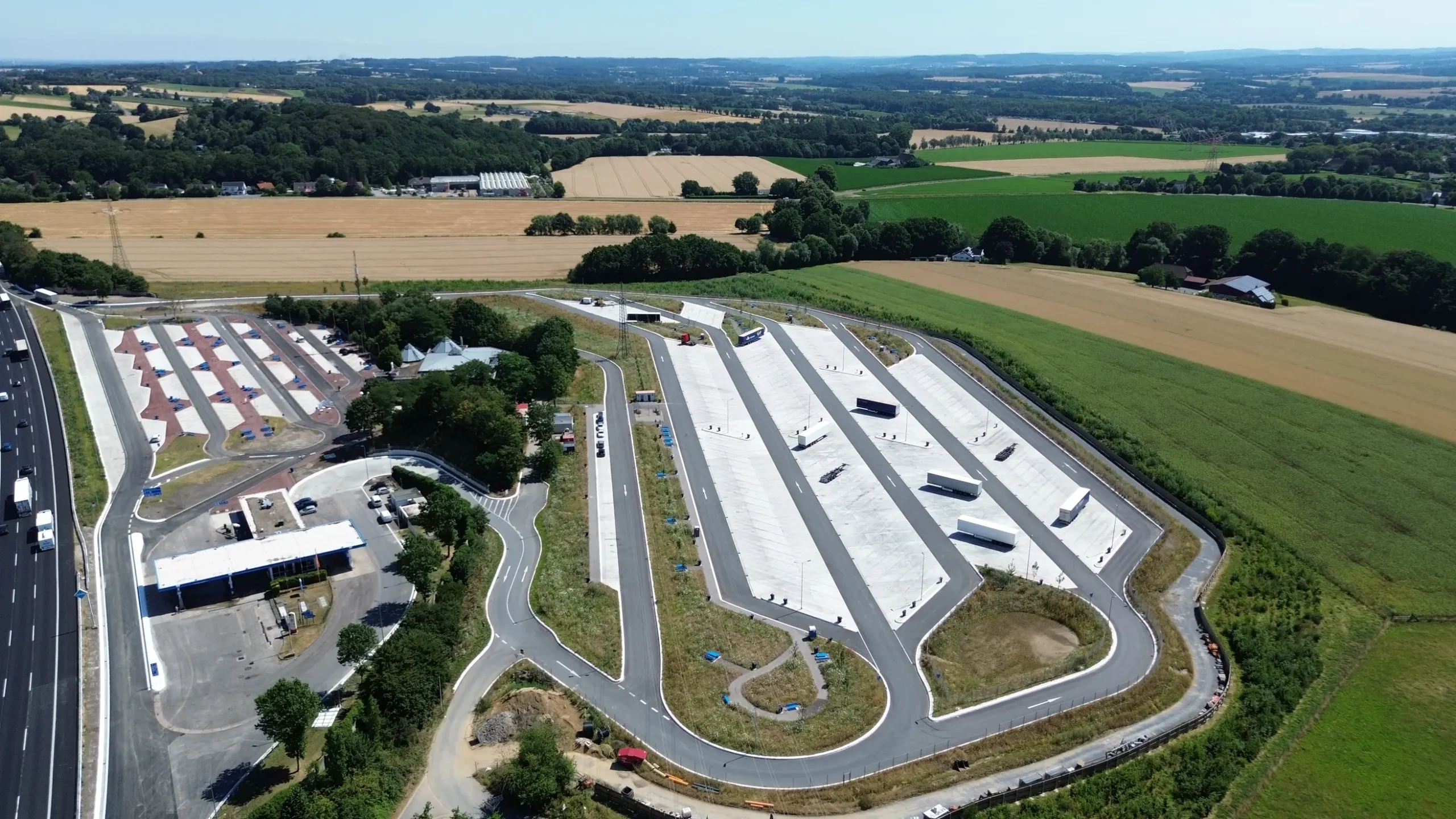
Autobahn GmbH will expand parking capacity along federal motorways and increase toilet-cleaning frequency to two to five times a day, although the additional spaces will cover only a small part of the existing shortage
Germany’s federal government intends to increase the number of truck parking spaces along the country’s motorways while improving conditions for drivers during mandatory rest periods.
State-owned Autobahn GmbH plans to create 1,725 new spaces between 2026 and 2028:
- 850 at serviced motorway rest areas;
- 875 at unserviced rest areas.
The figures are contained in the German government’s official response to a parliamentary inquiry submitted by the Alliance 90/The Greens parliamentary group.
The government did not provide information about additional projects at privately operated Autohöfe — truck stops located near motorway interchanges but outside the federal motorway estate.
Autobahn GmbH will need to complete an average of approximately 575 spaces a year. Actual delivery will depend on planning approval, land availability and the complexity of expanding existing sites.
Germany’s SID truck parking information service currently includes 65,635 parking opportunities at 1,838 rest areas along federal motorways. Approximately 750 additional spaces are located on federal roads.
A separate 2023 study of parking around the motorway network identified 19,680 spaces at 261 privately operated Autohöfe.
Night-time demand is considerably higher than the formally available capacity. A survey of 2,202 locations recorded an average night-time maximum of approximately 102,100 parked trucks:
- 41,984 at serviced rest areas;
- 39,447 at unserviced rest areas;
- 19,314 at private Autohöfe.
The figures represent the average of three survey nights between 10 p.m. and 3 a.m., rather than an annual daily average. They nevertheless illustrate the scale of evening and overnight pressure on Germany’s parking infrastructure.
The planned 1,725 spaces are equivalent to approximately 2.6% of the parking opportunities currently covered by SID along federal motorways.
Even after the programme is completed, shortages are likely to remain, particularly on major international freight corridors connecting Germany with the Netherlands, Belgium, Poland, the Czech Republic, Austria and France.
K2Cargo.News previously reported that Germany’s truck parking shortage was estimated at approximately 20,000 spaces. Limited capacity forces drivers to spend working time searching for legal parking or to stop on entry lanes, exit lanes and other areas not designed for overnight use.
For transport operators, this can increase fuel consumption, disrupt delivery schedules and create a risk that drivers will be unable to comply with regulated driving and rest periods.
The federal government links additional parking capacity with an improvement in truck drivers’ working conditions. The programme covers not only the number of spaces but also the quality of facilities available during rest periods.
Autobahn GmbH is developing common design standards for toilet buildings at unserviced rest areas across the country. A revised cleaning system is also being introduced.
Toilet-cleaning frequency is expected to increase from the current one or two times a day to between two and five times a day. At the busiest sites, sanitary facilities could therefore be serviced more than twice as frequently.
The common approach is expected to cover building layouts, materials, lighting, accessibility and ease of cleaning. The authorities have not disclosed a timetable for upgrading every facility or the total cost of the programme.
The parking programme forms part of the Federal Ministry for Transport’s five-point plan for better truck parking.
It covers:
- construction of new parking spaces;
- wider use of telematic parking systems;
- digital monitoring of parking availability;
- more efficient use of existing land;
- financial support for private projects near motorway interchanges.
Telematic parking allows trucks to be arranged in groups based on their planned departure times. According to the ministry, the technology can increase capacity by as much as 50% at suitable locations without requiring an entirely new parking facility.
Another part of the programme is SID. As K2Cargo.News previously reported, Germany has launched a nationwide truck parking availability system that uses road-toll data to provide near-real-time occupancy information.
Navigation and logistics application providers can integrate the data into their services free of charge. Drivers can check expected availability in advance and adjust their stopping plans.
Digital information does not, however, create additional physical capacity. If every suitable parking area along a route is full, SID can only show that no spaces are available.
The Greens argued that some parking capacity is being used for purposes other than mandatory driver rest. The concern relates to semi-trailers without tractors and complete vehicle combinations left at rest areas for extended periods.
These vehicles can block spaces needed by drivers to comply with legally required breaks. The federal government acknowledged, however, that Autobahn GmbH does not systematically record vehicles, tractors, trailers or semi-trailers that remain at motorway parking areas for several days.
General parking-time limits are usually not imposed at federal motorway rest areas. The government argues that enforcing such restrictions would require significant resources.
Introducing charges for parking lasting more than 24 hours would also require barriers and additional control infrastructure. According to the government, this could make rest areas less convenient for the majority of drivers without resolving the underlying capacity shortage.
If a vehicle remains parked for a period significantly exceeding regulated driving and rest requirements, its presence may in some cases be treated as unauthorized commercial use of public road property. Autobahn GmbH can order such use to end, while the Federal Highway Authority is responsible for administrative enforcement.
The federal government has commissioned a new forecast of truck parking demand. The study will examine average parking duration according to the type of journey interruption, including short stops, mandatory breaks and daily or longer rest periods.
The results have not yet been published. Until they are available, the authorities cannot precisely determine how much capacity is being used by drivers complying with rest requirements and how much is being occupied by long-term vehicle storage.
The forecast should help Autobahn GmbH identify locations where expansion would have the greatest effect. It may also support planning for digital services, sanitary facilities and future charging infrastructure for battery-electric trucks.
The additional 1,725 spaces should reduce pressure on selected corridors but will not resolve Germany’s nationwide shortage.
The programme’s effect will depend on the location of the new spaces, the pace of construction and the quality of sanitary, safety and digital services.
For transport operators, safe parking directly affects route planning, driver working time and delivery predictability.
For drivers, lighting, toilets, showers, food, security and the ability to complete mandatory rest away from unsafe road areas are equally important.
Germany is therefore attempting to increase physical capacity, introduce digital monitoring and improve the quality of motorway facilities simultaneously. Even after the new spaces are completed, however, carriers will still need to account for a high risk of evening overcrowding along the country’s principal freight corridors.
Read also: Spain Builds Covered Truck Parking for 383 Trucks