

Artificial intelligence improves demand forecasting, freight management and CMR processing, but its economic impact depends on data quality and end-to-end supply chain digitalization
Artificial intelligence is moving from experimental projects into the daily operations of transport, warehousing and distribution companies. Algorithms are being used to forecast demand, position inventory, plan routes, allocate truck capacity and manage disruptions.
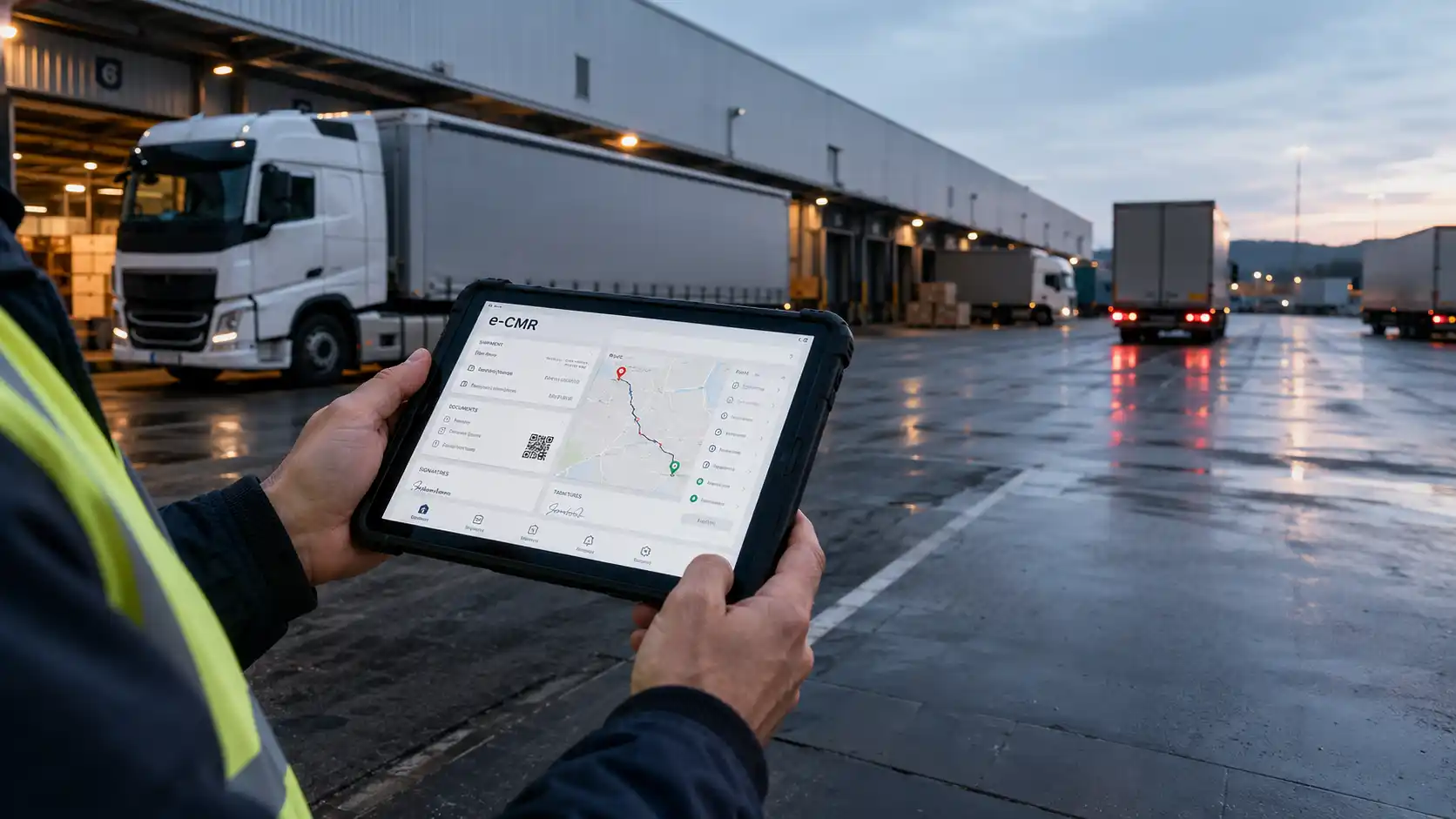
The impact becomes more significant when AI is connected to digital transport documents, including the electronic e-CMR consignment note. Such integration gives automated systems access to structured information about the cargo, consignor, consignee, carrier, route and delivery status.
According to a McKinsey analysis published in May 2026, distributors that redesigned their supply chains around AI achieved network cost reductions of up to 20%, together with improvements in on-time delivery and frontline productivity. These figures reflect specific implementations and should not be treated as guaranteed results for every logistics operator.
Demand forecasting is one of the most mature applications of AI in supply chain management. Traditional systems generally rely on historical sales and predetermined coefficients. Modern models can also process seasonality, weather, promotions, price changes, lead times and customer behaviour.
A more accurate forecast helps companies determine where and when products will be required. This allows them to optimize inventory and reduce urgent freight movements, which are normally more expensive than scheduled shipments.
McKinsey estimates that AI applications in distribution can reduce inventory by 20–30%, logistics costs by 5–20% and procurement spending by 5–15%. Earlier analyses found that some AI supply chain leaders had achieved 15% lower logistics costs, 35% lower inventory levels and 65% higher service levels than slower-moving competitors.
These figures cannot be applied automatically across the entire industry. Results depend on network structure, data quality, product range, existing automation and the company’s ability to turn algorithmic recommendations into operational decisions.
In road freight, AI can simultaneously evaluate distance, traffic conditions, driver availability, warehouse time slots, vehicle capacity and the probability of delays.
An AI-enabled transportation management system can allocate orders to trucks, consolidate compatible loads, reduce empty mileage and recalculate routes when conditions change. If a truck breaks down or a warehouse moves its receiving slot, the system can recommend another vehicle, revise the unloading sequence and provide the customer with an updated estimated arrival time.
In one McKinsey case involving a distributor with more than 200 branches, an AI-enabled dispatch control layer improved on-time delivery by 20% within six months. It also returned more than two hours per day to supervisors who had previously spent that time manually rerouting trucks and reallocating loads.
As K2Cargo.News previously reported, European logistics companies are already applying AI to route planning, fleet management, predictive maintenance and delivery monitoring.
The CMR consignment note remains a central document in international road freight. It records information about the transport contract, participating companies, cargo, points of departure and delivery, number of packages and accompanying instructions.
AI does not replace the legal function of the CMR document or assume the carrier’s liability. Its role is to process and analyse the information contained in the consignment note.
When a paper CMR is used, optical recognition systems can extract information from a scan or photograph, compare it with the transport order and transfer it into a logistics platform. The system can flag discrepancies involving addresses, weight, package quantities, vehicle registration details or collection times.
The electronic e-CMR format creates broader opportunities because the information is produced as structured digital data from the outset. AI can check whether mandatory fields are complete, match the consignment note with the transport order and invoice, monitor delivery status and identify transactions requiring human attention.
According to the United Nations Economic Commission for Europe, the CMR note is primarily used for commercial transport contracts, although it is also used by enforcement and other authorities. An electronic consignment note must comply with the Additional Protocol to the CMR Convention.
Digital CMR information can be exchanged automatically between the consignor, carrier, freight forwarder, warehouse and consignee. This reduces repeated data entry and lowers the risk of documentation errors.
After loading, the system can connect an e-CMR record to the truck’s telematics data. If the vehicle deviates from its planned route, AI can estimate the probability of a late arrival. Once delivery is completed, the consignee’s electronic confirmation can support proof of delivery and subsequent invoice processing.
This integration is especially valuable for international carriers processing hundreds of CMR documents every day. Automated consignment-note handling reduces administrative work, speeds up document verification and identifies discrepancies that could delay payment.
AI is also changing warehouse planning. Systems can analyse order flows, workforce and equipment availability, loading-dock utilization and expected truck arrival times.
McKinsey estimates that AI tools can unlock an additional 7–15% of capacity across warehouse networks. In one case, a major logistics provider used an AI-powered digital twin to increase warehouse capacity by almost 10% without adding new real estate.
Connecting warehouse systems to e-CMR can also accelerate receiving operations. The warehouse obtains cargo information in advance, allocates a loading bay and compares the expected quantity with the shipment actually delivered. Any discrepancy can be forwarded automatically to the responsible employee.
AI cannot automatically repair poorly organized business processes. If mandatory information is missing from CMR documents, addresses use inconsistent formats or the transport platform is not connected to warehouse and accounting systems, algorithms will produce incomplete or unreliable results.
Before implementation, companies need to standardize master data, assign responsibility for its quality and establish rules for reviewing AI recommendations. Personal driver information, commercially sensitive data and legally significant documents require particular protection.
Final decisions involving liability, claims, changes to a transport contract or rejection of cargo should remain under the control of an authorized employee. AI can identify a risk and prepare a recommendation, but it should not independently modify legally significant information in a CMR document.
The greatest benefits will go to companies capable of connecting e-CMR, transportation management, warehouse systems, vehicle telematics and forecasting tools within one digital environment.
For carriers, this means less manual work, better routing, lower empty mileage and faster invoicing. Shippers gain greater visibility over inventory and deliveries, while warehouses receive more reliable vehicle arrival forecasts and can balance dock capacity more effectively.
AI and e-CMR do not eliminate transport risks, but they help companies detect them earlier and make decisions using current operational data. Competitive advantage will therefore depend not on possessing a separate algorithm, but on integrating it across the entire supply chain.