

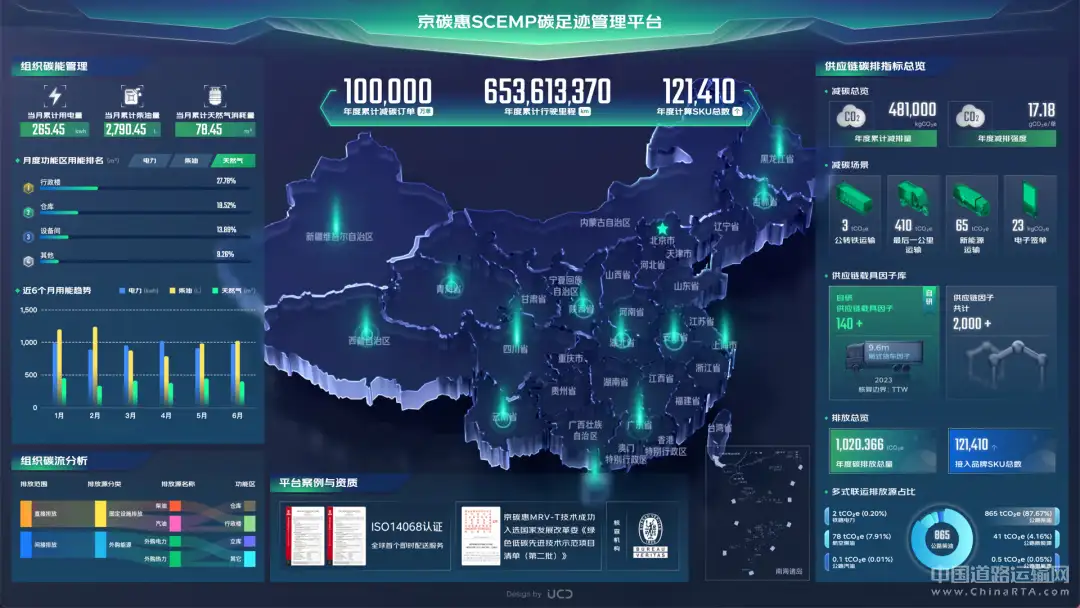
The platform calculates transport carbon footprints using actual vehicle routes, monitors Scope 3 emissions and helps companies select more sustainable logistics solutions
JD Logistics Digitalizes Emissions Accounting
JD Logistics has developed the Supply Chain Emission Management Platform, a cloud-based system known as SCEMP, to monitor and manage emissions across supply chains. The Chinese company introduced the platform in April 2023 in cooperation with the Green Supply Chain Committee of the All-China Environment Federation.
JD Logistics described SCEMP as the world’s first supply chain emissions management platform developed specifically for the logistics industry. This remains a company claim, as there is no independent global registry officially granting SCEMP that distinction.
The platform’s functionality has expanded since its launch. According to JD Logistics, SCEMP had tracked the carbon footprint of more than 100 million orders by July 2025. It supported over 100 international brands and more than 60,000 corporate carbon accounts.
How SCEMP Calculates Transport Emissions
SCEMP uses data reflecting the actual movement of vehicles rather than relying exclusively on standard estimates based on the distance between the point of departure and destination. The platform considers the route, vehicle category, fuel type and timing of each transport operation.
Its database contains more than 140 carbon-emission factors applicable to road transport in China. SCEMP uses these factors to calculate the footprint of an individual order, a transport route or a group of logistics operations over a specified period.
Users can examine the relationship between orders and emissions, identify mobile emission sources by fuel type and monitor changes over time. This allows companies to determine which vehicles, routes or operations are responsible for the largest share of their transport footprint.
For businesses, this level of detail is more useful than a general annual estimate. It allows operators to compare individual shipments and assess how vehicle utilization, route length, electric mobility or a shift to rail affects emissions.
SCEMP Covers Scope 3 Emissions
A central purpose of SCEMP is monitoring Scope 3 emissions—the indirect emissions generated throughout a company’s value chain. These can include subcontracted transport, purchased goods, packaging, warehousing and the delivery of products to customers.
Scope 3 is often the most difficult emissions category for manufacturers and retailers to measure. Information must be collected from numerous carriers, suppliers and logistics providers that may use different calculation methods.
SCEMP is designed to consolidate these records within a common monitoring, reporting and verification system. The platform can generate emissions reports, analyse performance and provide access to independent verification services.
JD Logistics works with Bureau Veritas, an international testing, inspection and certification company. According to the developer, SCEMP incorporates requirements and methodologies associated with ISO 14064, ISO 14067, ISO 14083, ISO 14068 and the Smart Freight Centre’s GLEC Framework.
AI Connects Sustainability with Operational Efficiency
The current version of SCEMP uses artificial intelligence and real-time vehicle data to calculate emissions, analyse routes and identify options that may reduce both the carbon footprint and operating costs.
Emissions can be lowered without reducing freight volumes. Better planning can minimize empty mileage, eliminate inefficient routes, improve truck utilization and reduce the amount of energy consumed per order.
As K2Cargo.News previously reported, artificial intelligence is increasingly used in logistics for demand forecasting, cargo allocation, route planning and transport management. SCEMP adds emissions data to these decisions, allowing companies to consider environmental performance when selecting a logistics option.
SCEMP Receives WSIS Recognition
In 2025, JD Logistics’ shared supply chain carbon-reduction project was selected among the top 20 initiatives in the ICT Applications — E-Environment category of the WSIS Prizes.
The awards are connected to the World Summit on the Information Society and involve organizations including the International Telecommunication Union, UNESCO, UNDP and UNCTAD.
JD Logistics reported that SCEMP had recorded cumulative carbon reductions exceeding 500 tonnes by the time of the recognition. The figure represents reductions calculated within the platform’s ecosystem and should not be interpreted as a 500-tonne reduction in all emissions generated by JD Logistics.
JD Logistics Expands Low-Carbon Freight
In June 2026, JD Logistics joined the World Economic Forum’s First Movers Coalition, becoming the first Chinese company to participate in the global initiative supporting the commercialization of clean technologies.
By 2030, the company has committed to making zero-emission vehicles account for at least 30% of newly purchased heavy-duty trucks and 100% of newly purchased medium-duty trucks. Alternatively, it aims for 15% of its overall road freight operations to achieve net-zero emissions.
JD Logistics has also reported operating more than 14,000 self-owned new-energy vehicles, running electric and hydrogen-powered truck routes and transferring additional freight volumes to rail.
“Logistics should be a pioneering force driving global sustainable development,” a JD Logistics spokesperson said
What SCEMP Means for the Logistics Market
The practical significance of SCEMP lies in moving from approximate corporate reporting to the calculation of emissions at order and shipment level.
Shippers can compare carriers not only by freight rates and delivery times but also by emissions. Logistics operators receive data that can support fleet renewal, vehicle utilization and route-network decisions. Manufacturers and retailers can use verified results for ESG reporting and Scope 3 assessments.
The reliability of these calculations nevertheless depends on the completeness of primary data, the accuracy of emissions factors and the consistent application of methodologies. A digital platform does not reduce emissions on its own. Environmental gains appear only when companies change routes, vehicles, fuels, packaging or supply chain design.
SCEMP demonstrates how carbon management is becoming part of everyday logistics. In international supply chains, emissions performance may gradually become as operationally important as transportation cost, delivery time and cargo integrity.