

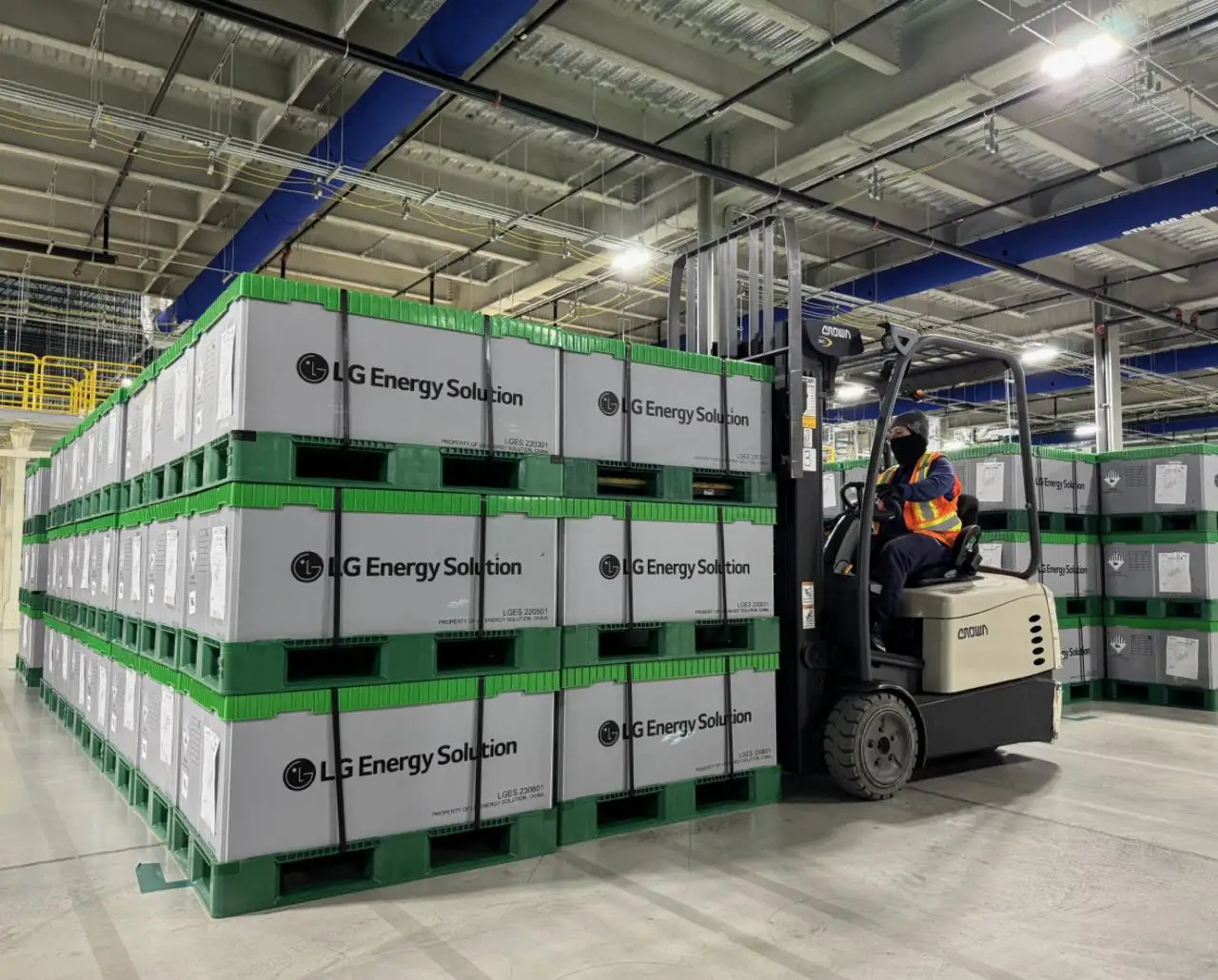
The South Korean manufacturer is not abandoning electric-vehicle batteries but is using the fast-growing stationary storage market to keep its North American factories operating
Five Plants Will Produce Energy Storage Batteries
LG Energy Solution, which originally directed most of its North American investment toward electric-vehicle batteries, is accelerating the conversion of some manufacturing capacity to stationary energy storage systems, or ESS.
By the end of 2026, five of the company’s eight North American plants are expected to be involved in ESS battery production. The move does not represent a complete withdrawal from the automotive market. Instead, LG Energy Solution is allocating capacity more flexibly between electric vehicles and stationary storage.
U.S. electric-vehicle sales have expanded more slowly than battery manufacturers expected when they approved billions of dollars in new factories. Those plants now need additional orders to improve utilisation, reduce fixed costs and generate returns on their investment.
At the same time, demand for large-scale storage is rising rapidly as utilities expand renewable generation, upgrade power networks and connect more data centres.
North American Demand Is Forecast at 76 GWh
Benchmark Mineral Intelligence expects North American stationary battery demand to reach 76 GWh in 2026. Demand could increase to approximately 125 GWh by 2031.
Storage systems allow utilities to retain electricity when demand is low and return it to the grid during peak periods. They are also essential for balancing fluctuations in solar and wind generation.
Data centres are becoming another important source of demand. Artificial-intelligence infrastructure requires large amounts of reliable, continuously available electricity, encouraging technology companies and utilities to invest in battery storage.
However, even growth to 125 GWh may not be sufficient to absorb all the battery capacity originally constructed for the electric-vehicle industry.
ESS Revenue Increased 4.6 Times
The effect of the new strategy is already visible in the company’s results. According to LG Energy Solution’s second-quarter report, first-half ESS revenue increased 4.6 times year over year.
Energy storage accounted for roughly one-quarter of total revenue, while new ESS orders exceeded KRW3 trillion. Higher North American storage-battery output also helped reduce the effect of fixed manufacturing costs on profitability.
LG Energy Solution plans to expand its global ESS production capacity to approximately 60 GWh in 2026, including more than 50 GWh in North America. It is targeting around 90 GWh of new orders and expects ESS sales to triple compared with 2025.
Plants Are Moving Toward LFP Chemistry
Converting production involves more than changing factory schedules. It also requires LG Energy Solution to expand its use of a different battery chemistry.
The company has traditionally specialised in high-nickel cells for electric vehicles. These batteries provide higher energy density, helping automakers increase vehicle range while limiting battery weight.
For stationary storage, LG Energy Solution is increasing lithium iron phosphate, or LFP, production. LFP cells generally have lower energy density but offer long service life, strong thermal stability and lower costs. Those characteristics are particularly valuable when batteries remain installed at a utility, data centre or industrial facility.
Chinese manufacturers have historically dominated large-scale LFP production. LG Energy Solution intends to compete through local manufacturing, compliance with U.S. supply-chain requirements and direct customer support in North America.
The company’s Holland, Michigan, facility has become one of its principal North American ESS production sites. Storage cells are also being introduced at joint-venture plants associated with General Motors and Honda, while the NextStar Energy facility in Ontario is expanding its ESS role.
Electric Vehicles Remain Part of the Strategy
Despite the shift in capacity, LG Energy Solution continues producing batteries for electric transportation. Its joint-venture plant with General Motors in Ohio has restarted EV cell production following a seven-month suspension.
Robert Lee, president of LG Energy Solution North America, believes the slowdown in the U.S. electric-vehicle market will prove temporary.
“EVs will come back, and they will eventually account for a majority of passenger vehicles in the United States. It is really just a matter of time,” he said in an interview with Reuters.
ESS is therefore becoming a second growth engine rather than a replacement for the automotive business. It gives the company an opportunity to diversify revenue and utilise factories while waiting for electric-vehicle demand to recover.
Battery Logistics Will Also Change
Higher stationary-storage production will reshape North American supply chains. Factories will require increasing volumes of lithium, phosphate, graphite, electrolytes, separators and battery-management components.
Local production can reduce dependence on imports of finished battery cells from Asia. At the same time, it will create additional domestic freight flows between manufacturing plants, warehouses, utilities, renewable-energy projects and data centres.
Large battery systems require specialised packaging, temperature monitoring, fire-safety procedures and dangerous-goods handling. Growth in the ESS market will consequently require investment not only in factories but also in protected storage facilities, monitoring systems, specialised containers and compliant road and rail transport.
LG Energy Solution’s strategy demonstrates how slower growth in one market can reshape an entire industrial and logistics network. While the U.S. electric-vehicle sector develops, stationary storage is becoming one of the most important sources of orders and factory utilisation for North American battery manufacturers.
Read also: U.S. Allocates $500 Million to Seven Critical Mineral Projects