

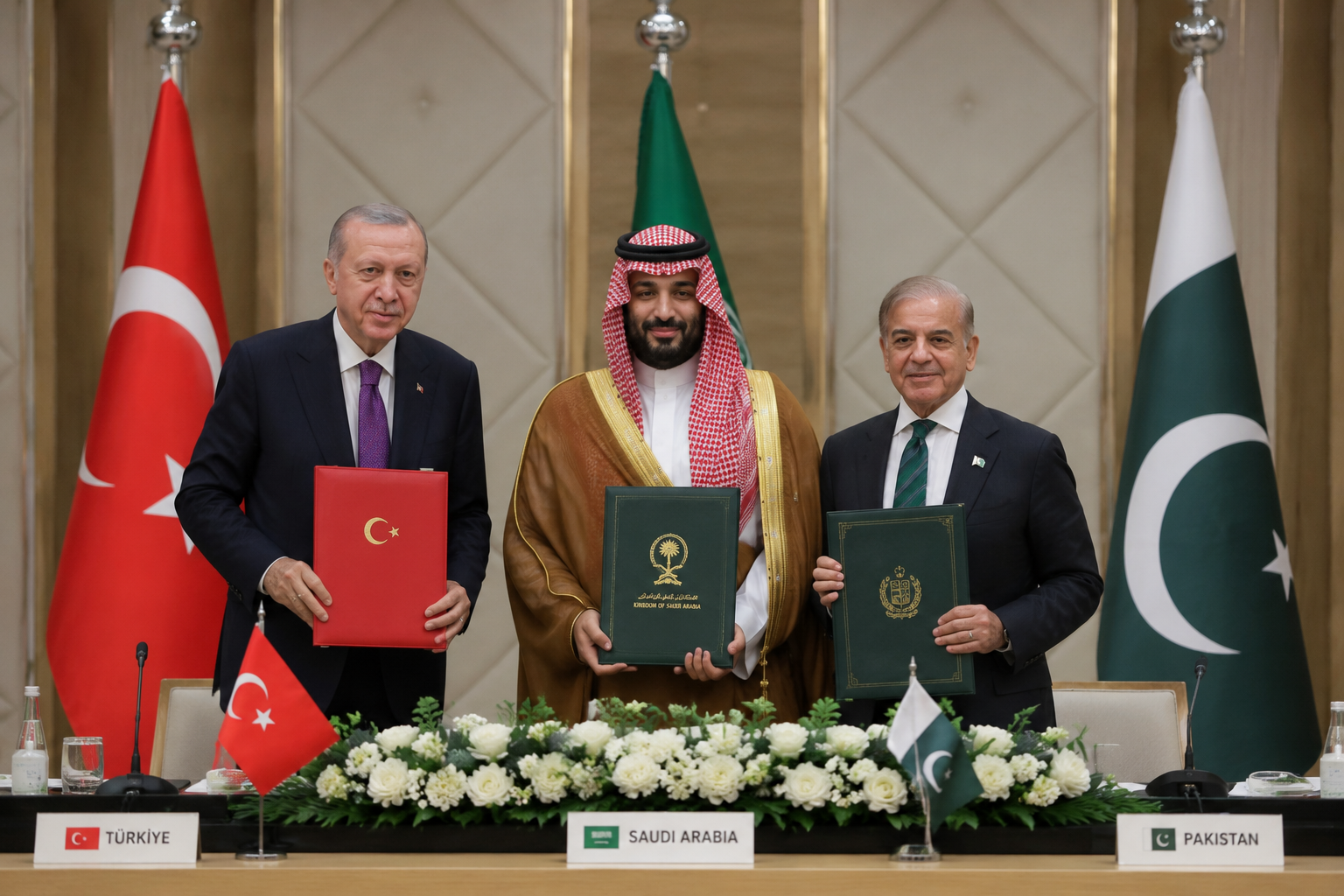
Makkah Agreement Signed on August 7
Türkiye, Saudi Arabia and Pakistan signed the Makkah Joint Defense Agreement on August 7, establishing a new trilateral security framework between the three countries.
The agreement was signed at Al-Safa Palace in Makkah during a summit dedicated to joint defense.
The signatories were Turkish President Recep Tayyip Erdoğan, Saudi Crown Prince and Prime Minister Mohammed bin Salman, and Pakistani Prime Minister Shehbaz Sharif.
According to Pakistan’s Ministry of Foreign Affairs, the agreement is intended to strengthen collective security and deterrence while promoting peace, security and stability in the region and beyond.
Attack on One State Will Be Considered an Attack on All
The central provision of the agreement establishes a collective defense principle.
An armed attack against Türkiye, Saudi Arabia or Pakistan will be regarded as an attack against all three countries.
This makes the agreement considerably broader than conventional arrangements covering military training, arms procurement or joint exercises.
However, publicly released information does not specify exactly what each country would be required to do following an attack. No automatic military response, permanent command mechanism or specific force commitment has been publicly detailed.
Agreement Expands Defense Cooperation
The pact also provides for broader cooperation between the three countries across the defense sector.
Potential areas include military training, operational coordination, experience sharing, defense technology and industrial cooperation.
All three states already maintain extensive bilateral military relationships.
Pakistan and Saudi Arabia signed a separate mutual defense agreement in September 2025. Türkiye has been expanding defense-industrial cooperation with Riyadh, including unmanned aircraft and other advanced military technologies.
Ankara and Islamabad also have longstanding military ties involving personnel training and defense industry projects.
Talks Continued for Around a Year
The new trilateral framework was not created unexpectedly.
In January 2026, Pakistan’s Minister for Defence Production Raza Hayat Harraj said a draft agreement between Pakistan, Saudi Arabia and Türkiye had already been prepared following roughly a year of negotiations.
At that stage, the document was still under consideration by all three governments and required final consensus.
The August 7 signing completed that process and formally established the trilateral defense arrangement.
It Is Not a New NATO in the Legal Sense
Because the agreement contains an “attack on one is an attack on all” provision, it has already drawn comparisons with NATO.
However, describing it as a direct equivalent of the North Atlantic Alliance would go beyond what has been officially established.
NATO is an institutionalized military alliance with permanent political and military structures, joint planning, integrated command arrangements, common standards and detailed collective defense mechanisms.
No comparable permanent institutional architecture has yet been publicly announced under the Makkah agreement.
Türkiye also remains a NATO member, and Turkish officials have said the new agreement does not replace or cancel existing bilateral or multilateral arrangements.
The more precise description is therefore a trilateral defense pact containing a collective defense commitment, while terms such as “Islamic NATO” remain unofficial political and media comparisons.
Pact Is Described as Defensive
Officials have emphasized that the agreement is defensive in nature and is not officially directed against any particular country.
That distinction is significant amid continuing instability across the Middle East, where security risks affect energy infrastructure, commercial shipping, airspace and international supply chains.
Saudi Arabia is a major global energy exporter, Türkiye controls strategic transport routes linking Europe and Asia, while Pakistan has one of the region’s largest armed forces and possesses nuclear weapons.
Closer coordination among the three therefore introduces a significant new element into the regional security architecture.
KAAN Could Become a Separate Area of Cooperation
Türkiye’s KAAN next-generation fighter program is one possible area of future defense-industrial cooperation.
In February, President Erdoğan said joint Saudi investment in the KAAN program was possible and that such a partnership could be implemented.
However, the publicly announced Makkah Joint Defense Agreement does not specifically identify the KAAN fighter program as part of the pact.
There is also insufficient basis to state that the agreement automatically makes Saudi Arabia or Pakistan full development partners in KAAN. Such participation would require separate contracts and government-level arrangements.
New Pact Could Affect Security Around Transport Corridors
For international trade, the significance of the agreement will depend on how its provisions are implemented.
Saudi Arabia is located beside critical Red Sea and Persian Gulf shipping routes, Türkiye controls the Bosphorus and Dardanelles and serves as a major transit hub between Europe, the Caucasus and the Middle East, while Pakistan provides access to the Arabian Sea.
Closer military cooperation could potentially lead to greater coordination in protecting ports, energy infrastructure and maritime communications.
The agreement itself, however, does not change commercial shipping rules or introduce new restrictions for freight operators. Its practical impact on logistics will depend on future decisions by the three governments and developments in regional security.
Read also: Saudi Arabia Seeks to Unite Dozens of Countries to Protect Maritime Shipping
