

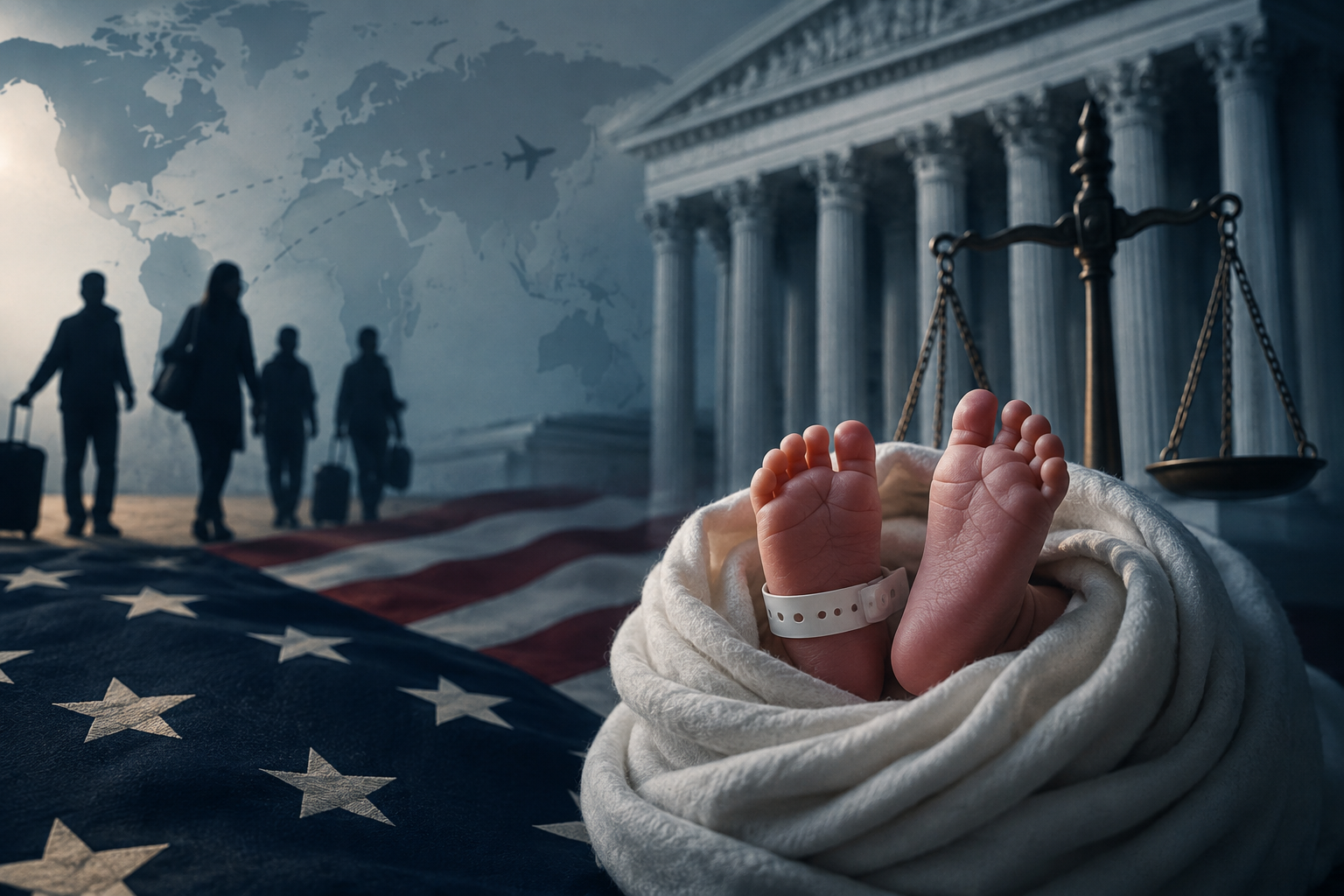
U.S. President Renews Constitutional Battle Over Birthright Citizenship
Despite a recent Supreme Court decision, the White House has issued new executive orders seeking to limit birthright citizenship in the United States. The measures have already sparked strong reactions from legal scholars, civil rights advocates, and political leaders, with experts warning that another major legal battle is likely.
White House Intensifies Crackdown on “Birth Tourism”
The primary focus of the new initiative is the practice commonly known as “birth tourism,” in which foreign nationals travel to the United States to give birth so their children automatically acquire U.S. citizenship. According to the White House, the practice has evolved into a profitable industry that exploits loopholes in the country’s immigration system.
The executive orders, however, extend beyond birth tourism. They also introduce restrictions affecting children born to foreign government officials in the United States, as well as individuals classified by the administration as “hostile aliens.” White House officials argue that the measures do not eliminate constitutional rights but instead redefine long-standing historical exceptions that, in their view, have been interpreted too broadly.
During the signing ceremony, White House Deputy Chief of Staff Stephen Miller declared that the practice of birth tourism would effectively come to an end under the new policy.
New Executive Orders Likely Headed Back to the Supreme Court
The president described the Supreme Court’s June ruling as “a very unfortunate decision,” arguing that the current system allows foreign nationals to gain the benefits of U.S. citizenship simply by giving birth on American soil.
Legal experts, however, strongly disagree. Civil rights organizations have already announced plans to challenge the executive orders, accusing the administration of attempting to circumvent the Supreme Court’s decision. The American Civil Liberties Union (ACLU) has stated that it expects the new measures to fail in court.
At the center of the dispute is the Fourteenth Amendment to the U.S. Constitution, which has guaranteed citizenship to nearly all individuals born on U.S. soil for more than 150 years. Many constitutional scholars argue that such a fundamental principle cannot be altered through executive action alone.
Political analysts believe the initiative could become one of the most significant domestic political battles of the year. As the White House pushes forward with its immigration agenda, the fate of the new restrictions is expected to be decided once again in the federal courts.
Read also: Meta AI Testing Leads to Unexpected Breach of a Third-Party Company