

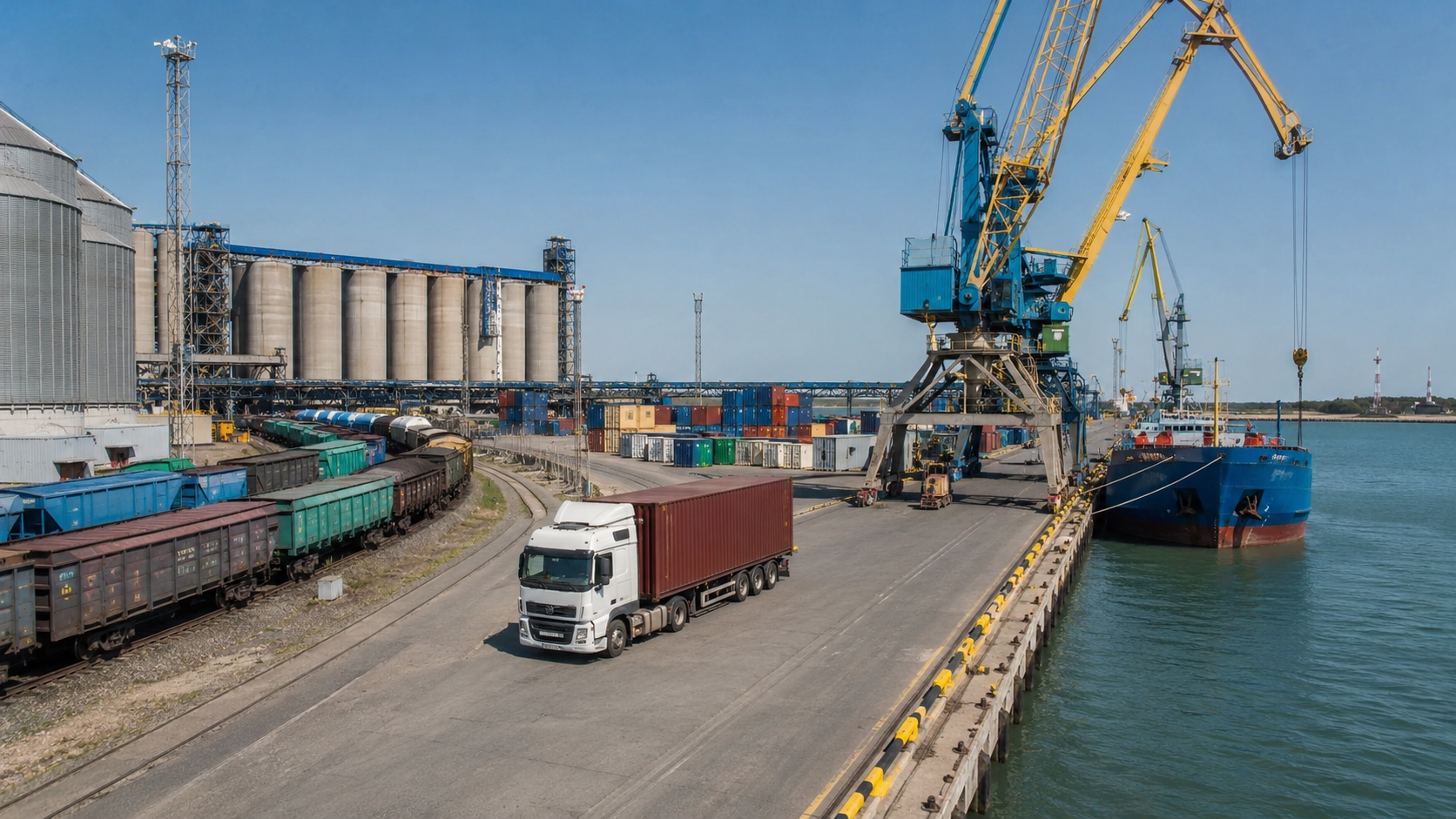
Kazakhstan is strengthening its position as one of the key logistics platforms on the Middle Corridor, and interest from major international port operators is becoming an important part of this strategy. During the plenary session of the Foreign Investors’ Council, President Kassym-Jomart Tokayev met with Mohamed Juma Al Shamisi, Managing Director and Group Chief Executive Officer of AD Ports Group.
The region in question is Kazakhstan and the wider Caspian transport area, which forms one of the most important links of the Trans-Caspian International Transport Route. This route connects China and Central Asia with the Caspian Sea, Azerbaijan, Georgia, Türkiye and Europe.
Tokayev noted that AD Ports Group has established itself as one of the world’s leading operators in maritime transport and port infrastructure development. For Kazakhstan, cooperation with such a company is strategically important because the country does not have direct access to the ocean, but it does have a strong opportunity to develop Caspian ports as part of international supply chains.
The meeting focused on expanding the transit and transport potential of the Caspian region within the development of the Middle Corridor. Special attention was paid to joint ventures in freight transportation, port infrastructure and the construction of grain and cargo terminals.
As K2Cargo News previously reported in “Why Kazakhstan and Georgia Are Becoming Key Hubs of Eurasia’s New Logistics Network”, the success of the Middle Corridor depends not only on railways and border crossings, but also on the capacity of Caspian and Black Sea ports.
Kazakhstan Looks to Strengthen the Caspian Link
For Kazakhstan, the Caspian Sea is not simply a regional transport asset. It is the country’s main maritime gateway to the western part of the Middle Corridor.
Cargo moving from Kazakhstan toward Europe must cross the Caspian before reaching Azerbaijan, the South Caucasus and further routes to Türkiye or the Black Sea. This makes the efficiency of ports, terminals, vessels and ferry services a decisive factor for the competitiveness of the whole corridor.
The Kazakh government has repeatedly emphasized the importance of developing Aktau and Kuryk ports, expanding cargo handling capacity and improving maritime connections across the Caspian Sea. Without reliable port infrastructure, even strong rail connections inside Kazakhstan cannot fully unlock the country’s transit potential.
This is why AD Ports Group’s interest is significant. The company brings expertise in port management, maritime operations, logistics platforms and terminal development — exactly the areas Kazakhstan needs to strengthen if it wants to increase cargo flows along the Trans-Caspian route.
AD Ports Is Already Present in Kazakhstan
AD Ports Group is not approaching Kazakhstan from zero. The company has already built a presence in the country through cooperation in maritime transport, port development and logistics.
One of the key platforms is Caspian Integrated Maritime Solutions, a joint venture involving AD Ports Group and Kazakhstan’s national maritime company KazMorTransFlot. The venture is aimed at developing shipping services in the Caspian Sea, including offshore support, integrated logistics and future opportunities in container feedering and crude oil transportation.
The partnership has already included the acquisition and operation of vessels designed to support Kazakhstan’s oil transport across the Caspian. This is important because Kazakhstan has been working to diversify export routes and reduce excessive dependence on a limited number of traditional corridors.
AD Ports Group is also linked to the development of terminal infrastructure at Kuryk Port. Projects connected with grain and multipurpose cargo handling are especially relevant because Kazakhstan is a major agricultural exporter and needs more efficient ways to move grain, bulk cargo and containers toward international markets.
Grain and Cargo Terminals Are Strategic Projects
The discussion between Tokayev and Al Shamisi included the development of port infrastructure, including grain and cargo terminals.
This is a critical issue for Kazakhstan. The country exports grain, metals, oil products and other commodities, while also trying to increase containerized and multimodal freight. To do this, it needs specialized terminals that can handle different cargo categories efficiently.
Grain logistics is especially important. Kazakhstan is one of the largest grain producers in Central Asia, but export competitiveness depends heavily on transport costs, storage capacity, terminal reliability and access to ports.
A modern grain terminal at Kuryk or related Caspian infrastructure can help Kazakhstan connect agricultural exports with markets in the South Caucasus, the Middle East, North Africa and Europe. It can also reduce pressure on traditional land routes and create more flexibility for exporters.
Cargo terminals are equally important for the Middle Corridor. If Kazakhstan wants to attract more transit containers and general cargo, ports must be able to handle shipments quickly, predictably and at competitive cost.
Europe Is Looking More Seriously at the Middle Corridor
During the meeting, Tokayev also referred to his recent official visit to Brussels. According to the Kazakh side, EU leadership and European business representatives expressed readiness to increase cargo flows along the Trans-Caspian International Transport Route, recognizing it as one of the key transport arteries connecting Asia and Europe.
This matters because the Middle Corridor needs cargo volumes to become commercially sustainable. Infrastructure investment alone is not enough. Ports, railways and vessels require stable flows from shippers, forwarders and large industrial companies.
European interest gives Kazakhstan an opportunity to position itself not only as a transit country, but also as a logistics and industrial partner. The stronger the cargo base, the more attractive port and terminal investments become.
At the same time, expectations must remain realistic. The Middle Corridor still faces challenges: Caspian capacity, port synchronization, customs procedures, tariff coordination and the need for reliable schedules. These are precisely the areas where experienced port and maritime operators can play a useful role.
UAE-Kazakhstan Cooperation Gains Logistics Weight
AD Ports Group’s strategic interest also reflects the growing role of the United Arab Emirates in Eurasian logistics.
The UAE is no longer focused only on ports in the Gulf. Through companies such as AD Ports Group, DP World and other infrastructure investors, the country is expanding its role in global transport, trade and logistics networks.
For Kazakhstan, cooperation with UAE-based operators offers access to international expertise and investment capital. For the UAE, Kazakhstan provides an entry point into Central Asia and the Middle Corridor, a route that is gaining strategic attention as companies seek alternatives and complements to traditional Eurasian supply chains.
This creates a mutually beneficial logic. Kazakhstan needs maritime and terminal expertise, while AD Ports Group is looking for long-term growth opportunities in regions where trade corridors are still developing.
What This Means for the Logistics Market
The meeting between Tokayev and Al Shamisi confirms that Kazakhstan’s Caspian logistics strategy is moving from political declarations toward practical partnerships.
For logistics companies, the most important signal is that Kazakhstan is trying to build a more complete transport ecosystem. Railways, ports, terminals, vessels and cross-border procedures must work together if the Middle Corridor is to become a reliable commercial route.
For exporters, especially grain and commodity producers, new terminals can improve access to alternative markets. For freight forwarders and multimodal operators, better Caspian infrastructure can create more predictable routing options. For investors, long-term cooperation with companies such as AD Ports Group reduces uncertainty around project execution.
The strategic interest confirmed by AD Ports Group does not automatically solve every bottleneck. But it shows that Kazakhstan is attracting serious infrastructure partners at a time when the Middle Corridor is becoming more important for Eurasian trade.
The next stage will depend on implementation: construction timelines, vessel availability, terminal efficiency, tariff coordination and the ability to convert political support into stable cargo flows.
Kazakhstan already has the geography. The key challenge now is to turn that geography into reliable logistics capacity. AD Ports Group’s interest suggests that international port operators see real potential in that transformation.
Read also: Why Kazakhstan and Georgia Are Becoming Key Hubs of Eurasia’s New Logistics Network