

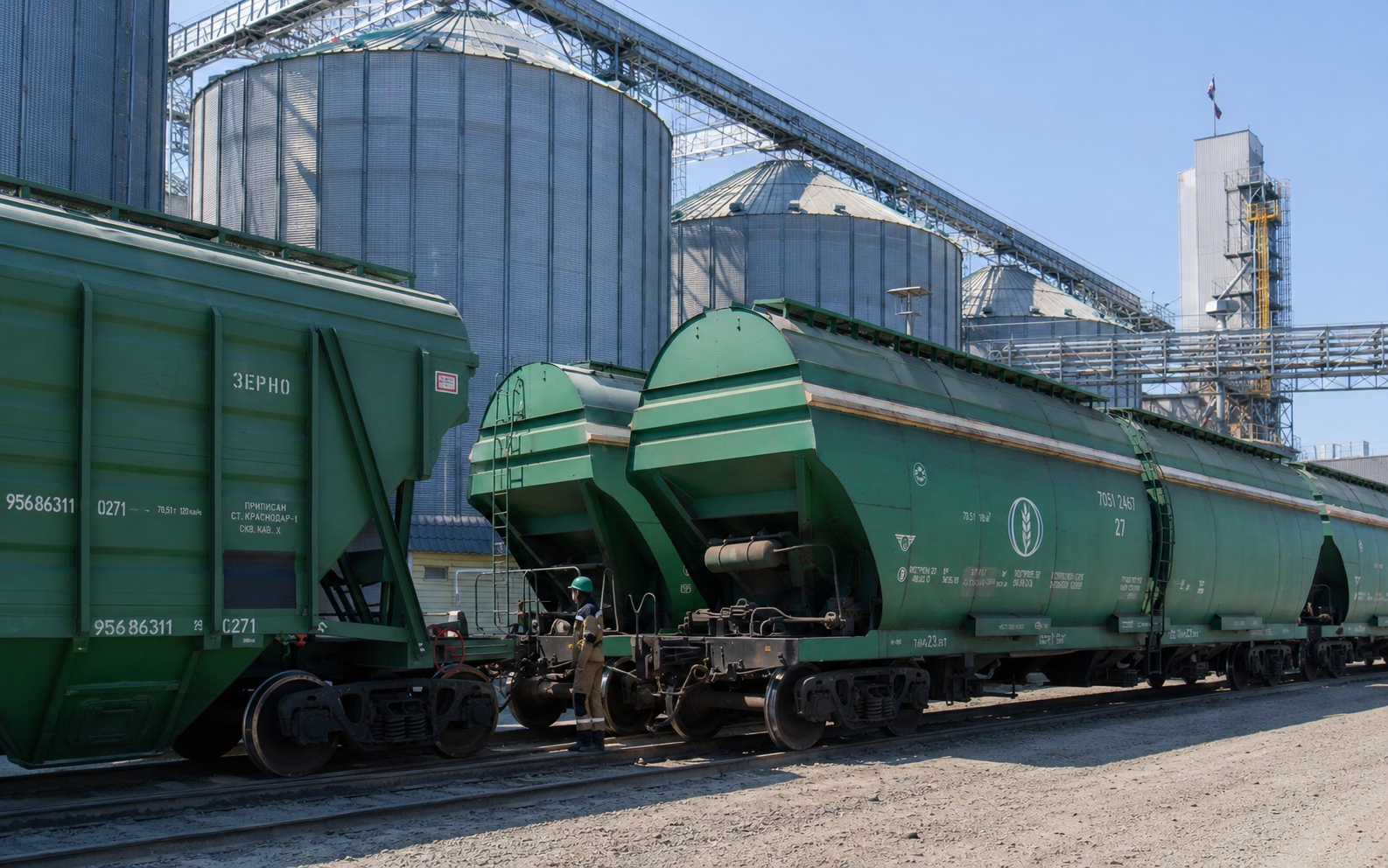
Kazakhstan’s grain and flour exports continue to grow, supported by stable demand from neighboring markets and the operation of southbound logistics corridors. According to the Ministry of Agriculture of Kazakhstan, citing Kazakhstan Railways data, exports of grain and flour in grain equivalent reached 13.1 million tons in the first ten months of the season.
This is 13% more than in the same period of the previous season, when Kazakhstan shipped 11.6 million tons abroad. The main growth drivers were traditional importers in Central Asia and Afghanistan — markets where Kazakh wheat and flour remain important for food supply, milling and trade.
The strongest increase was recorded in shipments to Uzbekistan, Afghanistan, Kyrgyzstan and Turkmenistan. These countries form the core of Kazakhstan’s southern grain export geography and depend heavily on rail logistics, border capacity and predictable delivery schedules.
For Kazakhstan, the result is important not only as an agricultural indicator. It also reflects the role of rail freight and regional corridors in maintaining export flows. Grain exports are one of the country’s key cargo categories, linking farmers, elevators, flour mills, railway operators and foreign buyers.
As K2Cargo News previously reported in Trans-Afghan Railway Project Estimated at $7 Billion, Central Asia is increasingly focused on transport routes that can connect regional markets with South Asia and wider Eurasian trade flows.
Uzbekistan Remains the Largest Buyer
Uzbekistan was the strongest driver of Kazakhstan’s grain and flour export growth.
Shipments to Uzbekistan increased by 38%, rising from 3.9 million tons to 5.5 million tons. This makes Uzbekistan the largest named destination in the latest export data and confirms the country’s central role in Kazakhstan’s grain trade.
The growth is logical. Uzbekistan has a large domestic consumer market, an active milling sector and strong demand for wheat imports. For Kazakh exporters, Uzbekistan is also geographically convenient: rail routes are established, transit times are shorter than to more distant markets, and trade links are long-standing.
For Kazakhstan, stable demand from Uzbekistan helps absorb large export volumes and supports prices for farmers and grain traders. For Uzbekistan, Kazakh grain remains a nearby and reliable source of supply.
Afghanistan Shows Strong Demand
Afghanistan also increased purchases significantly.
Exports to Afghanistan rose by 59%, from 1.4 million tons to 2.2 million tons. This is one of the most important results of the season because Afghanistan remains a key market for wheat and flour in the region.
Food supply needs, limited domestic milling capacity and regional trade patterns make Afghanistan a natural destination for Kazakh grain and flour. The route is more complex than shipments to Uzbekistan, but demand remains strong.
Afghanistan’s role is also important for future logistics planning. If regional corridors toward South Asia develop further, Kazakhstan could strengthen its position not only as a supplier to Afghanistan, but also as a participant in broader north-south food trade flows.
Kyrgyzstan and Turkmenistan Also Increase Imports
Kazakhstan also expanded exports to smaller but important regional markets.
Shipments to Kyrgyzstan grew 1.4 times, from 357,000 tons to 504,000 tons. Exports to Turkmenistan increased by 37%, from 150,000 tons to 205,000 tons.
These volumes are smaller than shipments to Uzbekistan and Afghanistan, but they matter for regional trade balance. Both markets are part of Kazakhstan’s traditional export network and rely on predictable rail and road connections.
The growth also shows that Kazakhstan’s export geography is not limited to one or two large buyers. A diversified regional customer base gives exporters more flexibility, especially when prices, harvest conditions or demand shift in individual markets.
Logistics Corridors Become a Strategic Asset
The Ministry of Agriculture linked the positive freight statistics with strong demand for Kazakh agricultural products and the stable operation of southbound logistics corridors.
This point is important. Grain exports depend not only on harvest size, but also on the ability to move cargo efficiently. Elevators, rail stations, border crossings, wagons, documentation and destination terminals all influence whether contracts are fulfilled on time.
For Kazakhstan, southern routes are especially important because the main buyers are located in Central Asia and Afghanistan. Any bottleneck at a border crossing or rail junction can affect delivery schedules and export competitiveness.
The current export performance suggests that the logistics system has been able to handle higher volumes. But continued growth will require investment in rail capacity, rolling stock, storage and digital coordination between exporters, rail operators and foreign buyers.
What the 13.1M-Ton Result Means
Kazakhstan’s export result confirms that the country remains one of the main grain suppliers for Central Asia.
The 13% increase shows that regional demand is strong and that Kazakh grain and flour remain competitive. It also demonstrates the importance of Kazakhstan Railways and export logistics in supporting agricultural trade.
For farmers, high export volumes can support market stability, especially if domestic storage is under pressure after a large harvest. For flour mills, continued demand from Afghanistan and neighboring markets supports processing. For logistics operators, grain remains a major seasonal cargo flow requiring reliable coordination.
The challenge now is to maintain this momentum. Kazakhstan needs not only high export volumes, but also predictable routes, balanced pricing and stronger access to new markets.
If southern corridors continue to work steadily, Kazakhstan can strengthen its role as a food supplier for the region and a logistics bridge between the grain-producing north and import-dependent southern markets.
Read also: Trans-Afghan Railway Project Estimated at $7 Billion