

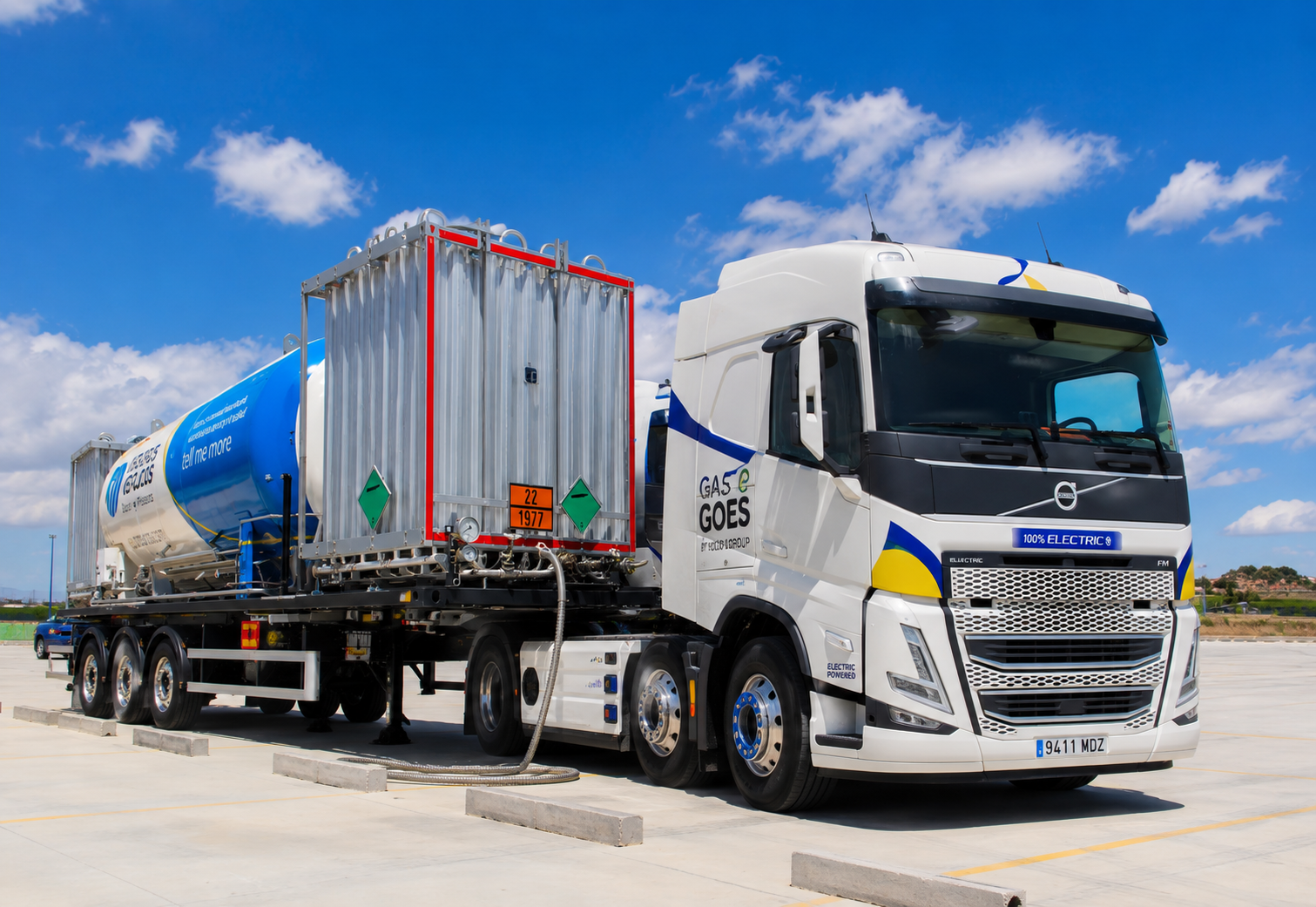
Spanish logistics company Primafrio has completed tests of a prototype refrigerated semi-trailer using an unusual energy concept: liquid nitrogen for cooling and solar panels for auxiliary electrical systems.
The solution was developed to replace the traditional diesel-powered refrigeration unit, which is still widely used in temperature-controlled road transport. Instead of burning fuel to run a generator, the prototype used liquid nitrogen stored in a special tank on the vehicle. The nitrogen was then directed through a heat exchanger to cool the cargo area.
At the same time, the trailer roof was fitted with eight lightweight photovoltaic panels. Their role was to supply electricity for the trailer’s auxiliary and control systems without drawing power from the tractor.
The project was carried out with several technology partners: Cryotrucks supplied and integrated the cryogenic cooling system, Apollo-Power installed the solar panels, and Carburos Metálicos, part of Air Products Group, provided liquid nitrogen and mobile refuelling infrastructure.
How the System Works
The prototype combines two separate technologies.
The first is cryogenic refrigeration. Liquid nitrogen is extremely cold, with a boiling point of around -196°C. When used in a controlled refrigeration system, it can absorb heat from the trailer’s cargo area and help maintain low temperatures without a diesel engine.
The second technology is solar power. Eight flexible photovoltaic panels were installed on the trailer roof, with total peak capacity of 2.48 kW. According to project data, the system can generate between 8.5 and 12.5 kWh of electricity per day.
That electricity is not used to drive the truck. Instead, it supports the trailer’s electrical systems, such as controls, sensors and auxiliary components. This reduces dependence on the tractor and helps make the refrigerated unit more autonomous.
Why It Matters for Cold-Chain Logistics
Refrigerated transport is one of the most difficult segments to decarbonise.
A conventional reefer trailer needs energy not only to move goods, but also to maintain strict temperatures throughout the journey. For food, pharmaceuticals and other sensitive products, a failure in cooling can damage the cargo and create serious losses.
This is why replacing diesel refrigeration units is not simple. Any alternative must be clean, but also reliable, safe and able to work in real operating conditions.
Primafrio says the pilot project was successful. The company has not disclosed detailed information about routes, cargo types, external temperatures or test duration, so it is too early to judge how quickly the system could be scaled. But the successful trial shows that the technology can work beyond laboratory conditions.
Emissions and Operational Benefits
The main promise of the system is emission reduction at the refrigeration-unit level.
By removing the diesel engine from the cooling process, the trailer can avoid local exhaust emissions from the refrigeration unit. According to project estimates cited by industry media, the use of liquid nitrogen could reduce emissions by around 49 tonnes of CO₂e per year per semi-trailer.
There may also be other benefits. Cryogenic systems can be quieter than diesel-powered units, which matters for night deliveries, urban logistics and operations near residential areas. Solar panels can also reduce the need for external charging or tractor-based power for auxiliary trailer systems.
For operators, however, the economic question remains open. Liquid nitrogen requires reliable supply, safe storage, trained staff and refuelling infrastructure. These factors will determine whether the system can move from a successful pilot to wider commercial use.
The Infrastructure Challenge
The technology is promising, but it depends on infrastructure.
A diesel reefer can be refuelled through an existing fuel network. A nitrogen-based reefer needs access to liquid nitrogen supply and dedicated refuelling procedures. In the Primafrio pilot, Carburos Metálicos provided both the nitrogen and a mobile refuelling station.
That model can work for controlled fleet operations, fixed routes, logistics hubs or large depots. It may be more difficult for long-distance international transport unless a wider network of nitrogen supply points is available.
This means the first practical use cases may appear in fleets with predictable routes and centralised operations. Large cold-chain companies are better positioned to test such systems because they can coordinate vehicles, depots, refuelling and maintenance.
A Step Toward Cleaner Refrigerated Transport
The Primafrio test does not mean that nitrogen-solar reefer trailers will immediately replace diesel units across Europe.
The next steps will depend on cost, infrastructure, safety procedures, maintenance requirements and performance in different climates and cargo profiles. Operators will also need to compare the technology with battery-electric refrigeration, hybrid systems and improved conventional units.
Still, the pilot is important because it shows that cold-chain decarbonisation is moving beyond the tractor. Even if the truck itself is modern and efficient, the refrigeration unit can remain a separate source of fuel use and emissions.
For temperature-controlled logistics, the future may not depend on one single technology. It may involve several solutions: electric trucks, solar-assisted trailers, cryogenic cooling, cleaner energy supply and smarter fleet management.
Primafrio’s prototype shows one possible direction. If nitrogen cooling and solar power can prove reliable at scale, refrigerated transport could become cleaner without compromising the strict temperature control that the cold chain requires.