

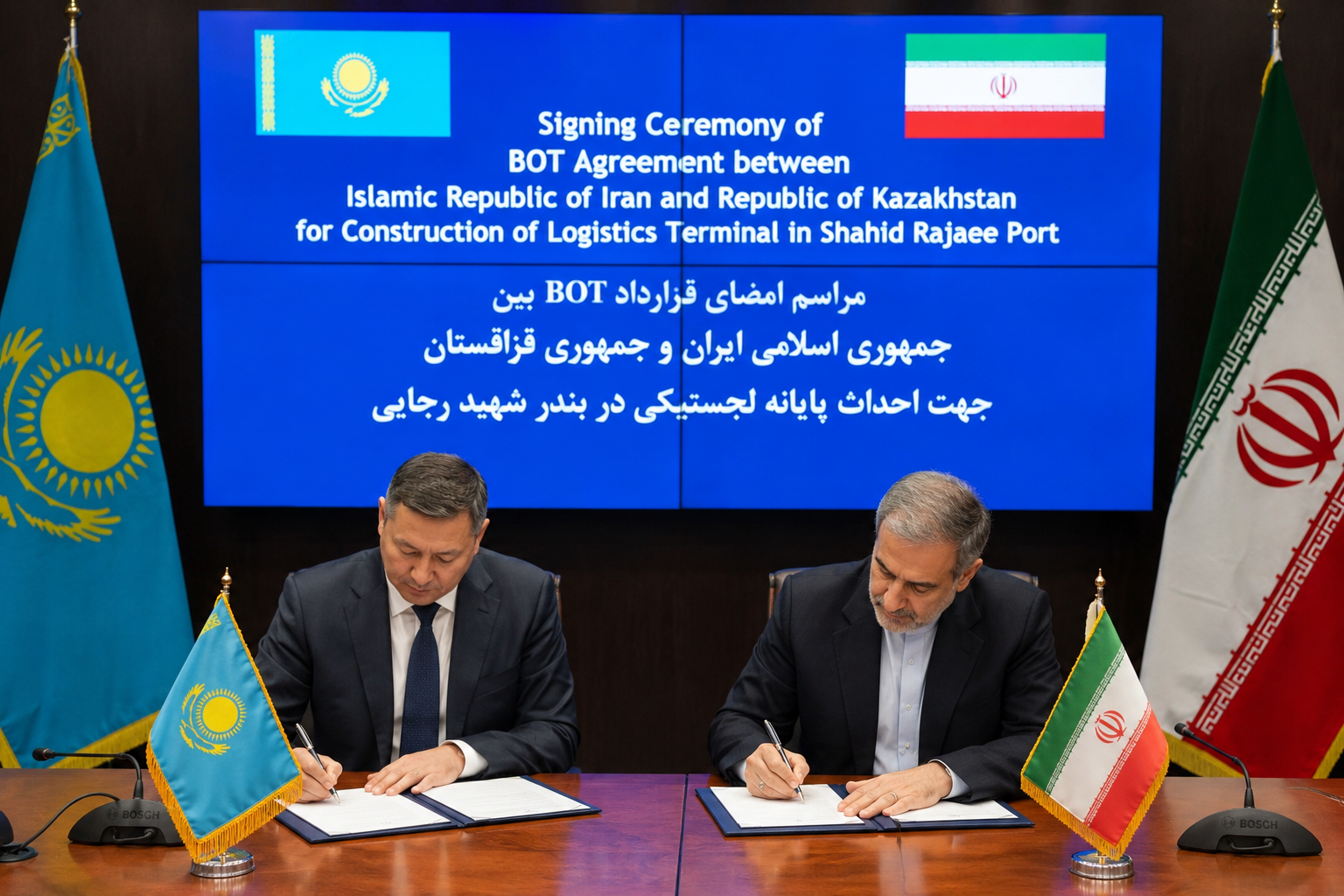
Kazakhstan is taking a major step toward expanding its access to southern maritime markets. The country has signed a BOT agreement with Iran for the construction of a Kazakh transport and logistics terminal at Shahid Rajaee Port in Bandar Abbas, Iran’s largest commercial port and a key gateway near the Strait of Hormuz.
The agreement was signed at the Ports and Maritime Organization of the Islamic Republic of Iran. Under the BOT model — Build, Operate, Transfer — Kazakhstan receives the right to develop and operate the terminal before the facility is eventually transferred under the agreed terms.
The contract is valid for 27 years. The first two years are allocated for construction, while the following 25 years are intended for operation. Commercial operation of the terminal is planned for the third year of the project.
For Kazakhstan, which has no direct access to the ocean, the project has strategic value. Shahid Rajaee Port opens a direct route toward the Persian Gulf, India, South and Southeast Asia, and East Africa. This can help Kazakh exporters reduce dependence on a limited number of traditional routes and strengthen the country’s position in the International North–South Transport Corridor.
As K2Cargo News previously reported in AD Ports Confirms Strategic Interest in Kazakhstan, Kazakhstan is increasingly looking at port partnerships as a way to turn its geography into practical logistics capacity.
Why Shahid Rajaee Port Matters
Shahid Rajaee Port is one of Iran’s most important transport assets.
Located near Bandar Abbas on the northern side of the Strait of Hormuz, the port connects Iran’s rail and road networks with major maritime routes across the Persian Gulf and the Indian Ocean. For Kazakhstan, this creates a southern maritime outlet that can complement Caspian, Russian, Chinese and Trans-Caspian routes.
The location is especially important for commodities and containerized goods. Kazakhstan exports grain, metals, fertilizers, oil products and other cargoes that require reliable bulk and multimodal logistics. A dedicated terminal in Iran can help consolidate these flows and make access to southern markets more predictable.
The port also has broader strategic importance because the Strait of Hormuz remains one of the world’s most sensitive maritime chokepoints. Any logistics project in this area is not only about trade, but also about route resilience, risk management and access to alternative markets.
A 27-Year BOT Model
The BOT structure gives the project a long-term investment logic.
In a Build-Operate-Transfer model, the investor builds the infrastructure, operates it for a defined period and then transfers it according to the agreement. This approach is common in ports, terminals, roads and other infrastructure projects where high upfront investment must be recovered over many years.
For Kazakhstan, the 27-year horizon gives enough time to build cargo flows, establish operating standards and integrate the terminal into export supply chains. For Iran, the agreement brings foreign investment, strengthens Shahid Rajaee Port and supports the country’s ambition to expand transit through the North–South corridor.
The first two years will be critical. Construction, equipment procurement, customs integration, railway connections, warehousing systems and digital procedures will determine how quickly the terminal can begin commercial operations.
North–South Corridor Gets a Practical Asset
The terminal is directly linked to the International North–South Transport Corridor.
This corridor connects Russia, Kazakhstan, the Caspian region, Iran, the Persian Gulf and India. It is designed to create a shorter and more diversified logistics route between northern Eurasia and southern maritime markets.
For years, the North–South corridor has been discussed as a strategic alternative, but its competitiveness depends on practical infrastructure: rail links, terminals, port capacity, customs coordination and predictable tariffs.
A Kazakh terminal in Shahid Rajaee Port turns the concept into something more concrete. It gives Kazakhstan a physical logistics base inside Iran’s largest port and creates an operational point for handling cargo moving south.
According to earlier regional transport discussions, freight volumes along the corridor increased in 2025, while rail cargo between Kazakhstan and Iran also grew strongly. That makes the timing of the terminal important: the project is being launched when the corridor is already gaining momentum.
What Cargoes Could Use the Terminal
The terminal can become useful for several categories of Kazakh exports.
Grain is one of the most obvious cargoes. Kazakhstan is one of the major grain producers in Central Asia, and access to ports in the Persian Gulf can open additional routes to Middle Eastern, African and Asian markets.
Metals and industrial products may also benefit. Kazakhstan needs reliable export channels for commodities and semi-finished goods, especially when traditional routes are congested or politically sensitive.
Containerized cargo is another opportunity. If the terminal is integrated with rail and road services, it can support not only bulk exports but also general cargo, consumer goods, machinery, components and transit shipments.
The key advantage is not only the port itself, but the ability to build a repeatable logistics chain: Kazakhstan — rail transit — Iran — Shahid Rajaee — maritime markets.
Why This Matters for Kazakhstan’s Export Strategy
Kazakhstan has been actively diversifying its export routes.
The country relies on several corridors: routes through Russia, the Trans-Caspian International Transport Route, links with China and Central Asia, and the North–South direction through Iran. Each route has advantages and risks.
A terminal in Iran strengthens the southern vector. It gives Kazakh exporters better access to markets that are difficult to reach through northern or western routes. It also improves bargaining power, because exporters with more route options are less vulnerable to disruptions, tariffs or bottlenecks on any single corridor.
For landlocked countries, logistics diversification is not optional. It is a core part of economic security. Kazakhstan’s investment in Shahid Rajaee Port reflects this logic.
Benefits for Iran
The project is also important for Iran.
Iran wants to increase its role in regional transit and attract more cargo through its ports and railways. A Kazakh terminal at Shahid Rajaee can support annual cargo flows through Iranian territory and strengthen the port’s position in international logistics chains.
Iranian officials have linked the project with higher transit revenues, new employment opportunities and better use of port infrastructure. For Tehran, cooperation with Kazakhstan also helps connect Iranian ports more directly with Central Asian markets.
This is especially relevant at a time when regional corridors are being reconsidered because of geopolitical risks, sanctions, maritime instability and the need for alternative trade routes.
Risks and Challenges
The project is promising, but not simple.
The first challenge is infrastructure coordination. The terminal must be connected with rail and road routes that can move cargo efficiently from Kazakhstan through Iran to the port. If inland links are slow, the port facility alone will not solve the logistics problem.
The second challenge is tariff competitiveness. Exporters will compare the Iranian route with alternatives through the Caspian, Russia, China and the Black Sea. The route must be reliable and cost-effective.
The third challenge is geopolitics. Shahid Rajaee is located near the Strait of Hormuz, a region exposed to periodic tensions. This does not reduce the value of the project, but it means that risk management, insurance and route planning will remain important.
The fourth challenge is cargo balance. For the terminal to be sustainable, Kazakhstan and Iran will need not only export flows southbound, but also return cargo and broader regional use.
A New Southern Gate for Kazakh Logistics
The BOT agreement marks a practical step in Kazakhstan’s long-term logistics strategy.
The country is not only discussing corridors, but securing infrastructure inside key foreign ports. That is important because access to a terminal can give exporters more control over handling, storage, schedules and service quality.
If implemented successfully, the Shahid Rajaee project can strengthen Kazakhstan’s access to the Persian Gulf, South Asia, Southeast Asia and East Africa. It can also make the North–South corridor more commercially relevant for shippers.
The next two years will show how quickly the terminal can move from agreement to construction and from construction to regular cargo operations. But the strategic direction is already clear: Kazakhstan is building not only routes, but logistics footholds beyond its borders.
Read also: AD Ports Confirms Strategic Interest in Kazakhstan
