

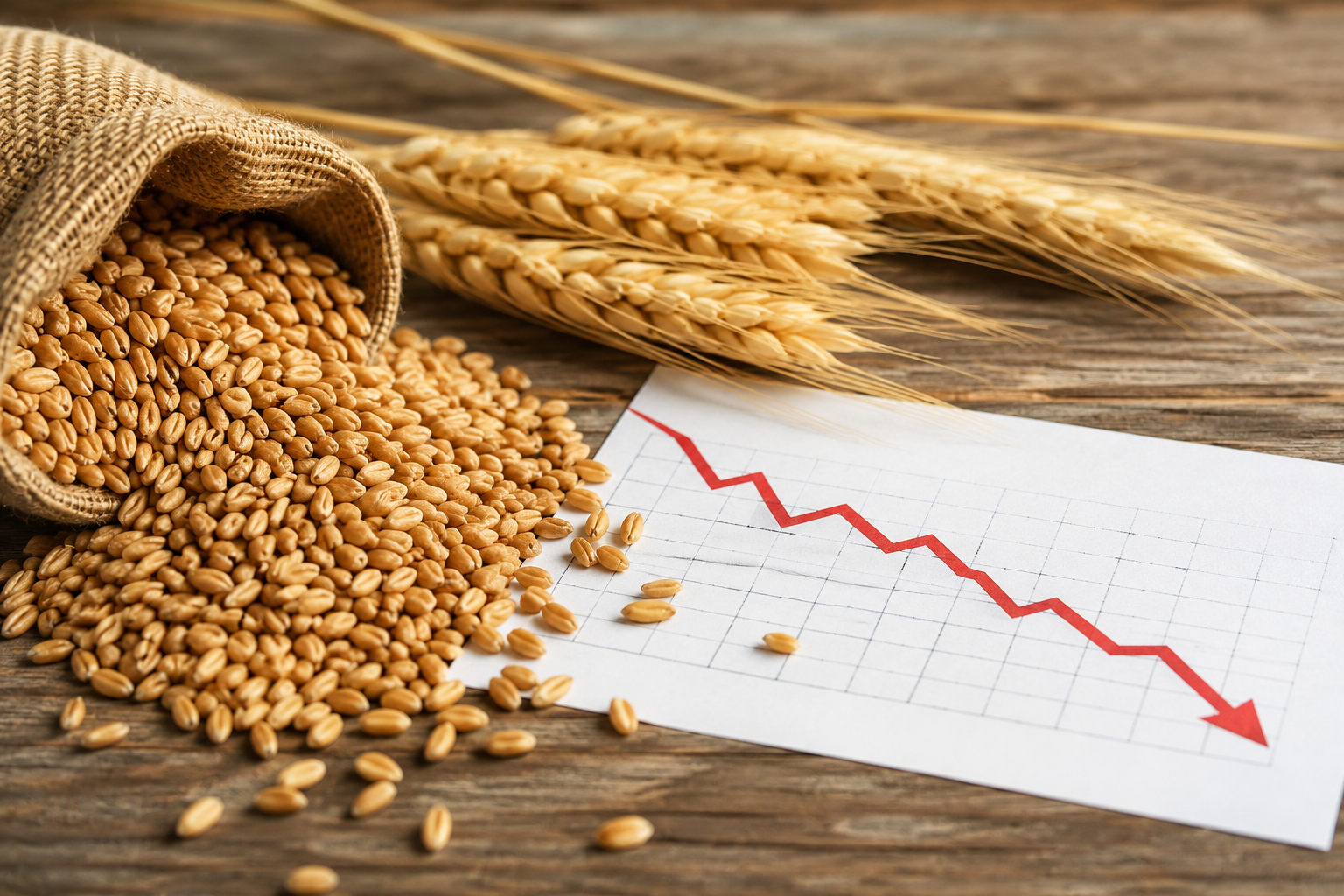
Ukrainian wheat remains under price pressure as the 2026 harvest begins and exporters adjust bids to weaker market conditions. According to APK-Inform, the domestic wheat market continued to show a downward price trend last week, with both milling and feed wheat becoming cheaper.
The main pressure factors have not changed: lower prices on the export market, the start of harvesting in Ukraine and a slowdown in trade and procurement activity. Some processors still maintained fairly strong demand and therefore did not sharply reduce prices. However, many farmers are in no hurry to sell higher-quality wheat, expecting a more favorable price environment later in the season.
This creates a divided market. New-crop wheat is putting pressure on prices, but high-quality grain is not always actively offered. For traders, processors and exporters, the next few weeks will be important: the balance between harvest pressure, quality risks and export demand will determine whether the current price decline continues.
As K2Cargo News previously reported in Ukrainian Ports Handle Over 40 Million Tons of Cargo Despite Ongoing Attacks, Ukrainian seaports remain a critical part of the country’s export system. That is why port prices for wheat are especially important for the entire agricultural logistics chain.
How Much Wheat Prices Fell
According to APK-Inform, prices for second-class wheat and feed wheat in Ukraine fell by 100–500 UAH per tonne over the week.
As a result, second-class wheat prices were formed within 9,200–10,700 UAH per tonne CPT. Feed wheat prices were within 8,500–10,000 UAH per tonne CPT.
The lowest demand prices were typical for new-crop wheat. This is a normal seasonal pattern: when fresh supply enters the market, buyers often lower bids, especially if they expect more grain to appear in the coming days.
The port market showed an even clearer decline in dollar terms. In Ukrainian ports, prices for milling and feed wheat decreased by $6–11 per tonne. Milling wheat was quoted at $202–209 per tonne CPT-port, while feed wheat stood at $188–199 per tonne CPT-port.
For exporters, this reflects both domestic supply pressure and international competition. For farmers, it creates a difficult choice: sell now at lower prices or hold grain in storage and wait for a possible rebound.
Harvest Pressure Is the Main Seasonal Factor
The start of harvesting is one of the strongest factors behind the current price decline.
When the new crop begins to enter the market, supply increases quickly. Elevators, traders and exporters start receiving fresh volumes, while some buyers reduce prices in expectation of further supply growth.
This is especially important in Ukraine because wheat exports are closely linked to port logistics. If the harvest moves quickly and ports receive enough grain, exporters can be more aggressive in lowering purchase prices.
At the same time, early harvest data may influence market sentiment. If yields are better than expected in some regions, buyers may assume that supply will remain strong. If rains or quality problems appear, the market may change direction.
For now, the pressure from the new crop is visible. But this pressure may not be permanent if weather conditions reduce the share of milling-quality wheat or if import demand strengthens.
Farmers Are Holding Quality Wheat
APK-Inform notes that many agricultural producers are not rushing to sell high-quality wheat.
This behavior is understandable. When prices are falling at the beginning of the harvest, farmers often prefer to wait, especially if they have access to storage and do not need immediate cash flow.
The strategy is different for each producer. Large farms with storage capacity can hold grain and watch the market. Smaller farms may need to sell earlier to finance harvesting, fuel, salaries and preparation for the next production cycle.
This is why the market can show falling prices even when not all sellers are active. Buyers lower bids because new supply is appearing, but farmers with better-quality wheat may resist those prices.
Such a situation can create a temporary mismatch between demand and supply. Processors may still need quality wheat, but farmers may not be ready to sell it cheaply.
Ports Remain the Price Signal
Port prices are one of the most important indicators for Ukrainian wheat.
They show what exporters are ready to pay for grain delivered to the export chain. When CPT-port prices fall, the pressure usually moves back through the entire logistics system: from ports to elevators, traders and farmgate prices.
The current decline to $202–209 per tonne for milling wheat and $188–199 per tonne for feed wheat indicates that exporters are cautious. They are watching global demand, Black Sea competition and the pace of the Ukrainian harvest.
For logistics companies, lower prices do not necessarily mean lower activity. In some cases, falling prices can accelerate movement if farmers decide to sell before further declines. In other cases, it can slow shipments if producers hold grain and wait.
This affects rail transport, road carriers, port terminals, elevators and storage operators. Wheat prices are therefore not only an agricultural issue, but also a logistics signal.
Black Sea Wheat Remains Competitive
Despite the price decline, Ukrainian wheat remains one of the most competitive offers in the Black Sea region.
Low prices can stimulate demand from importers, especially if wheat from other origins becomes more expensive or if buyers need quick supply. This is why the decline may eventually support new export activity.
However, competition remains strong. Russian wheat, Romanian wheat and other Black Sea origins influence pricing. Importers compare not only price, but also delivery reliability, quality, payment terms, insurance and logistics risk.
Ukraine’s advantage is that its maritime corridor and ports continue to function, allowing large volumes to move by sea. But war risks, insurance costs and infrastructure attacks remain important factors in export pricing.
What Could Stop the Decline
Several factors could slow or stop the fall in Ukrainian wheat prices.
The first is weather. If rains delay harvesting or reduce grain quality, the amount of milling wheat available for export and processing could become smaller than expected.
The second is global demand. Large tenders from importers in the Middle East, North Africa or Asia can quickly support Black Sea prices, especially if Ukrainian wheat remains cheaper than competitors.
The third is international futures markets. If U.S. or European wheat prices rise, Ukrainian export prices may also stabilize.
The fourth is farmer behavior. If producers continue to hold high-quality wheat, buyers may have to raise bids to secure needed volumes.
For now, the market remains under pressure. But the situation can change quickly during harvest, especially if quality risks appear.
What This Means for Agribusiness and Logistics
For farmers, the current market requires careful selling strategy. Selling immediately gives cash flow, but may lock in lower prices. Holding grain can bring better returns later, but requires storage capacity and financial stability.
For processors, lower wheat prices can improve margins, but only if they can secure the right quality. If farmers hold milling wheat, processors may not benefit fully from the general price decline.
For exporters, the key issue is timing. They need to buy competitively, fill vessels and meet contract requirements while managing price volatility.
For logistics operators, the coming weeks may bring uneven demand. Some regions may see active movement of new-crop wheat, while others may experience slower sales as farmers wait.
The Ukrainian wheat market has entered a seasonal adjustment phase. Prices are falling because harvest pressure is growing and export bids are weaker. But the market is not one-directional. Quality, weather, global tenders and farmer selling behavior can still change the picture.
For now, the main conclusion is clear: Ukrainian wheat is getting cheaper, but the real test for the market will come when the harvest pace, grain quality and export demand become clearer.
Read also: Ukrainian Ports Handle Over 40 Million Tons of Cargo Despite Ongoing Attacks