

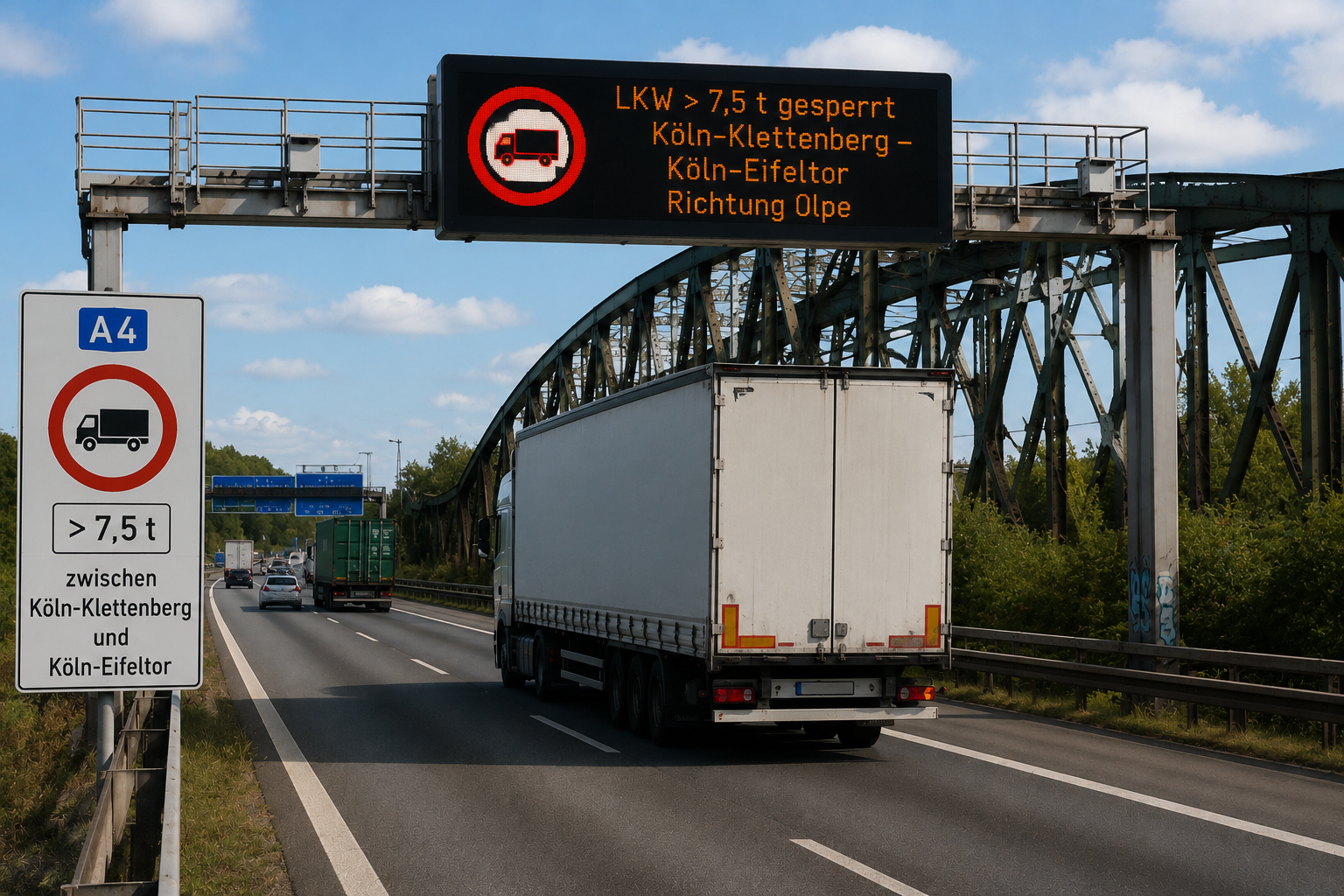
Additional restrictions have been introduced on one of Germany’s key freight corridors. Since June 10, 2026, trucks with a gross vehicle weight exceeding 7.5 tonnes have been prohibited from using the A4 motorway between the Köln-Klettenberg and Köln-Eifeltor interchanges in the direction of Olpe.
The measure was implemented to reduce pressure on the Eifeltor Bridge, whose structural condition has raised concerns among road authorities. Autobahn GmbH Rheinland introduced the restriction as part of a broader effort to preserve traffic safety and prevent further deterioration of the bridge.
According to the motorway operator, the structure has been exposed to significant dynamic and static loads due to the high volume of heavy freight traffic. To enable reinforcement works and ensure safe operation, authorities decided to temporarily remove heavy trucks from the most critical section of the route.
At present, the restriction remains in force indefinitely, with no official end date announced. Transport companies and drivers are advised to adjust routes accordingly and prepare for detours when traveling through the Cologne region.
Cameras Monitor Violations
To ensure compliance, Autobahn GmbH has deployed an Enforcement Bar monitoring system along the restricted section. Specialized cameras automatically identify trucks that continue to use the route despite the prohibition.
During the first days after the measure took effect, authorities reported several cases of non-compliance, prompting increased monitoring by police and traffic enforcement agencies.
Drivers who violate the restriction may face fines of approximately €100. Additional administrative costs and potential liability may also apply to transport companies. Repeated violations could result in higher penalties under Germany’s administrative enforcement procedures.
The restrictions are already affecting freight traffic patterns in western Germany. A significant share of truck traffic has been diverted to alternative routes, including sections of the A1 motorway. This has periodically increased congestion and traffic density on surrounding roads.
The latest measures follow a series of earlier actions introduced during spring 2026. Initial efforts to reduce stress on the bridge structure began in April and were expanded in early June after further inspections revealed the need for stricter controls.
Representatives of Autobahn GmbH emphasize that compliance with the restrictions is essential for maintaining the safety of both the bridge and road users. If the condition of the structure worsens, authorities may consider additional traffic management measures, including more extensive restrictions on one of Germany’s busiest transport corridors.
For international carriers, the situation highlights the importance of monitoring road updates and traffic advisories. The restrictions around Cologne may impact delivery schedules, increase transit times, and require additional route planning for freight movements across Germany.
Read also: Tunnel Renovation to Reshape Traffic Flow in Munich