

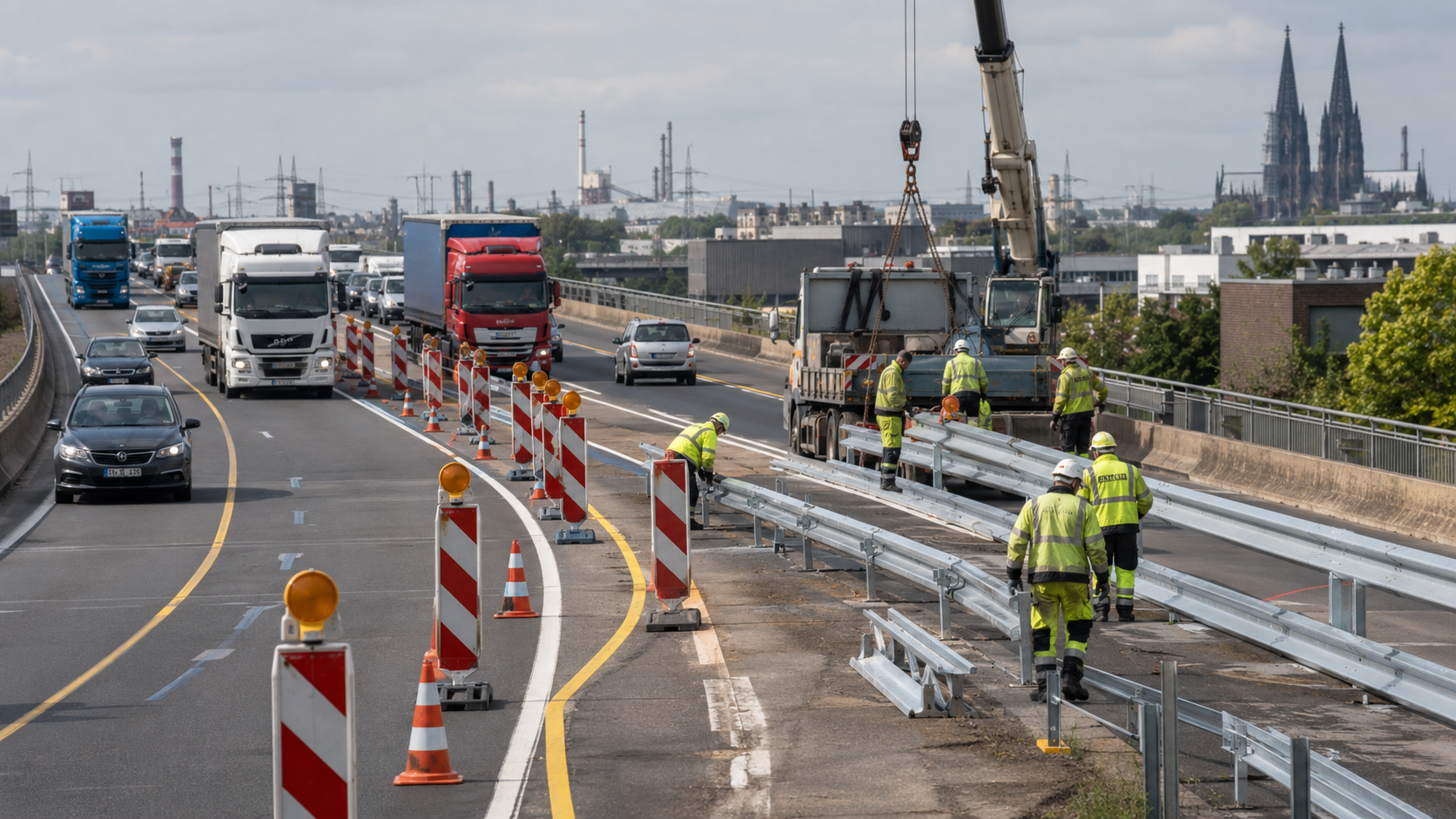
A key section of the A4 near Cologne will be closed for several days as Germany’s Autobahn GmbH Rheinland prepares to install a new barrier system at the Eifeltor structure. The closure will affect traffic heading toward Olpe between the Köln-West motorway interchange and the Köln-Eifeltor exit.
The works are scheduled to begin at 22:00 on July 10 and continue until around July 16. The road operator initially considered installing the system without a full closure, but after consultations with traffic authorities, police, the City of Cologne and other stakeholders, a complete shutdown was chosen for safety reasons.
Autobahn GmbH argues that reducing the number of lanes instead of closing the section completely could have created long tailbacks and higher safety risks. A full closure also allows traffic to be directed more clearly through planned diversion routes.
For freight operators, the measure is important because it directly affects heavy goods traffic in one of Germany’s busiest logistics regions. Cologne is not only a major urban area, but also a key point on routes linking western Germany, Belgium, the Netherlands and central Germany.
As K2Cargo News previously reported in Europe Introduces Summer Truck Driving Restrictions for 2026, road freight operators in Europe are facing a summer season shaped by bans, construction works and route limitations. The A4 closure adds another planning challenge for carriers crossing North Rhine-Westphalia.
Why the A4 Section Must Be Closed
The closure is linked to the condition of the Eifeltor structure, which carries the A4 over railway tracks near the Cologne-Eifeltor freight terminal. This is a sensitive point for both road and rail logistics, and protecting the structure has become a priority.
Since the end of April 2026, restrictions have already applied to certain categories of heavy transport. Initially, the ban affected vehicles requiring special permits. From June 10, the restriction was expanded to heavy goods traffic above 7.5 tonnes between Köln-Klettenberg and Köln-Eifeltor in the direction of Olpe.
The new barrier system is intended to make the weight restrictions technically enforceable across all lanes. This is important because Autobahn GmbH has said too many heavy vehicles and vehicles with insufficient spacing continued to use the affected structure.
What Changes After the Barrier Is Installed
After the barrier system is put into operation, the traffic regime will change again.
The two left lanes will remain available only for vehicles weighing up to 3.5 tonnes. The right lane is expected to reopen for trucks weighing up to 44 tonnes. Vehicles heavier than 44 tonnes will still have to leave the motorway earlier, at the Köln-Klettenberg exit.
For carriers, this creates a more predictable but still restricted situation. Trucks up to 44 tonnes should regain access to the right lane after the works, but oversize or exceptionally heavy transport will remain excluded from the Eifeltor section.
This means dispatchers will need to check vehicle weight, permits and routing before sending trucks toward the A4 in Cologne. The wrong route could lead to delays, detours or enforcement action.
Diversions Will Affect Regional Traffic
Large-scale diversions will be organized from the Köln-West interchange. Several connections to the A4 toward Olpe will be unavailable, including movements from the A1.
Drivers coming from the A1 in different directions will not be able to enter the A4 toward Olpe through Köln-West. At the Köln-Klettenberg junction, vehicles will also be unable to join the A4 toward Olpe, although access toward Aachen will remain possible.
Autobahn GmbH recommends wide-area detours via the A1 and A3. For local traffic, the closure may increase pressure on Cologne’s urban road network, especially if drivers try to avoid motorway detours.
The timing also matters. From July 10 to July 12, another A4 closure is planned between Frechen-Nord and Kerpen because of bridge works. Autobahn GmbH says the works were deliberately coordinated to reduce the overall number of separate closures in the region.
What It Means for Freight Companies
For trucking companies, the main issue is planning.
The A4 is a major corridor for regional distribution, long-distance road freight and access to the Cologne logistics area. Even a temporary closure can affect delivery windows, driver schedules, fuel consumption and compliance with working-time rules.
Carriers serving the Eifeltor freight terminal, warehouses in Cologne or customers in the Rhine region should review routes in advance. Heavy vehicles heading toward Olpe may need earlier diversion planning, especially if they exceed 44 tonnes or rely on special permits.
The measure also shows how aging infrastructure increasingly affects freight transport in Europe. When a bridge or road structure requires protection, truck traffic is often the first to face restrictions because vehicle weight directly affects structural load.
The A4 closure is therefore more than a local roadworks notice. It is another example of how infrastructure condition, safety rules and freight efficiency are becoming tightly connected. For carriers, the best response is early planning, clear communication with customers and careful monitoring of changing motorway restrictions.
Read also: Europe Introduces Summer Truck Driving Restrictions for 2026