

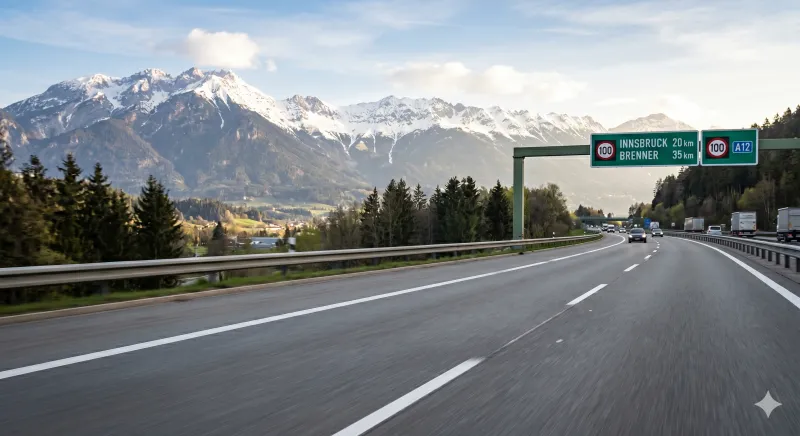
Controlled truck entry will operate from January 7 to March 15, potentially causing queues before Kufstein and delays along the Brenner freight corridor
The Austrian state of Tyrol has approved 11 truck-metering days on the A12 motorway during the first quarter of 2027. Traffic will be controlled at Kufstein-Nord for vehicles entering Austria from Germany and travelling towards Innsbruck and the Brenner Pass.
The first operation is scheduled for Thursday, January 7, immediately after Epiphany. The remaining ten dates are Mondays: January 11, 18 and 25; February 1, 8, 15 and 22; and March 1, 8 and 15.
The schedule is contained in Tyrol’s official truck-metering calendar for the first quarter of 2027, commissioned by the state government’s mobility planning department.
Operations are expected to begin at approximately 05:00. Their duration and intensity will depend on real-time traffic conditions. Police will restore the normal flow as soon as congestion risks on the A12 and connecting routes have eased.
Tyrol’s system does not introduce another road charge for trucks. The German term Lkw-Dosierung refers to truck metering or block processing.
During periods of peak demand, police limit the number of heavy vehicles permitted to pass Kufstein-Nord each hour. Trucks are released in controlled groups to reduce pressure on the A12 Inntal motorway, the Innsbruck area and the A13 route towards the Brenner Pass.
“The objective is to prevent large-scale network congestion and dangerous situations at motorway junctions,” the Tyrolean government report said
The exact hourly release rate is not permanently fixed in advance for every operation. Police adjust the flow according to truck volumes, passenger traffic, queues, weather, incidents and available road capacity.
Metering is conducted in the Austria-bound direction. However, the resulting queue usually develops on the German side near Kufstein and Kiefersfelden. Hauliers travelling from Germany to Italy must therefore allow for delays before entering Tyrol.
Ten of the 11 dates are Mondays because winter truck bans can cause vehicles to accumulate over the weekend. When the restrictions expire, a large number of trucks resume their journeys towards Innsbruck and the Brenner corridor at approximately the same time.
The greatest pressure develops during the early morning. Drivers seek to restart immediately after the ban ends, rapidly increasing demand at the A12 border section.
January 7 was selected separately. In 2027, Epiphany falls on Wednesday, January 6. The following Thursday will be the first regular school and working day after the Christmas holiday period for much of the region, creating the potential for simultaneous growth in truck and passenger traffic.
No metering is planned for January 4 or 5 because those dates fall within the holiday period, when morning traffic is expected to remain comparatively moderate.
As K2Cargo.News previously reported, Austria already applies additional seasonal truck bans on the A12, A13 and other major motorways during tourism peaks. Kufstein metering operates alongside these restrictions but is a separate traffic-management measure.
Tyrol uses an assessment model combining two indicators. The first measures heavy trucks entering at Kufstein towards Innsbruck and the Brenner Pass. The second covers total vehicle traffic on the A12 near Ampass.
More than 483 category 4+ trucks per hour at Kufstein is classified as an extreme level. For total traffic at Ampass, the highest category begins above 3,775 vehicles per hour.
A particularly severe peak was recorded on Monday, January 19, 2026. Between 05:00 and 06:00, 673 category 4+ trucks entered through Kufstein towards Innsbruck and the Brenner corridor.
This was 14.8% above the 586 trucks recorded during the comparable Monday in January 2025. The figure of 673 vehicles substantially exceeded the extreme threshold and required an additional unplanned metering operation between 08:00 and 09:00.
The official report considers hourly peaks of around 650 heavy trucks extremely problematic for traffic flow and road safety. Increasing Monday demand was therefore one of the principal reasons for concentrating the early-2027 schedule on the first working day after weekend restrictions.
Total traffic on the A12 at Ampass declined by 3.3% in the first half of 2026 compared with the same period of 2024, falling from 13.99 million to 13.54 million vehicles.
At the same time, vehicles exceeding 3.5 tonnes at the A12 Kufstein border section increased by 2.5% compared with the first half of 2025. Their number rose from 1.502 million to 1.540 million.
The busiest day for category 4+ trucks during the first half of 2026 was June 9, when 6,296 heavy vehicles travelled towards Innsbruck and the Brenner Pass. The highest hourly peaks, however, were more frequently recorded on Monday mornings.
The figures show that a decline in total traffic does not necessarily reduce pressure from road freight. Hauliers may continue to face queues even when the overall number of vehicles on the A12 decreases.
The published schedule applies only from January through March 2027. Further dates will be announced after truck-ban periods linked to the reconstruction of the Luegbrücke have been formally determined.
Since January 1, 2025, traffic on the A13 bridge has generally been restricted to one lane in each direction. The arrangement was introduced because of the structure’s condition and the need to reduce pressure during reconstruction.
Motorway operator ASFINAG says construction began in March 2025. The first new bridge structure is due for completion by the end of 2027, while the entire project is scheduled to finish by the end of 2030. Total costs are estimated at approximately €380 million.
Restrictions at the Luegbrücke affect the capacity of the wider Brenner corridor. The Kufstein metering calendar must therefore be coordinated with additional truck bans on the A12 and A13.
Regular truck metering at Kufstein began in 2018. There were 27 metering days that year, including one unplanned intervention. The number rose to 35 in 2019, 41 in 2021, 43 in 2022 and 44 in 2023.
Metering was used on 50 days in 2024, including ten unplanned operations. In 2025, the total reached 57 days, 21 of which were not included in the original calendar.
During the first half of 2026, Tyrol conducted 15 scheduled and 14 unplanned operations. Metering lasted an average of 4.4 hours. Additional controls were introduced in response to congestion, incidents, construction and other conditions that could not be precisely anticipated.
Tyrol’s official information page states that 30 scheduled metering days were planned for the whole of 2026. By August, another 15 unplanned interventions had been required.
The restrictions can hold trucks on the German side of the border and disrupt Germany–Austria–Italy delivery schedules. The greatest impact is likely to affect time-sensitive shipments, perishable cargo and operations involving tightly coordinated trailer exchanges.
Hauliers should include metering days in route planning, warn customers about potential delays and verify parking availability on the German approach to Kufstein. Arriving immediately before controls begin may increase the total waiting time.
The published calendar does not prevent additional restrictions. Tyrol can introduce unplanned metering if an accident, snowfall, construction work or disruption on the A13 or Italy’s A22 creates an immediate threat to traffic flow.
Read also: European truck bans in September 2026: key dates across nine countries
