

Bulgarian Police Announce Stronger Enforcement
Bulgarian police plan to increase inspections of trucks operated by Turkish carriers transiting the country. The decision follows a road-safety analysis and the interception of a vehicle carrying more than 20 tonnes of flammable materials.
Lyubomir Nikolov, acting Chief Secretary of Bulgaria’s Interior Ministry, said Turkish citizens accounted for a substantial share of serious heavy-vehicle violations identified in the country.
The ministry intends to go beyond roadside enforcement. Bulgarian authorities plan to use international cooperation channels to investigate the transport companies operating trucks involved in serious offences.
There is currently no formal ban on Turkish carriers. The announcement instead signals a stricter enforcement model involving vehicle inspections, checks on drivers’ working time and cross-border information exchange.
One Inspection Revealed Multiple Serious Violations
The central example presented at the official briefing involved a Turkish articulated truck stopped near Sofia on June 28.
The vehicle was travelling from Belgium to Türkiye with more than 20 tonnes of flammable paints and varnishes. Such cargo is classified as dangerous and must be transported in accordance with the ADR agreement.
Bulgarian police said the operation did not comply with the required procedures. The driver and operator reportedly lacked the necessary documentation demonstrating that the dangerous goods were being carried legally under ADR rules.
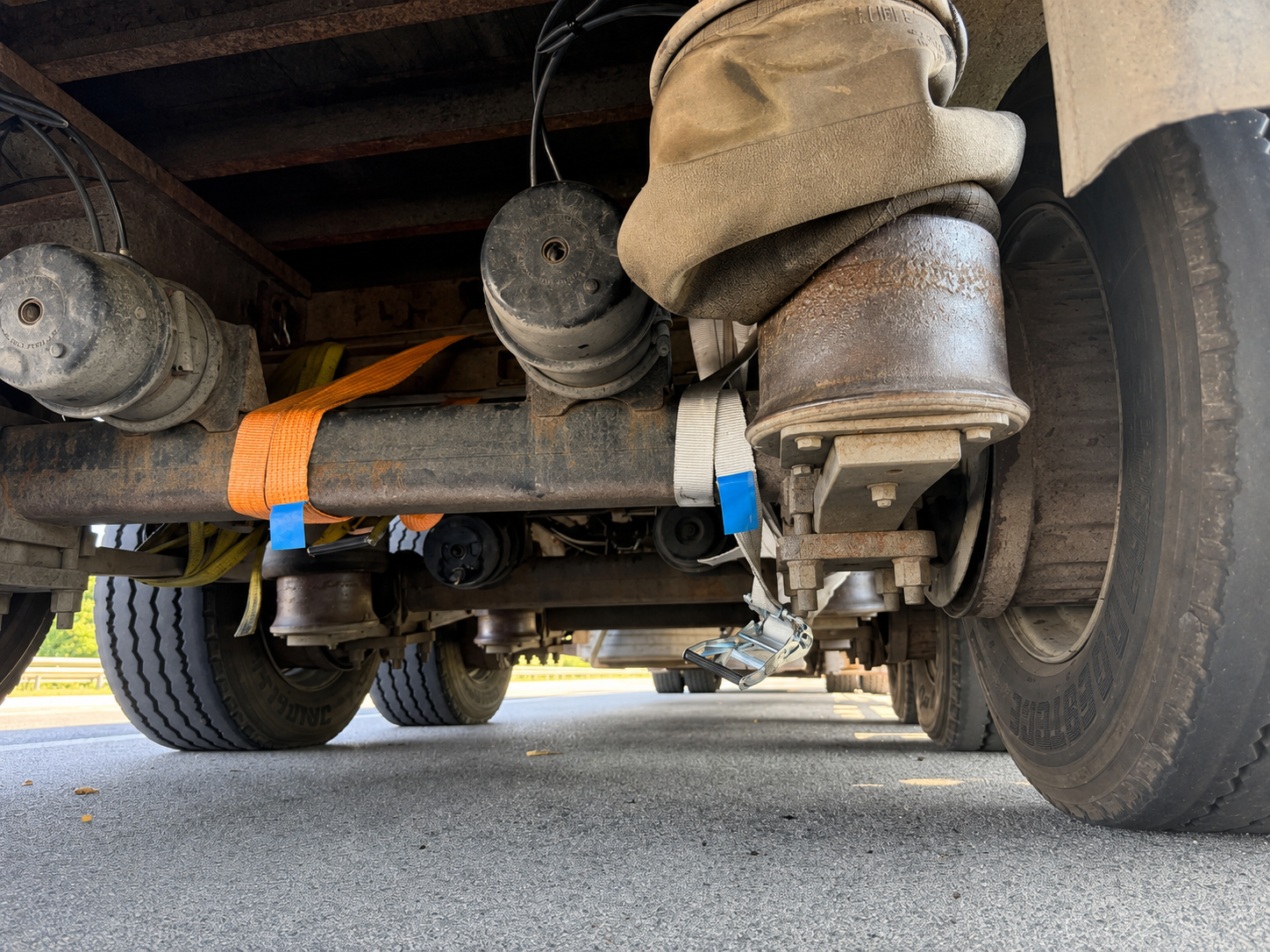
Inspectors also discovered a major technical defect in the semi-trailer. Air-suspension components on both sides of the third axle were damaged, while the rear axle was effectively being held in place with heavy-duty straps.
Despite the defect and the substantial load, the truck continued travelling at approximately 80–90 kilometres per hour.
The Defect Could Have Caused a Major Accident
The combination of a mechanical failure and flammable cargo created an exceptional risk to other road users.
Damaged suspension affects trailer stability, axle-load distribution and vehicle control. The danger increases during emergency braking, lane changes or travel over uneven surfaces.
Using straps to hold a damaged axle is not a proper repair. It does not restore the suspension’s designed characteristics or guarantee that the assembly can withstand the load at motorway speed.
If the semi-trailer had become unstable or overturned, damaged containers of paints and varnishes could have caused a chemical spill and fire.
The consequences would have extended beyond the driver. Authorities might have needed to close the road, deploy firefighters and hazardous-material specialists and conduct an environmental cleanup.
The Cargo Had Crossed Much of Europe
The transport documents showed that the vehicle had departed from Belgium and was travelling to Türkiye.
The truck may therefore have crossed several European countries before the violations were identified in Bulgaria.
The case raises questions about cross-border enforcement. A dangerous shipment moving without proper documentation or on an unsafe vehicle should not remain solely the responsibility of the country where it is finally stopped.
Bulgarian authorities consequently plan to use international channels to investigate the carrier and share information with other states.
The incident demonstrates the need for closer coordination between European road-inspection agencies. Technical inspection results and the compliance history of transport companies should be accessible to enforcement bodies along the entire route.
Inspectors Found Another Driver’s Tachograph Card
The inspection also uncovered a tachograph card issued to a different driver.
The card belonged to another employee of the same Turkish transport company, who was operating a second truck in Bulgaria that day.
Using another person’s card can conceal actual driving hours and create false records of a driver’s working schedule.
European rules limit driving time and require breaks and rest periods to reduce fatigue-related accidents.
When a driver uses a colleague’s card, inspectors cannot reliably establish how long that person has been behind the wheel. Even a mechanically sound vehicle becomes more dangerous when its driver may be fatigued.
The Second Truck Was Found Near Plovdiv
After identifying the card, Bulgarian authorities established that its owner was also travelling in the country.
The second truck was intercepted approximately 100 kilometres from the first vehicle, near Plovdiv. Its driver was also a Turkish citizen.
Inspectors began additional checks on both vehicles and the transport company.
The incident illustrates why enforcement agencies increasingly expand an inspection from one vehicle to the operator’s broader activities.
A violation may not be an isolated decision by one driver. If tachograph cards are exchanged between employees or technical defects are ignored to keep vehicles moving, responsibility must also be examined at fleet-management level.
The Truck and Driver Were Removed from Service
Bulgarian authorities removed the registration plates from the defective vehicle combination.
The driver’s licence was also temporarily confiscated. Both the truck and its driver were therefore prevented from continuing the journey.
Administrative proceedings were opened, although the final penalties were not disclosed.
Potential sanctions may relate to operating an unsafe vehicle, failing to comply with dangerous-goods rules and improperly using a tachograph card.
The carrier will also face costs connected with repairs, parking, cargo transfer or replacement transport. The delay could lead to contractual claims from the shipper or consignee.
Bulgaria Plans to Investigate Transport Operators
The most significant part of the Interior Ministry’s announcement was its intention to look beyond individual drivers.
Bulgarian authorities plan to identify vehicle owners, examine carrier operations and share information with international partners.
This could create risk profiles for individual companies. Operators with repeated violations may be selected more frequently for detailed inspections.
Officers could pay particular attention to vehicle condition, ADR documents, driving and rest time, operating licences and international permits.
Compliant Turkish carriers may also face consequences. Violations by individual operators could lead to longer inspections across the wider flow of trucks arriving from Türkiye.
Transport associations and major companies will therefore need to demonstrate that the intercepted vehicle does not represent normal industry practice.
The Statement About Turkish Drivers Needs Context
The claim that Turkish citizens commit most serious heavy-vehicle offences requires detailed supporting statistics.
Turkish trucks represent a large share of international heavy traffic on Bulgarian roads. Bulgaria forms part of the main land route between Türkiye and markets in Central and Western Europe.
A high absolute number of offences may therefore reflect the size of the Turkish transit flow as well as driver behaviour.
An objective assessment should compare violations with the number of inspected vehicles, kilometres travelled and total freight journeys.
Without such information, strong public statements risk appearing to blame an entire national transport industry for individual cases.
Enforcement should be based on vehicle condition, documentation and driver conduct rather than registration country alone.
Bulgaria Is a Key Route for Turkish Carriers
Turkish transport companies use Bulgaria as one of their main land corridors into the European Union.
After crossing the border, trucks travel through Sofia toward Serbia, Romania and other European markets. These routes carry industrial products, automotive components, textiles, food, chemicals and machinery.
Any increase in Bulgarian inspections could affect delivery times across the wider supply chain.
A detailed vehicle examination, tachograph download and ADR document check all require time. Large-scale controls may create queues near inspection sites.
For carriers, this means missed warehouse slots, additional driver expenses and greater difficulty complying with driving-time limits.
Dangerous Goods Will Receive Greater Attention
The case may lead to additional enforcement focused specifically on ADR operations.
Such transport requires a properly trained driver, suitable vehicle equipment, hazard markings, documentation and firefighting equipment.
Operators must consider cargo properties, packaging, compatibility and emergency procedures.
Some dangerous goods are also subject to restrictions concerning routes, tunnels, parking areas and stopping locations.
Missing ADR documentation deprives emergency services of essential information. In the event of a fire or spill, responders must know what substance is involved and which extinguishing methods are safe.
Compliance failures in this sector cannot therefore be treated as minor administrative errors.
Tachograph Enforcement Is Becoming Digital
Tachograph manipulation remains a major target of European roadside enforcement.
Modern devices store information about vehicle movement, speed, driving time and possible interference with the system.
Authorities can compare data from the driver card, vehicle unit and other digital sources.
As remote inspection develops, some irregularities can be detected before the truck is stopped. Officers receive a warning and select the vehicle for a detailed check.
K2Cargo.News previously reported that Spain began testing remote tachograph monitoring. The spread of similar technology is gradually reducing the ability to hide violations by exchanging cards.
Bulgaria Is Automating Truck Enforcement
The Interior Ministry’s announcement coincides with a broader expansion of road monitoring in Bulgaria.
From July 1, the country began using electronic toll cameras to identify trucks violating overtaking bans.
The first stage covers selected sections of the Trakia and Hemus motorways. Cameras can record an offence without a police patrol being present.
Bulgaria’s automated truck-overtaking enforcement shows how toll infrastructure is evolving into a wider monitoring network.
The same systems may eventually be used to enforce toll payments, average-speed rules, route restrictions and other road-transport requirements.
Stricter Checks Could Slow Transit
The main practical consequence for logistics companies will be a greater risk of delays.
If Bulgarian agencies increase inspections of Turkish vehicles, transit times through the country will become less predictable.
Carriers will need to add schedule buffers and conduct more thorough checks of tractors and semi-trailers before departure.
Particular attention should be paid to air suspension, brakes, tyres, cargo securing and mandatory ADR equipment.
Dispatchers must also control tachograph cards and ensure that every driver uses only their own document.
One defective vehicle can result not only in a fine but in the complete suspension of a journey, trailer recovery and an urgent search for replacement capacity.
Turkish Companies Will Need Stronger Internal Controls
Carriers can reduce enforcement risks only through stricter internal procedures.
Pre-trip inspections must identify defects before a truck begins an international journey. Drivers should not be expected to continue when damage affects suspension, brakes or other safety-critical systems.
Dangerous-goods documents should be checked at loading and again before each border crossing.
Companies must also eliminate the exchange of tachograph cards between employees. Responsibility for such conduct may affect both the driver and company management.
Larger operators will need internal audits and records demonstrating proper maintenance. During an international investigation, such documents can show that the company has systematic compliance measures.
International Cooperation Will Increase Owner Liability
Bulgarian authorities plan to use international channels to investigate the companies operating the vehicles involved.
This could include requests to Turkish transport and law-enforcement agencies, licence checks and reviews of previous violations.
If an operator is found to have systematically dispatched defective vehicles or tolerated tachograph manipulation, the consequences could extend beyond one Bulgarian fine.
The company may face additional inspections in other countries, insurance problems and the loss of contracts with major customers.
Shippers also have an interest in carrier reliability. An accident involving dangerous goods can result in cargo loss, environmental damage and reputational consequences.
Enforcement Should Remain Risk-Based
Bulgaria’s strong reaction is understandable from a safety perspective. A truck with a damaged axle, more than 20 tonnes of flammable cargo and possible tachograph manipulation presented a genuine threat.
Effective enforcement, however, should not become automatic suspicion of every Turkish driver.
The most efficient system uses a carrier’s history, vehicle condition, cargo category and previous offences to identify higher-risk operations.
This allows authorities to focus resources on problematic companies without imposing unnecessary delays on compliant businesses.
The distinction is particularly important for international trade. Bulgaria must protect road users while maintaining the capacity of one of the main freight corridors between Türkiye and the European Union.
The Case Is a Warning for the Freight Market
The inspection near Sofia demonstrated how several violations can combine within one transport operation.
Unsafe suspension, high speed, flammable cargo, inadequate documentation and another driver’s tachograph card created the risk of a major road accident.
For Bulgaria, the case became a reason to increase inspections of Turkish trucks and investigate foreign transport companies more actively.
For carriers, it demonstrates that technical and digital violations are becoming increasingly difficult to conceal while crossing multiple European countries.
The appropriate outcome should not be a “war” against carriers from one state, but an enforcement system capable of stopping an unsafe vehicle regardless of its registration or the nationality of its driver.
Read also: Bulgaria Uses Toll Cameras to Police Truck Overtaking