

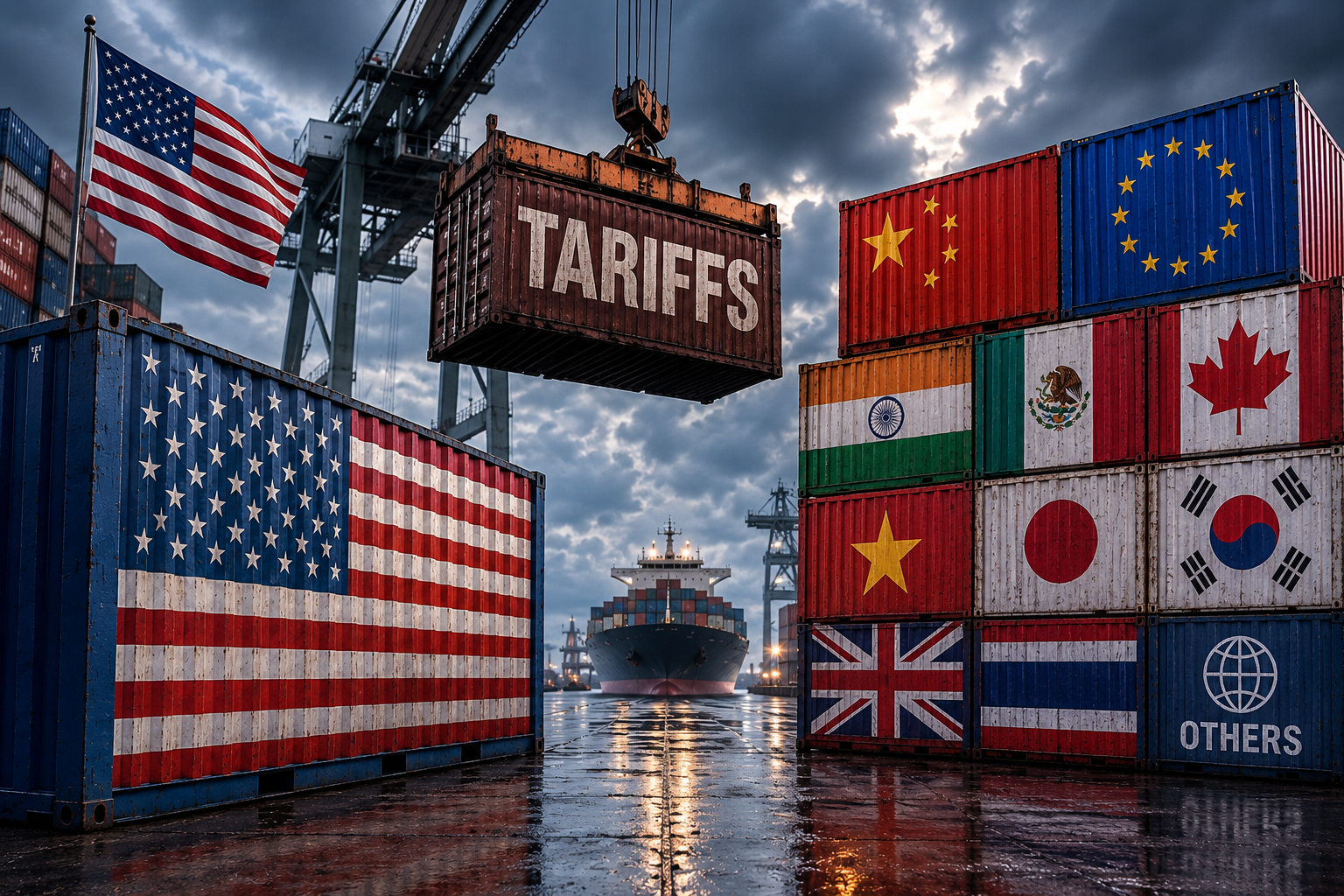
A new chapter has opened in global trade.
The administration of President Donald Trump has formally introduced a new import tariff regime covering 60 of the United States’ largest trading partners and nearly the entire volume of goods entering the American market.
The measures are officially tied to efforts to combat forced labor in global supply chains. But their consequences could extend far beyond labor enforcement, affecting consumer prices, manufacturing decisions, transportation costs, and the structure of international trade.
The new tariffs took effect at 12:01 a.m. Eastern Time on Friday, replacing the temporary 10% global tariff that had been in place for 150 days.
Trade Policy Receives a New Legal Foundation
Unlike earlier restrictions imposed through presidential emergency powers, the latest measures are based on Section 301 of the Trade Act of 1974.
The tariffs followed investigations launched on March 12 by the Office of the United States Trade Representative. U.S. officials examined whether 60 countries were adequately prohibiting or enforcing restrictions against goods produced with forced labor.
The administration concluded that the policies of those economies were unreasonable and placed an additional burden on American commerce.
According to U.S. Trade Representative Jamieson Greer, Washington intends not only to protect the domestic market but also to pressure international trading partners to strengthen their labor enforcement practices.
“The United States has prohibited the importation of goods made with forced labor for nearly a century, and that prohibition is strictly enforced. It is long past time for our trading partners to do the same,” Greer said.
In practical terms, the administration has established a new legal basis for maintaining broad import restrictions after an earlier tariff mechanism relying on emergency authority was rejected by the U.S. Supreme Court.
Nearly All U.S. Imports Are Covered
According to the White House, the new tariff structure applies to trading partners responsible for approximately 99.4% of all U.S. imports.
Most countries have been divided into two principal tariff categories.
Countries Subject to a 10% Tariff
- Mexico
- Canada
- India
- United Kingdom
- Argentina
- Indonesia
- Malaysia
- Pakistan
- Bangladesh
- Cambodia
- Guatemala
- Honduras
- El Salvador
- Jordan
- Sri Lanka
- Ecuador
- Trinidad and Tobago
Countries Facing Tariffs of Up to 12.5%
A higher tariff rate applies to several major economies, including:
- China
- Australia
- Brazil
- Vietnam
- Thailand
- South Africa
- Dozens of other countries
The European Union and Taiwan will be subject to a special calculation combining their existing most-favored-nation tariff rates with the new Section 301 duty.
For Japan, South Korea, and Switzerland, the combined tariff burden will be capped at 12.5%.
Hundreds of Products Are Exempt
To reduce potential disruption to U.S. manufacturers and consumers, the administration has created a broad list of exemptions.
Products excluded from the new tariffs include:
- Oil and natural gas
- Fertilizers
- Certain food products
- Raw materials unavailable from domestic suppliers
- Products whose restriction could cause severe economic disruption
- Goods not produced in sufficient quantities within the United States
Goods that were already in transit before the tariffs took effect may enter the United States without the new duties through July 28.
Many products qualifying under the United States-Mexico-Canada Agreement, or USMCA, will also remain exempt.
Textile Imports Face Additional Changes
In a separate directive, the White House instructed the Office of the United States Trade Representative to establish tariff-rate quotas for certain textile and apparel imports from Bangladesh, Cambodia, Indonesia, and Malaysia later this year.
The objective is to encourage manufacturers exporting clothing to the United States to use more American cotton, fabrics, and other textile materials.
The policy could reshape sourcing decisions across the apparel industry and affect production networks extending from Asian factories to U.S. ports, distribution centers, and retail stores.
International Opposition Emerges Immediately
Several major U.S. trading partners challenged the policy shortly after it was announced.
China described the tariffs as another unilateral trade action by Washington.
Australia, Brazil, and Norway questioned whether the measures had a sufficient legal foundation.
The European Union said the new duties appeared to remain within the tariff limits established under its recent trade arrangements with the United States.
The United Kingdom said its bilateral trade agreement had secured more favorable treatment for several major exports, including whiskey.
Canada said it would continue discussions with U.S. officials.
Why It Matters
History shows that import tariffs rarely remain isolated instruments of domestic economic policy.
They influence freight rates, customs procedures, manufacturing strategies, purchasing contracts, investment decisions, and the routes through which goods move around the world.
Because the latest tariff package covers nearly the entire volume of U.S. imports, its effects will be felt by manufacturers, retailers, freight forwarders, customs brokers, ocean carriers, trucking companies, warehouse operators, and consumers.
Businesses may now be forced to reconsider suppliers, revise landed-cost calculations, renegotiate contracts, and search for alternative sourcing markets.
Companies importing products that contain components from multiple countries may face an especially complex task as they determine which tariff rates, exemptions, and trade agreement provisions apply.
If the new system remains in place, it could become one of the most consequential changes to U.S. trade policy in recent years, redirecting global cargo flows and reshaping supply chains far beyond America’s borders.