

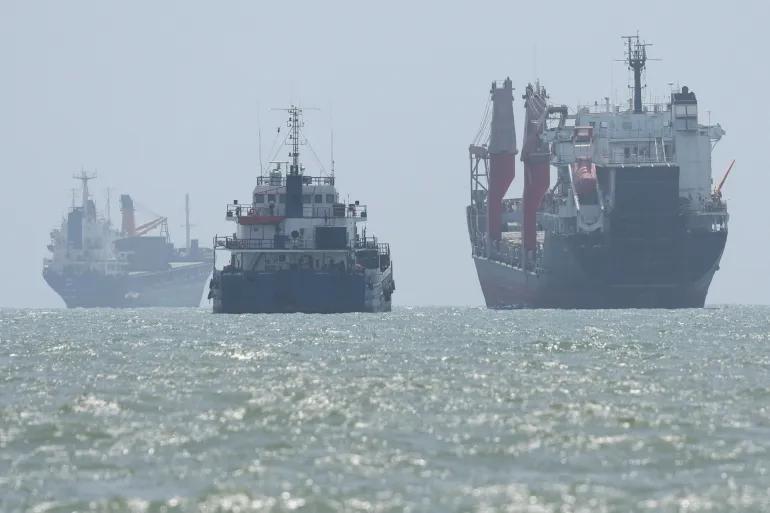
The IRGC says the two countries have agreed on shares of the waterway and shipping revenue, but their joint statement confirms only a temporary route, mine clearance and further negotiations
IRGC Announces Agreements With Oman
Iran and Oman have moved closer to establishing a new temporary route for commercial vessels through the Strait of Hormuz, but a final agreement on traffic management and possible revenue sharing has not yet been completed.
Islamic Revolutionary Guard Corps spokesperson Hossein Mohebbi said on August 26 that approximately one month of negotiations had produced results acceptable to both sides.
According to Mohebbi, agreements covered the division of parts of the strait and the distribution of revenue between Iran and Oman. His comments were circulated by Iranian state and semi-official media, including Tasnim.
The spokesperson also linked the effective reopening of the strait to the United States accepting Tehran’s conditions. He accused Washington of obstructing the Iran-Oman negotiations.
A senior Iranian source subsequently said that the overall agreement had not been finalized and that discussions on its details were continuing. The Iranian and Omani foreign ministries have not confirmed a separate revenue-sharing arrangement.
Joint Statement Does Not Mention Revenue
The principal official document remains the joint statement issued on August 25 following talks in Tehran between Omani Foreign Minister Badr Albusaidi and Iranian Foreign Minister Abbas Araghchi.
It outlines a phased framework for restoring safe navigation. The proposal includes a joint temporary navigational corridor and a project to clear mines from the strait.
Iran and Oman also agreed to continue technical discussions on:
- a permanent navigational corridor;
- the future administration of the Strait of Hormuz;
- information sharing;
- vessel traffic management;
- the provision of navigational and security services.
The joint statement does not mention transit tolls, mandatory payments or revenue sharing. It also provides no proposed fee levels or payment mechanism.
The claim that shipping revenue has already been divided therefore remains an IRGC position rather than a confirmed provision of a bilateral agreement.
Temporary Route Would Cross Both Countries’ Waters
Iranian Deputy Foreign Minister for Legal and International Affairs Kazem Gharibabadi said the proposed corridor would have an overall width of approximately seven nautical miles.
Ships entering the Persian Gulf from the Gulf of Oman would travel through Iranian territorial waters. Outbound traffic would initially pass through Omani waters before also crossing an Iranian section.
Gharibabadi compared the arrangement to a two-way highway. However, a complete chart showing the route’s coordinates, individual lane widths and entry points has not been published.
According to the Iranian description, the corridor would be available only to commercial vessels. Foreign warships would not be permitted to use it. This restriction is absent from the two foreign ministries’ joint statement and currently represents a unilateral Iranian condition.
Once a temporary route is agreed, Iran and Oman intend to negotiate a permanent traffic system within 30 to 60 days.
IMO Traffic Scheme Has Operated Since 1968
The proposed corridor would replace the existing Traffic Separation Scheme, or TSS.
Iran and Oman proposed the scheme, which the International Maritime Organization adopted in 1968. It establishes separate lanes for inbound and outbound shipping to reduce collision risks in the narrow strait.
The IMO continues to regard the TSS as the only internationally recognized route through the Strait of Hormuz. Before the conflict, the system had operated for decades under coordination between Iran and Oman.
Tehran argues that the existing arrangement gives Oman a disproportionately large role in managing maritime traffic and does not adequately address Iranian security concerns.
Creating an alternative corridor would require more than a bilateral political announcement. Official navigation charts, notices to mariners, agreed traffic-management procedures and coordination with the IMO, flag states and the shipping industry would all be needed.
Meaning of “Revenue” Remains Unclear
The IRGC has not explained how the proposed Strait of Hormuz revenue would be generated.
It could refer to payments for pilotage, vessel traffic management, navigational information, insurance, security or access to a specially protected route.
Another possibility is a general charge imposed simply for transit. This scenario would create the most significant legal and commercial dispute.
International maritime law protects transit passage through straits used for international navigation. The International Maritime Organization has stated that countries have no legal basis to impose tolls, fees or discriminatory conditions solely for crossing an international strait.
Charges for a specific service actually delivered to a vessel may have a different legal character. However, the parties would need to establish whether the service is voluntary, who provides it, how the tariff is calculated and whether a vessel can refuse it without losing its passage rights.
The Iran-Oman statement refers to navigational and security services but says nothing about their price or whether their use would be mandatory.
Reopening Remains Linked to the US Dispute
Iran has emphasized that its understanding with Oman does not automatically mean the strait will reopen.
Tehran wants the southern route along Oman’s coast, which is supported by the United States, to be closed. Iran considers the corridor a violation of the Islamabad Memorandum signed with Washington on June 17.
The memorandum provided for safe and toll-free commercial passage for 60 days, the removal of technical and military obstacles and Iran-Oman discussions on the future administration of the strait.
The arrangement quickly unraveled. Donald Trump declared it over on July 7, and the Iranian Foreign Ministry subsequently announced that the memorandum had been suspended.
Tehran’s conditions include ending the US blockade of Iranian ports, lifting oil sanctions, releasing frozen assets and halting further threats and military operations.
Washington and Tehran Disagree Over Mine Clearance
The Iran-Oman statement includes a joint mine-clearance project, but that provision conflicts with Washington’s account.
On August 25, Donald Trump said the US military had removed or destroyed all mines in the international waters of the Strait of Hormuz. He warned that vessels laying new mines would be destroyed and said US Space Force capabilities were monitoring the area.
Iran does not accept American operations as sufficient grounds for declaring the strait safe. Tehran continues to say that the waterway remains closed and under the control of its armed forces.
For shipowners, statements by the opposing sides do not replace an independent security assessment. A large-scale return of traffic would require verified hydrographic surveys, navigational warnings and guarantees acceptable to marine insurers.
US Expands Sanctions Pressure on Shipping
The Iran-Oman negotiations are taking place alongside a major expansion of US economic restrictions.
On August 24, the US Treasury launched Operation Economic Outcast. The campaign expands potential sanctions exposure across five Iranian economic sectors: digital assets, technology, gold, aviation and shipping.
OFAC also imposed restrictions on nearly 60 individuals, companies and vessels across multiple jurisdictions. The decisions increase secondary-sanctions risks for foreign entities providing services to Iran’s transport and shipping sectors.
The United States had already sanctioned Iranian bodies offering transit authorization, insurance and other services for vessels using the Strait of Hormuz.
Foreign involvement in a future joint management system would therefore require detailed screening of payment recipients, intermediary banks, insurers and the ultimate use of collected revenue.
Shipowners Still Lack Operational Information
Even if a temporary corridor is established, shipping companies need answers to several practical questions.
It remains unclear which authority would authorize transits, whether registration would be mandatory, who would manage vessel traffic and whether pilotage or military escort would be provided.
Tariffs, liability for delay or vessel damage, navigation-data requirements and applicable insurance conditions have not been defined.
The proposed exclusion of military vessels creates another obstacle. If the United States refuses to recognize that restriction, the new route could become subject to competing systems of control.
Oil transit through the strait stood at approximately 5 million barrels per day on August 24, compared with more than 20 million barrels per day before the conflict. Some traffic is therefore continuing, but the waterway remains far below its previous capacity.
The IRGC announcement indicates progress in political negotiations, but it does not yet create an operational shipping regime. Implementation will require a signed bilateral agreement, an official corridor chart, verified mine clearance and rules acceptable to the IMO, insurers and international carriers.
Read also: Iran Blacklists 45 Ships in Hormuz and Threatens Cargo Seizures