

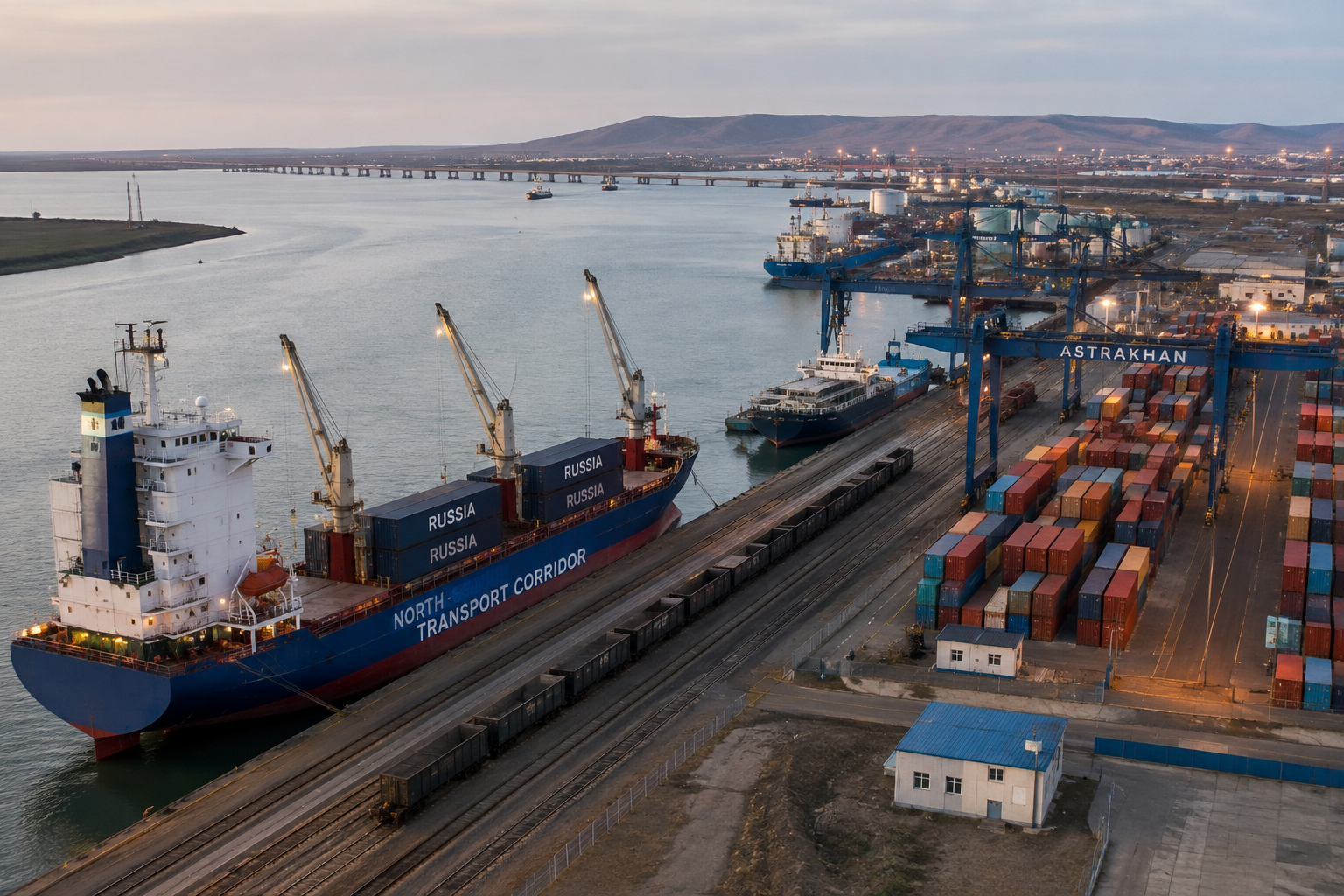
More Countries Could Join the Corridor
Russia is preparing cooperation documents on the International North–South Transport Corridor with Qatar, Saudi Arabia and several other states, according to the Russian Ministry of Transport.
The ministry has not disclosed the expected signing dates or the complete list of potential partners. It said the documents would be similar to memoranda previously concluded with Iran, Bahrain, Afghanistan and Oman.
Countries in the Persian Gulf and Southeast Asia have expressed interest in using the corridor and connecting their port capacity to the network. Broader participation could expand the corridor’s geographical reach and create additional freight options between Russia, the Middle East and South Asia.
Pakistan Prepares for a Trial Shipment
Pakistan could become one of the corridor’s new destinations. Russia and Pakistan are working on the parameters of a trial freight shipment using the North–South network.
The parties still need to determine the test route, cargo category, tariffs and delivery schedule. According to the Russian Transport Ministry, the two countries’ railway administrations have already established the necessary basis for the pilot movement.
The trial will need to assess more than the physical availability of railway lines. It will also test coordination among rail operators, ports, customs authorities and logistics companies in several countries. Harmonised documentation and efficient transfer of cargo between national transport systems will be essential.
Afghanistan Could Become Part of a New Route
Another route is being considered through Afghanistan in connection with the Trans-Afghan Railway project. The proposed line is intended to connect Uzbekistan, Afghanistan and Pakistan, providing Central Asian countries with additional access to Pakistani ports on the Arabian Sea.
For now, this remains a prospective route. The Trans-Afghan Railway has not yet been built and therefore cannot be presented as an operational section of the North–South Corridor.
Future integration of the two projects could establish an additional overland connection between Russia, Central Asia and South Asia. Its implementation would depend on infrastructure construction, financing, tariff coordination and transport security.
Corridor Has Three Main Branches
The International North–South Transport Corridor is a multimodal system extending for approximately 7,200 kilometres and connecting Russia with Iran and India. Its wider logistics network combines rail, road and maritime transport.
The corridor has three principal branches. The Trans-Caspian route uses ports and shipping services across the Caspian Sea. The western overland branch passes through Azerbaijan, while the eastern branch runs through Kazakhstan and Turkmenistan.
The participation of Persian Gulf states could strengthen the maritime dimension of the project. Ports in Qatar, Saudi Arabia, Oman and other regional countries could potentially serve as additional distribution points for cargo moving between Eurasia, the Arabian Peninsula, Africa and Asia.
Memoranda Do Not Automatically Create Freight Services
International memoranda demonstrate the parties’ interest but do not by themselves guarantee the launch of regular commercial services. Operational routes require coordinated tariffs, schedules, customs procedures and sufficient cargo volumes in both directions.
Their effectiveness will also depend on the capacity of ports, railways and border crossings. Trial shipments will therefore be a crucial step in identifying bottlenecks and calculating the actual cost and duration of delivery.
Read also: Trans-Afghan Railway Project Estimated at $7 Billion
