

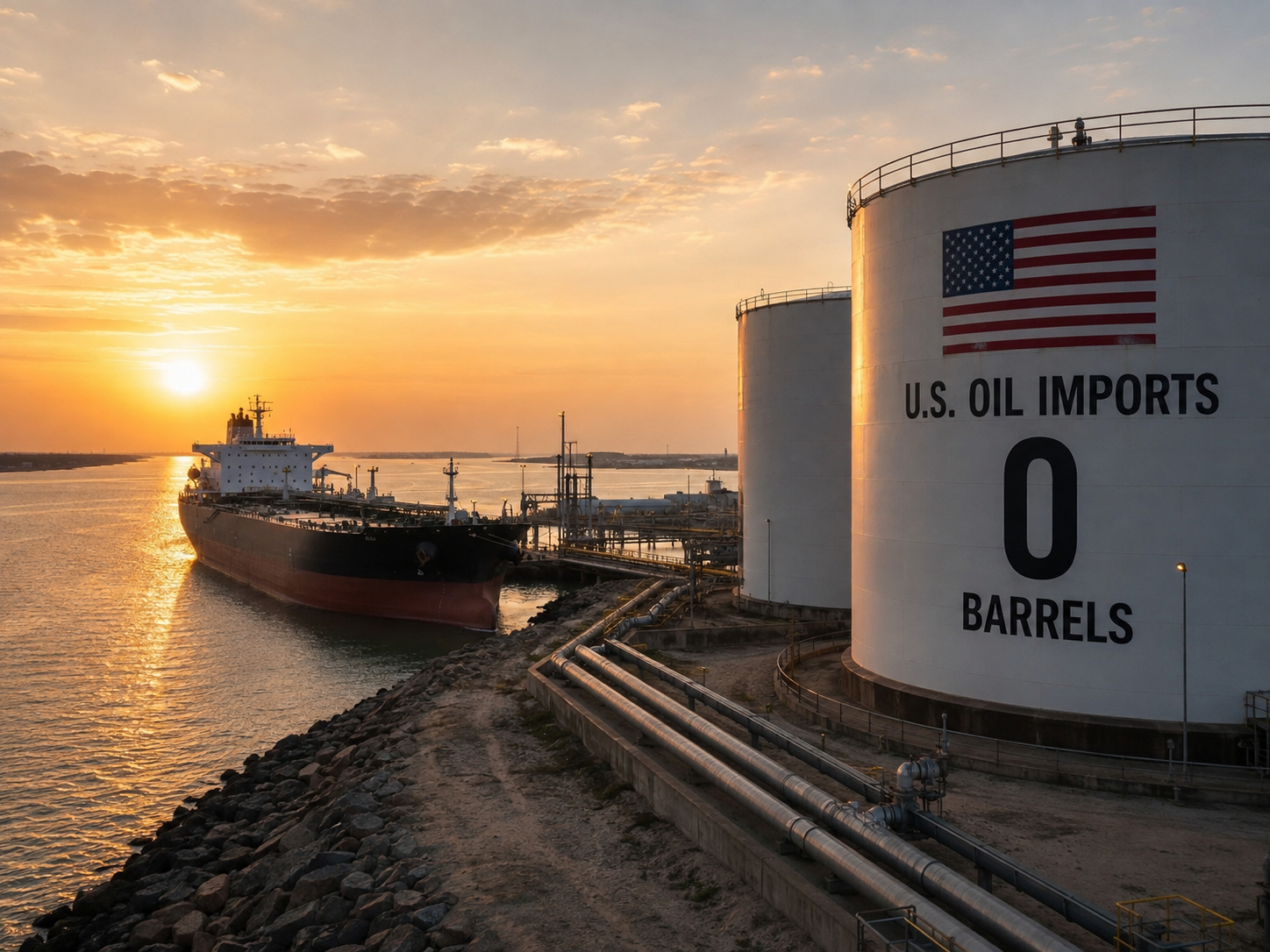
U.S. Saudi Crude Imports Fell to Zero
The United States imported no Saudi crude oil in July 2026, according to preliminary U.S. government data cited by Bloomberg. It was the first full month without Saudi crude imports since 1985. Only a few months earlier, U.S. refiners were purchasing more than 600,000 barrels per day from the kingdom.
This was more than a gradual decline in Saudi Arabia’s share of U.S. supply.
Reuters reported that no Middle Eastern crude reached the United States at all during July. By the end of the month, the U.S. had received no Saudi crude for five consecutive weeks and no Iraqi crude for six weeks.
The main reason was disruption surrounding the Strait of Hormuz. The Iran war sharply reduced traditional Persian Gulf flows, while shipping through the strategic waterway remains far below pre-war levels.
Crude and condensate exports from major Gulf producers averaged around 10.7 million barrels per day in July, roughly 40% below pre-war levels, with flows weakening again during the second half of the month.
July’s Zero Does Not Mean Saudi Oil Has Permanently Left the U.S.
The July figure primarily reflects a breakdown in traditional shipping routes rather than a permanent severing of U.S.-Saudi oil trade.
Middle Eastern crude imports into the United States could rebound to around 600,000 barrels per day in August, according to vessel-tracking data. Some Saudi barrels have been rerouted through alternative channels including the Red Sea and Suez Canal, while brief improvements in Hormuz traffic allowed additional cargoes to head toward U.S. ports.
July therefore demonstrates how quickly geopolitical disruption can redirect physical crude flows.
The United States has enormous domestic production capacity, but refinery configurations also matter. Some Gulf Coast refineries were designed to process medium and heavier imported grades, meaning domestic light crude cannot always replace Saudi or other imported grades on a simple barrel-for-barrel basis.
Venezuela Has Become a Major Replacement Supplier
Venezuela has emerged as one of the biggest beneficiaries of the shift.
Figures reported alongside the Bloomberg data indicate that U.S. imports of Venezuelan crude increased from roughly 100,000 barrels per day at the beginning of the year to about 600,000 barrels per day in July.
Reuters vessel-tracking data point to an even larger physical flow, with Venezuelan shipments to the United States reaching approximately 786,000 barrels per day in July, the highest level since early 2019.
The figures can differ because of methodology, timing and how cargoes are classified, but both show the same direction: Venezuelan crude has become much more important to U.S. refiners.
Heavy Venezuelan grades are also valuable for some Gulf Coast refineries historically configured for heavier crude. The adjustment is therefore more complex than simply replacing every lost Saudi barrel with one barrel of domestic light shale oil.
U.S. Crude Exports Also Fell to 3.66 Million Barrels per Day
The other side of the U.S. oil balance shifted at the same time.
U.S. crude exports declined to 3.66 million barrels per day in July, their lowest level in eight months, after reaching a record 5.7 million barrels per day in May.
That decline does not by itself mean the United States is running short of crude.
Reuters attributed the drop to several factors. A short-lived U.S.-Iran agreement in June temporarily increased Middle Eastern supply and reduced international demand for U.S. barrels. Meanwhile, U.S. refinery utilization reached approximately 96.3%, keeping more domestic crude inside the country for processing.
U.S. shipments to Europe fell from about 2.5 million barrels per day in May to 1.7 million in July. Exports to Japan dropped 67%, while volumes sent to South Korea fell 39%.
The U.S. therefore reduced both Persian Gulf imports and its own crude exports while diverting more domestic supply toward refineries.
Diesel, Not Just Crude Oil, Is the Bigger Problem
The most visible pressure is now appearing in refined fuels.
The Financial Times reported that average U.S. diesel prices had risen roughly 43% since the Iran war began, reaching $5.37 per gallon. Gasoline was up about 37% over the same period.
The average diesel price during Donald Trump’s second term since January 2025 has also reached about $4.09 per gallon, marginally above the approximately $4.08 average during Joe Biden’s presidency.
Those are different measures: $4.09 is the average over the broader period, while $5.37 reflects the much higher level reached during the current energy shock.
The distinction matters because refined fuel prices can remain extremely high even when crude futures temporarily decline.
Why Diesel Can Rise While Crude Falls
The crude and refined-product markets are facing different constraints.
U.S. distillate inventories, including diesel and heating oil, have fallen to around 107.2 million barrels, the lowest seasonal level in roughly 30 years.
At the same time, global refining capacity has been disrupted. Russian refineries have been hit repeatedly, while Russian seaborne petroleum-product exports fell by roughly one-third in July. Russian restrictions on fuel exports have added further pressure.
In the Middle East, the reopening of Saudi Arabia’s Jazan refinery has been delayed following attacks, while Hormuz continues to constrain Gulf energy flows.
On August 10, U.S. ultra-low-sulfur diesel futures jumped 7.4% in one session to $4.19 per gallon, while European diesel refining margins climbed nearly 10%.
The result is a seemingly contradictory market: crude can become cheaper while diesel becomes more expensive if refinery capacity and finished-product inventories remain tight.
U.S. Households Have Spent More Than $600 Extra
The energy shock is increasingly moving beyond oil markets.
Brown University researchers estimate that the average U.S. household has spent more than $600 extra on gasoline and diesel since the Iran war began, according to the Financial Times.
Fuel costs affect households through two channels.
The first is direct spending at filling stations. The second is indirect: diesel powers trucks, agricultural equipment and a large portion of industrial and distribution infrastructure.
Higher diesel prices therefore feed into agriculture, construction, freight transport and supply chains, eventually affecting the delivered cost of food, raw materials and manufactured goods.
Fuel Prices Are Becoming Politically Sensitive
The Financial Times also notes that rising fuel costs are becoming politically sensitive ahead of the U.S. midterm elections in November 2026.
Fuel prices alone cannot determine election outcomes, which are influenced by incomes, overall inflation, employment, interest rates and many other issues.
Economically, however, diesel has an unusually broad impact because almost every physical product transported by road carries some exposure to trucking costs.
Industries with thin margins are particularly vulnerable because higher transport costs cannot be absorbed indefinitely.
The Strategic Petroleum Reserve Was Only 42.7% Full
Another concern is the condition of the U.S. Strategic Petroleum Reserve.
As of July 31, 2026, the SPR held approximately 304.8 million barrels of crude oil. Against maximum nominal capacity of around 714 million barrels, that represented a fill level of just 42.7%. EIA data covering the week ending July 31 were released on August 5.
The U.S. Department of Energy lists nominal SPR storage capacity at 714 million barrels, with maximum drawdown capability of approximately 4.4 million barrels per day. Oil can begin reaching the U.S. market roughly 13 days after a presidential decision to release barrels.
The drawdown continued after July 31. By August 10, market reporting put the reserve at about 298.7 million barrels, below 300 million for the first time since the early 1980s.
The SPR Is Not a Diesel Reserve
Hundreds of millions of barrels in strategic storage do not mean Washington can simply open the caverns and immediately supply cheap diesel.
The SPR stores crude oil, not hundreds of millions of barrels of finished gasoline or diesel.
Oil released from the salt caverns still has to reach refineries, be processed and then move through the distribution system before it can become usable transportation fuel.
That limits the SPR’s ability to directly solve a diesel shortage caused by constrained refining capacity.
Washington can increase crude availability, but the reserve cannot by itself restore damaged refineries overseas, create new processing capacity or normalize tanker traffic through Hormuz.
Physical Markets and Futures Are Sending Different Signals
The U.S. import shift also illustrates one of the defining characteristics of the current energy crisis: physical oil availability and futures markets can temporarily tell different stories.
Reuters highlighted a striking divergence earlier in the conflict. During severe Hormuz disruption, physical Dated Brent climbed to around $120 per barrel and some North Sea cargoes traded even higher, while futures remained significantly lower because traders expected the conflict to ease relatively quickly.
A similar mechanism appeared during the summer.
Brief expectations that Hormuz could normalize increased Middle Eastern supply and reduced foreign demand for U.S. crude, contributing to the July decline in U.S. exports to 3.66 million barrels per day.
Yet actual Gulf exports remained about 40% below pre-war levels during July.
A softer futures price therefore does not prove that there is no physical shortage. Futures incorporate expectations about supply weeks or months ahead, while refiners and shippers must deal with barrels that can actually be delivered today.
Oil Prices Were Rising Again by August 11
As expectations for a rapid U.S.-Iran settlement weakened, crude prices moved higher again.
On August 11, Brent rose to around $89.12 per barrel, while U.S. WTI reached approximately $83.48. Oil exports through Hormuz averaged only about 3 million barrels per day in the week ending August 7, down from 4.4 million the previous week.
The figures underline the importance of logistics.
Oil may physically exist in Saudi Arabia, Iraq, Kuwait or elsewhere in the Gulf, but if tankers cannot safely transit the strait or must use longer and more expensive alternative routes, nominal production does not equal immediately available supply.
Diesel Is the Main Risk for U.S. Freight
For logistics companies, the most important number is increasingly not the WTI crude benchmark but the price of diesel at the pump.
U.S. road freight remains heavily dependent on diesel. If prices remain around $5 per gallon or above, carriers face rising fuel surcharges and shippers ultimately face higher transport costs.
Long-haul trucking, agriculture and construction are particularly exposed because fuel consumption is high and replacing conventional equipment quickly is rarely possible.
The very high utilization of U.S. refineries shows that the industry is already attempting to maximize output. But with distillate inventories near seasonal multi-decade lows, another refinery outage, Gulf Coast hurricane or further deterioration around Hormuz could trigger another sharp price move.
The U.S. Is Less Dependent on Saudi Oil — but Not on the Global Oil Market
Zero Saudi imports in July can look like evidence of American energy independence.
The United States does have enormous domestic production and considerable flexibility to change its crude supply mix.
But the current crisis shows the limits of that independence.
Even if U.S. refiners replace Saudi crude with domestic barrels and Venezuelan imports, diesel is priced in a global market. When Russian fuel disappears, Middle Eastern refineries are disrupted and Hormuz shipping is restricted, U.S. consumers still face higher prices.
At the same time, strategic crude reserves are far below maximum capacity, distillate inventories are at exceptionally low seasonal levels and existing U.S. refineries are already running at very high utilization.
The bigger story of July is therefore not simply that America went a full month without buying Saudi crude for the first time since 1985.
It is how rapidly the entire U.S. energy balance has been reshaped by the Hormuz crisis: Venezuela has increased its role, U.S. crude exports have fallen, domestic refineries are running harder, the SPR has continued to decline, and diesel prices have risen even when crude futures temporarily suggested that conditions were improving.
Read also: Analytical Report: The Blockade of the Strait of Hormuz During the U.S.-Israeli War Against Iran