

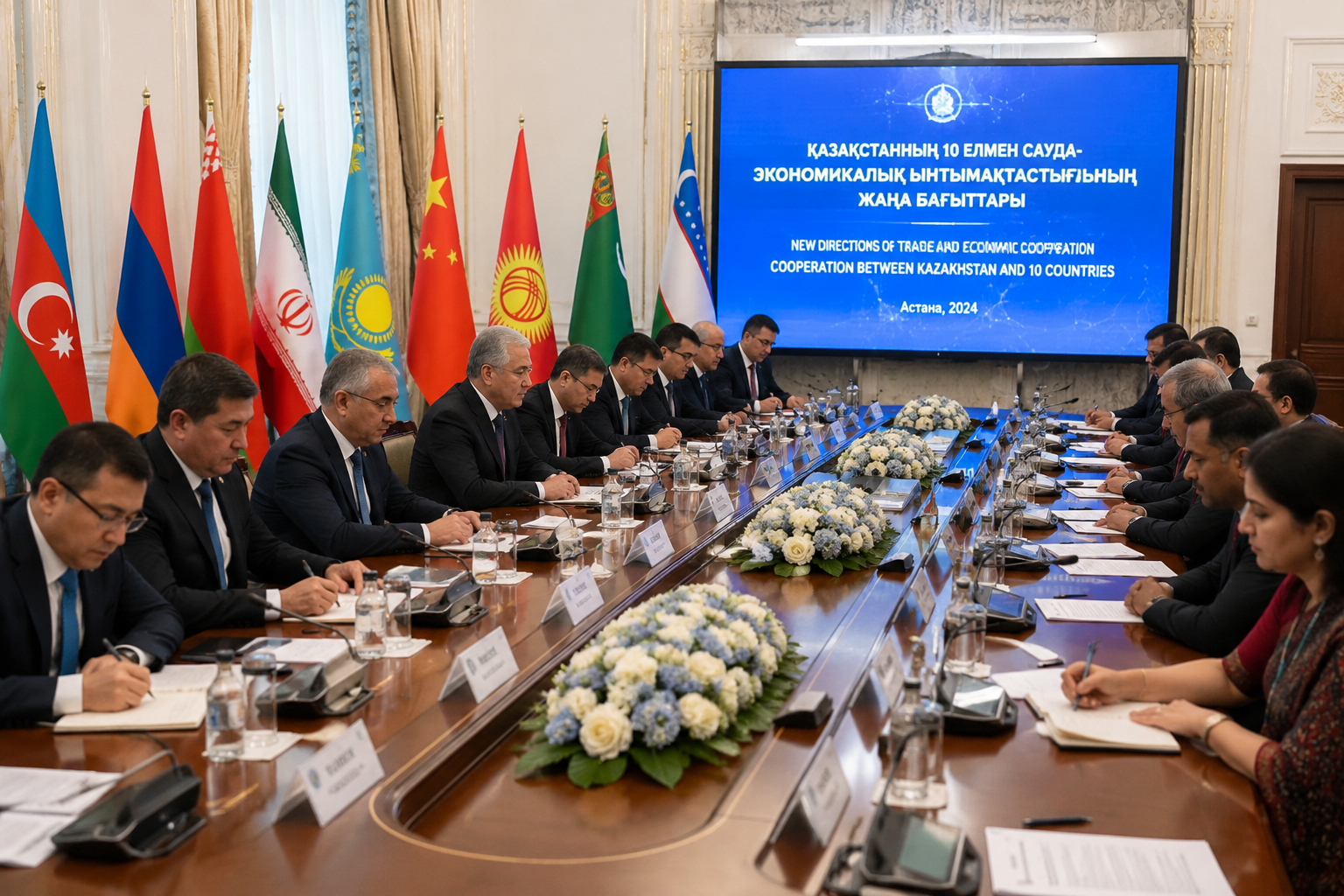
Government Reviews Cooperation With 10 Countries
Kazakhstan’s First Deputy Prime Minister Nurlibek Nalibayev chaired a meeting on August 7 covering trade, economic and investment cooperation with ten foreign partners.
The list included Türkiye, China, Azerbaijan, the Republic of Korea, Japan, Tajikistan, France, Germany, the United Kingdom and Turkmenistan. Heads of government agencies and national companies reported on current economic relations and the implementation of joint projects.
The government said stronger cooperation with these countries is considered an important factor in Kazakhstan’s industrial and technological development.
Country-by-Country New Priorities Have Not Yet Been Disclosed
The meeting identified priority areas and prospective directions for further external economic cooperation. However, the government did not publish a detailed list of new projects or sectors assigned to each of the ten countries.
It would therefore be premature to interpret the meeting as the announcement of specific new contracts.
Government agencies and organizations were instructed to accelerate the implementation of existing agreements and continue developing new initiatives.
The meeting was primarily a coordination exercise: authorities reviewed current projects and established priorities for the next stage of negotiations.
China Remains Kazakhstan’s Largest Economic Partner in the Group
China represents the largest bilateral trade relationship among the countries covered by the meeting.
Kazakhstan-China trade reached a record $48.7 billion in 2025. During the first five months of 2026, bilateral trade had already reached $22 billion, up 27% year on year. The two countries have a longer-term objective of bringing trade to $100 billion.
Investment cooperation is also expanding. Chinese direct investment in Kazakhstan has reached around $30 billion, while 77 joint projects worth $13.3 billion have already been implemented. More than 269 additional initiatives are included in the prospective project portfolio.
Areas discussed during 2026 include deeper agricultural processing, metallurgy, agrochemicals, drone production, the digital economy, artificial intelligence, energy and manufacturing localization.
Kazakhstan Handles 85% of China-Europe Land Freight
China also has exceptional importance for Kazakhstan’s transport sector.
According to the Kazakh government, approximately 85% of all overland freight traffic between China and Europe passes through Kazakhstan. The country is expanding rail and road border infrastructure and developing a third railway crossing on the Kazakhstan-China frontier.
With the Bakhty-Ayagoz crossing included, the three railway gateways are expected to reach combined capacity of 100 million tonnes annually.
The Kazakhstan-China logistics terminal in Lianyungang demonstrates how far cooperation has already developed. In July 2026, the facility dispatched its 8,000th international freight train, while 485 China-Europe and China-Asia train services were handled during the first half of the year alone.
Japan Brings Technology and Logistics Investment
Japan is another partner with which Kazakhstan wants to move beyond conventional merchandise trade toward deeper technology and investment cooperation.
During the Kazakh president’s visit to Japan in December 2025, the two sides signed 47 commercial documents worth more than $3.7 billion. Bilateral trade exceeded $1.7 billion in 2025, while 68 Japanese-backed enterprises were operating in Kazakhstan.
During talks with Japan’s Keidanren business federation in July, Kazakhstan highlighted transport and logistics, the Middle Corridor and Caspian port infrastructure, energy, digitalization, artificial intelligence and industrial cooperation.
The government is emphasizing technology transfer and local production alongside capital investment.
South Korea Focuses on Industry and Energy
Kazakhstan is pursuing a similar approach with South Korea.
Nalibayev met South Korean Trade, Industry and Energy Minister Kim Jung-kwan in June to discuss industrial cooperation and investment. Energy cooperation, including nuclear energy, was also addressed.
For Kazakhstan, relationships with Japan and South Korea are particularly valuable for attracting advanced technologies and developing production capacity inside the country.
This fits Astana’s wider effort to increase the share of higher-value manufactured products rather than relying primarily on commodity exports.
Azerbaijan Connects Kazakhstan With the Caucasus and Europe
Azerbaijan has a special role because of the Middle Corridor.
Kazakh cargo crosses the Caspian Sea from Aktau and Kuryk and then moves through Azerbaijan toward Georgia, Türkiye and European transport networks.
Kazakhstan-Azerbaijan trade totaled $533 million in 2024, while freight on the Trans-Caspian International Transport Route increased 62% to 4.5 million tonnes. The two countries’ railway operators have also integrated their Digital Trade Corridor platforms.
Cooperation is expanding beyond physical freight.
In August 2026, the key offshore stage of the Trans-Caspian fibre-optic cable between Aktau and Sumgait was completed. The system is intended to create an additional high-speed digital corridor between Asia and Europe.
Azerbaijan is therefore simultaneously a trade partner, transit country and digital infrastructure partner for Kazakhstan.
Turkmenistan Strengthens the Southern Route
Turkmenistan is also included in Kazakhstan’s renewed external economic agenda.
At a bilateral intergovernmental commission meeting in June, the countries discussed industrial cooperation, agriculture, oil and gas, and transport and logistics.
For Kazakhstan, Turkmenistan is particularly relevant to southbound connectivity toward Iran, the Persian Gulf and international maritime routes.
These links complement the east-west system running through China, Kazakhstan, the Caspian Sea and the South Caucasus, giving Kazakh exporters and transit operators a broader range of route options.
Türkiye and Major European Economies Are Part of the Same Agenda
The August meeting also covered Türkiye, France, Germany and the United Kingdom.
Their inclusion shows that Kazakhstan is simultaneously working across several groups of partners: neighboring and regional economies, Asian technology centers and major European investors.
However, the August 7 government statement did not specify individual new projects involving Türkiye, France, Germany or the United Kingdom.
The next meaningful indicator will therefore be the investment agreements, new factories, trade contracts and infrastructure projects that emerge from the follow-up work.
Kazakhstan Wants Trade to Support Industrialization
The wider significance of the strategy is that Kazakhstan increasingly wants foreign economic relations to deliver more than higher trade volumes.
The government is linking international cooperation with industrial development, technology transfer, localized manufacturing and transport infrastructure. Nalibayev explicitly described foreign trade and investment cooperation as an important factor in Kazakhstan’s industrial and technological development.
That model is already visible in cooperation with China, Japan and South Korea, where investment is increasingly connected with manufacturing and technology. Azerbaijan and Turkmenistan, meanwhile, strengthen the logistics dimension by expanding alternative routes for Kazakh exports and transit traffic.
For transport and logistics, the result could be growth across several freight categories at once: imported machinery, components for localized factories, exports of finished products and transit flows connecting China, Central Asia, the Caucasus and Europe.
The August meeting itself did not produce a publicly announced package of new contracts. It established an updated working agenda. The next step is for government agencies to turn those priorities into specific projects, trade growth and investment.
Read also: China-Kazakhstan Lianyungang Base Reaches 8,000 Trains