

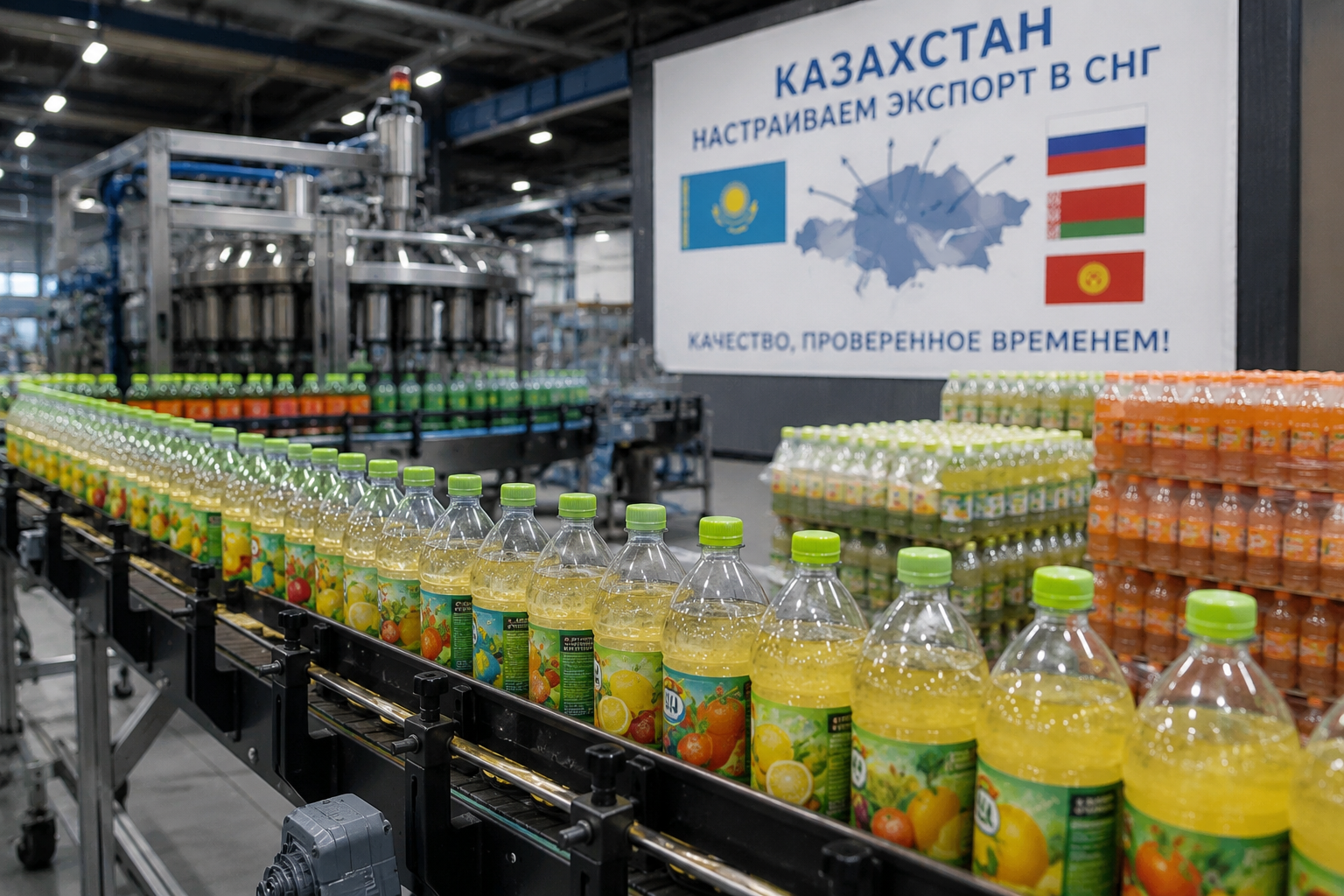
Soft Drink Exports Reach 172.8 Million Litres
Kazakhstan is expanding exports of processed food and beverage products to neighbouring markets, with soft drinks becoming one of the categories showing significant regional demand.
According to Kazakhstan’s Bureau of National Statistics, the main export category consisted of waters containing added sugar, other sweeteners or flavouring, together with other non-alcoholic beverages. Shipments reached 172.8 million litres worth $75.5 million in January-May 2026.
The trade remains heavily concentrated in nearby CIS and Central Asian markets. That geography offers an important logistics advantage for beverages, where large physical volumes make transport distance and reliable border operations particularly important to overall distribution costs.
Kyrgyzstan Buys 94.9 Million Litres Worth $39 Million
Kyrgyzstan remains by far the largest foreign market for Kazakhstan’s soft drinks.
Kazakh producers shipped 94.9 million litres worth $39 million to the country during the first five months of 2026. That represents more than half of the physical volume recorded for the main export category.
The figures highlight the depth of trade integration between the neighbouring economies.
A relatively short transport distance allows producers to organize frequent road shipments to wholesalers, distributors and retail networks without depending on complex maritime supply chains or multiple transshipments.
For the beverage industry, this proximity becomes increasingly valuable as sales volumes rise and distributors require regular replenishment rather than occasional large export consignments.
Uzbekistan Increases Imports to 48.3 Million Litres
Uzbekistan is Kazakhstan’s second-largest destination and continues to increase its purchases.
Soft drink exports rose from 39.2 million to 48.3 million litres, while the value of shipments reached $28.1 million.
Uzbekistan is becoming an increasingly important market for Kazakh consumer goods, supported by its large domestic market and geographic proximity.
Transport links are also being upgraded. K2Cargo.News previously reported that Kazakhstan and Uzbekistan are upgrading border checkpoints, including moves toward international status and round-the-clock operations at selected crossings.
Such changes can become increasingly important as trade in high-volume consumer goods expands.
Russia Increases Purchases More Than 2.5 Times
Russia recorded the fastest increase among Kazakhstan’s major soft-drink export destinations.
Shipments rose from 9.2 million litres to 23.5 million litres, representing an increase of more than 2.5 times.
The Bureau of National Statistics did not publish the monetary value of Russian shipments in its announcement, so estimating their value by applying an average export price would not be appropriate.
The physical increase alone nevertheless shows a rapid expansion of Kazakh beverages in the Russian market. Russia has now emerged as the third major destination after Kyrgyzstan and Uzbekistan.
Together, the three countries account for the overwhelming majority of the reported export volume, underlining how strongly the sector currently depends on regional markets.
Smaller Export Markets Are Growing Rapidly
Kazakh producers are also expanding in several smaller destinations.
Exports to Armenia increased almost tenfold, reaching 548,500 litres. Shipments to Azerbaijan rose more than twelvefold to 342,100 litres, while exports to Georgia also increased more than twelvefold to 393,500 litres.
Tajikistan increased its purchases from 2.5 million to 2.9 million litres.
Outside the CIS, exports to Mongolia rose from 802,100 to 930,200 litres, while shipments to South Korea increased from 117,700 to 171,500 litres.
These markets remain small compared with Kyrgyzstan, Uzbekistan and Russia, but the broader geographic reach suggests that Kazakh producers are gradually testing more distant export opportunities.
Domestic Production Rises 17%
The export expansion is being supported by higher domestic production.
Kazakhstan produced 1.6 billion litres of mineral water and non-alcoholic beverages in January-May 2026, an increase of 17% from the same period a year earlier.
At the end of 2025, 145 enterprises were involved in soft-drink production across Kazakhstan.
The expanding production base gives manufacturers room to increase foreign sales while continuing to serve a much larger domestic market.
Exports of 172.8 million litres remain considerably smaller than overall production, meaning domestic consumption is still the industry’s primary outlet.
Kazakhstan’s Domestic Market Is Growing Even Faster
Domestic beverage sales are also expanding strongly.
Sales on the Kazakh market reached 1.7 billion litres, up 21% year on year. At the same time, imports increased 29.6% to 217.1 million litres, with imported products accounting for 11.4% of the domestic market.
This means rising exports have not come at the expense of foreign brands entering Kazakhstan.
Instead, the domestic market is expanding for both local and international producers. For Kazakh manufacturers, stronger competition at home provides another incentive to develop regional export channels.
Kazakhstan Is Pushing More Processed Goods Abroad
The beverage trend forms part of Kazakhstan’s broader strategy to increase exports of higher-value processed products.
As K2Cargo.News previously reported, the country’s exports of higher-value goods increased from $4.2 billion to $11.1 billion over five years, while the government is developing mechanisms intended to help Kazakh producers enter retail networks including Carrefour, Lulu Hypermarket, Gross, Panda and Spinneys. No direct supply agreements with those chains had yet been announced when the initiative was presented.
For beverage producers, broader retail access could eventually complement the large regional volumes already being sold across the CIS.
Serving international retailers, however, would require consistent supply, certification, suitable packaging, warehouse availability and reliable replenishment across distribution networks.
Regional Logistics Is Becoming a Competitive Advantage
The structure of Kazakhstan’s beverage exports highlights one of the country’s strongest advantages: its largest customers are geographically close.
Kyrgyzstan and Uzbekistan share land borders with Kazakhstan, while Russia is connected through extensive road and rail networks. Producers can therefore develop regional distribution systems without depending on maritime transport.
Further expansion will increasingly depend on border throughput, customs efficiency, warehousing and reliable trucking capacity.
Russia is a particularly clear example. Increasing shipments from 9.2 million to 23.5 million litres within a year means logistics operators and distributors must now handle a substantially larger physical flow.
The next challenge for Kazakhstan will be to turn rapid increases in individual markets into stable long-term export capacity. If domestic production continues expanding and regional transport infrastructure improves, Kazakh beverage manufacturers could strengthen their position not only across Central Asia and the CIS but eventually in more distant consumer markets as well.
Read also: Kazakhstan Ice Cream Exports Rise 46%