

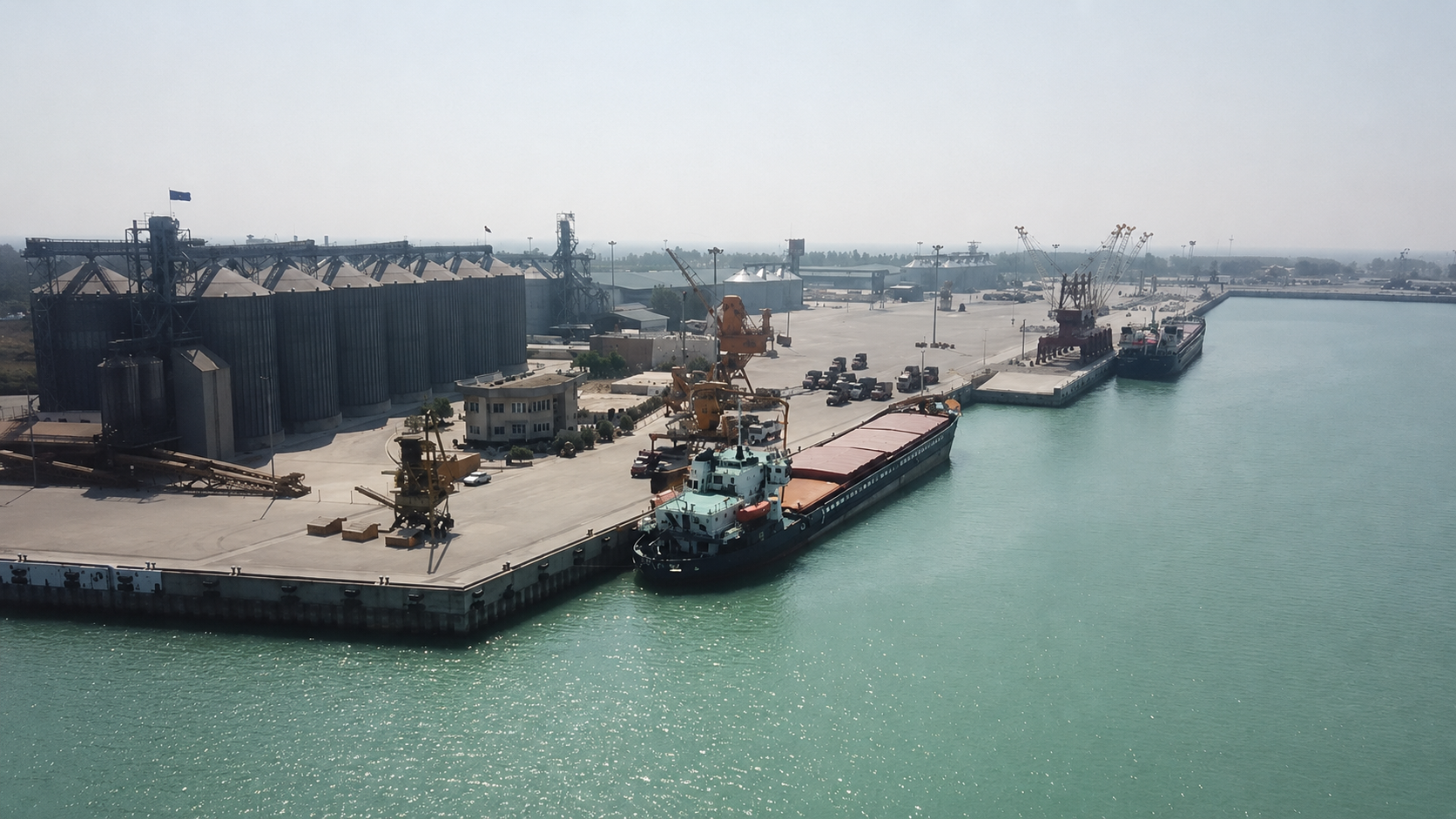
The Caspian Route Gains Strategic Importance
Russia and Iran are expanding shipments across the Caspian Sea, which is becoming an increasingly important part of an alternative trade network between northern Eurasia and the Indian Ocean. An analysis published by The Telegraph describes the route as an important mechanism allowing Tehran to maintain imports amid the US naval blockade and restricted traffic through the Strait of Hormuz.
Caspian logistics connect the Russian ports of Astrakhan, Olya and Makhachkala with Iran’s northern coast. Cargo can then move by rail or road to Iran’s domestic markets or continue towards the country’s southern regions.
The route forms part of the International North–South Transport Corridor, linking Russia, Azerbaijan, Iran and India through a combination of maritime, rail and road transportation.
Iranian Ports Switch to Round-the-Clock Operations
According to information cited by the British newspaper from Iranian sources, four Iranian ports on the Caspian Sea are operating around the clock. They are handling wheat, corn, animal feed, sunflower oil and other essential supplies.
Cargo volumes for each of the four ports have not been disclosed. Round-the-clock operations therefore indicate higher pressure on the facilities but do not by themselves establish the actual increase in throughput.
The resumption of grain shipments has been confirmed by other sources. In March, Reuters reported that Russian grain exports to Iran through the Caspian had resumed. At the time, five vessels were loading approximately 22,600 tonnes of grain in Astrakhan, while nine ships carrying another 28,000 tonnes were waiting to unload off Iran.
Russia’s Caspian grain ports had a combined annual capacity of at least 3 million tonnes. A new terminal with capacity of 1.5 million tonnes is also expected to open in Makhachkala in 2028.
The US Blockade Cannot Be Extended to the Caspian
The United States is maintaining a naval blockade of Iranian ports in the Persian Gulf and Gulf of Oman. US Defense Secretary Pete Hegseth said the Navy could sustain the operation indefinitely by rotating ships through the region, according to Reuters.
The Caspian Sea, however, has no natural connection to the world’s oceans. Access depends on inland waterways and territory controlled by the Caspian littoral states. This makes an American naval interception campaign comparable to the operation near the Strait of Hormuz practically impossible.
The Convention on the Legal Status of the Caspian Sea, signed by the five littoral states, also establishes the principle that armed forces belonging to non-Caspian countries should not be present in the basin. The agreement has not completed every procedure required to enter fully into force, meaning geography and the coastal states’ control over access remain the decisive factors.
Food Cargo Does Not Automatically Constitute Sanctions Evasion
Caspian transport reduces Russian and Iranian dependence on sea routes monitored or controlled by Western powers and makes external tracking of cargo more difficult. However, it would be inaccurate to describe every shipment as illegal sanctions evasion.
Wheat, animal feed and other food products are generally not prohibited goods and may fall under humanitarian exemptions. For such cargo, the route’s primary function is to avoid blockaded ports, military threats and disruption in the Strait of Hormuz.
At the same time, the Caspian’s enclosed geography and the practice of vessels switching off tracking transponders can enable less transparent trade. Western governments are consequently paying closer attention to dual-use goods and possible shipments of military components. No comprehensive, independently verified data are available on all cargo moving across the Caspian.
North–South Corridor Receives New Momentum
The current crisis is accelerating the development of routes that Russia, Iran and other participants have been planning for years. Moscow is already preparing new North–South Corridor agreements intended to extend the network towards the Persian Gulf and South Asia.
The Caspian route cannot fully replace conventional ocean shipping. Falling water levels restrict vessel loads, while much of the available fleet consists of river-sea vessels carrying approximately 3,000–6,000 tonnes. Port capacity, railway infrastructure and repeated transfers between transport modes create additional constraints.
Against the backdrop of the continuing US-Iran confrontation in the Strait of Hormuz, these disadvantages are becoming less decisive. For Tehran, reliable delivery of essential supplies currently matters more than achieving the lowest possible transport cost.
Read also: Russia Prepares North–South Corridor Agreements With Qatar and Saudi Arabia