

Türkiye Is Expanding Its Role as a Eurasian Transport Hub
The restructuring of freight flows following the Russia–Ukraine conflict, the development of the Middle Corridor and instability affecting maritime trade routes have increased Türkiye’s importance as a transit link between Europe, Central Asia and China.
However, rising traffic has exposed limitations in the country’s railway infrastructure. The existing Marmaray tunnel is primarily used by intensive passenger services, restricting the number of available freight paths across Istanbul.
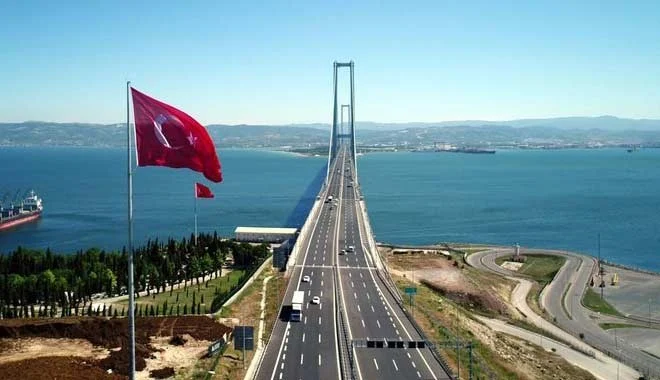
The Istanbul North Rail Crossing Project, known as INRAIL, is intended to address this bottleneck by creating a new railway bypass and crossing the Bosphorus via the Yavuz Sultan Selim Bridge.
INRAIL Will Deliver 127 Kilometres of Electrified Railway
According to the Asian Infrastructure Investment Bank, the corridor will connect Çayırova on Istanbul’s Asian side with Çatalca on the European side.
The project includes:
- 122.3 kilometres of double-track main line;
- approximately 4.7 kilometres of single-track connections;
- electrification and modern signalling;
- tunnels, bridges, viaducts and stations;
- connections between Istanbul Airport, Sabiha Gökçen Airport and Türkiye’s high-speed rail network.
The complete infrastructure package will cover approximately 127 kilometres. Freight trains will operate at speeds of 80–120 km/h, while passenger services will be able to reach 160 km/h.
The Yavuz Sultan Selim Bridge was constructed with space reserved for railway tracks. INRAIL will therefore use the rail-ready section of the existing bridge rather than requiring an entirely new Bosphorus crossing.
Freight Transit Time Could Fall to 3.6 Hours
INRAIL will provide a northern alternative to the Marmaray corridor and allow a greater separation of passenger and freight operations.
The railway could reduce freight transit time between Çayırova and Çatalca from approximately 13 hours to 3.6 hours. Its maximum freight capacity is estimated at 50 million tonnes per year.
The project is expected to strengthen connections with:
- the Trans-Caspian Middle Corridor;
- Türkiye–EU rail routes;
- the Baku–Tbilisi–Kars railway;
- Iraq’s proposed Development Road;
- Turkish ports and industrial centres.
“The project will remove a longstanding structural bottleneck for freight and passenger transport,” AIIB Chief Investment Officer Konstantin Limitovskiy said.
Six Banks Will Provide $6.75 Billion
INRAIL’s total cost is estimated at approximately $8.27 billion. The figure equivalent to roughly €7 billion therefore refers to the overall project cost rather than a single financing commitment.
According to the World Bank, six multilateral development banks are coordinating a $6.75 billion financing package.
The World Bank approved a $2 billion loan, AIIB committed up to $1.5 billion and the Asian Development Bank approved $750 million. The European Bank for Reconstruction and Development, Islamic Development Bank and OPEC Fund for International Development are also participating.
This makes INRAIL one of the largest railway investments undertaken in modern Türkiye.
Balkan Infrastructure Remains a Weak Link
The Istanbul bypass will increase capacity inside Türkiye, but it cannot remove every constraint affecting rail transport between Asia and Central Europe.
Freight trains travelling from Türkiye to the EU depend on connections through Bulgaria, Serbia and Romania. Several sections remain single-track, non-electrified or subject to substantial speed restrictions.
One of the most important projects is the modernisation of the Niš–Dimitrovgrad railway in Serbia. It is Serbia’s only direct railway connection with Bulgaria and forms part of the Western Balkans–Eastern Mediterranean European Corridor.
According to the European Investment Bank, the project covers approximately 96 kilometres of existing railway and a new Niš bypass of around 22 kilometres.
Freight Capacity Could Reach 6.2 Million Tonnes
The Serbian programme includes electrification, new signalling, reconstruction of the Sićevo–Dimitrovgrad section and construction of a northern bypass around Niš.
The Western Balkans Investment Framework puts total EU support for the project at €342 million. Once completed, maximum speeds should reach 120 km/h, while annual freight capacity is expected to increase from 3.2 million to approximately 6.2 million tonnes.
Construction may nevertheless require extended restrictions or closures on parts of the route, creating operational risks for services between Türkiye and the European Union.
UIRR Warns About Overlapping Closures
The International Union for Road-Rail Combined Transport has warned that work on the Niš–Dimitrovgrad corridor could overlap with the modernisation of the Ruse–Giurgiu route.
The latter crosses the Danube over the Friendship Bridge between Bulgaria and Romania. Opened in 1954, the approximately 2.2-kilometre bridge carries both road and railway traffic and now requires substantial modernisation.
In its public warning, UIRR said the simultaneous unavailability of the Serbian and Romanian routes could interrupt established intermodal services between Türkiye and the EU, force freight back onto roads and increase transport costs and transit times.
“Infrastructure investment and reliable rail freight connectivity must go hand in hand,” the association said.
UIRR called on the European Commission, national authorities and European corridor coordinators to sequence the projects so that at least one viable railway route remains open.
Closures Could Push Cargo Back Onto Roads
If both corridors become unavailable simultaneously, operators may have to use longer alternatives via Vidin–Golenti or Kardam–Negru Vodă. Their capacity and readiness to absorb additional freight trains remain limited.
Potential consequences include:
- longer transit times;
- higher traction, labour and rolling-stock costs;
- disruption to scheduled intermodal services;
- a shift from rail to road transport;
- additional pressure on border crossings;
- reduced competitiveness for the route through Türkiye.
INRAIL’s eventual effectiveness will therefore depend on more than completing the new Istanbul railway. Türkiye, the European Union and the Balkan states will also need to coordinate infrastructure upgrades throughout the corridor between the Bosphorus and Central Europe.
Read also: Can the Middle Corridor Become Eurasia’s Main Alternative?