

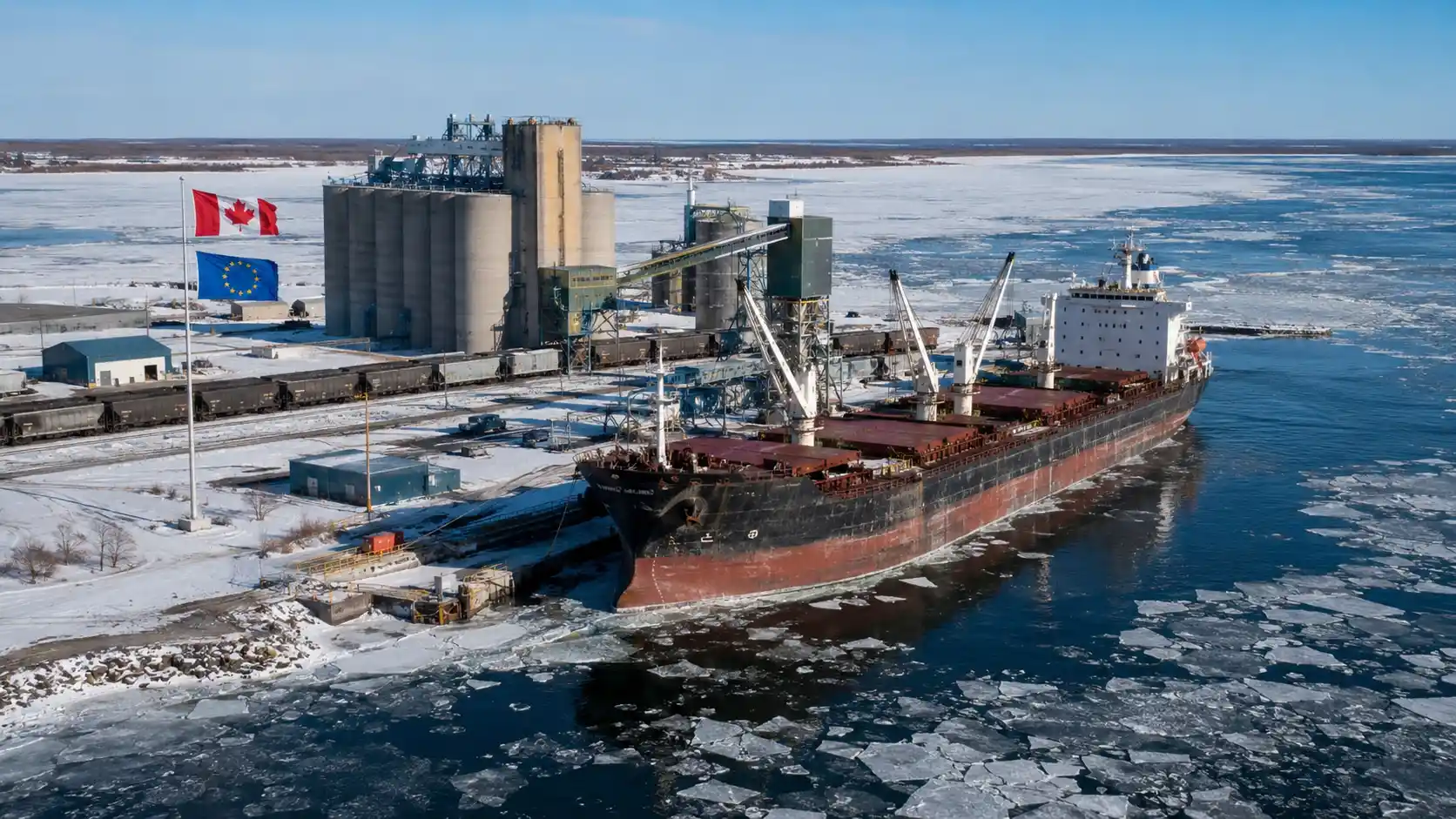
Three Studies Confirm Technical Feasibility
Canada has taken another step toward transforming the Port of Churchill into a year-round export gateway. Studies conducted by Fednav Limited, the University of Manitoba and the Arctic Research Foundation found that modern ice-class vessels are technically capable of operating through Hudson Bay and Hudson Strait throughout the year.
The findings were presented on August 21 by the governments of Canada and Manitoba alongside Arctic Gateway Group, which owns the Port of Churchill and the Hudson Bay Railway.
According to the Manitoba government’s official announcement, existing vessel technology and accumulated Arctic operating experience could support year-round voyages without waiting for an entirely new generation of ships.
“Year-round shipping out of the Port of Churchill is achievable today,” Manitoba Premier Wab Kinew said
The studies confirm technical feasibility rather than the immediate launch of permanent winter services.
What the Three Studies Found
Each study examined a different part of the proposed shipping corridor.
Fednav assessed ice conditions, vessel capabilities and operational requirements. Its analysis incorporated ten years of Canadian ice charts, satellite imagery and regulatory standards. The company concluded that existing ice-class vessel designs could operate through the corridor year-round without mandatory icebreaker assistance.
The University of Manitoba examined changes in sea-ice conditions. It found that Churchill’s navigable season has already expanded considerably over recent decades and is expected to continue lengthening throughout this century.
Preliminary findings from the Arctic Research Foundation also confirmed that extended-season and year-round operations are technically possible with modern ice-capable vessels. The organization additionally assessed potential icebreaking options and associated costs.
A detailed explanation of the findings has been published by Arctic Gateway Group.
Year-Round Operations Are Not Starting Yet
Despite the encouraging results, regular winter shipping will require significant additional work. Preparations would include:
- environmental studies;
- consultation with Indigenous Rights Holders and northern communities;
- assessment of impacts on hunting, harvesting and travel over sea ice;
- port and railway infrastructure upgrades;
- development of safe routes and operating schedules;
- regulatory approvals;
- trial voyages.
The completed studies did not fully assess the possible effects of increased shipping on polar bears, belugas, seals, fish and birds. Future operating plans will therefore have to account for wildlife movements, sensitive habitats and the traditional use of sea ice by local communities.
Arctic Gateway Group has stressed that no final winter routes or operating practices will be established before the necessary environmental studies and consultations are completed.
Churchill Could Provide Another Route to Global Markets
Churchill is Canada’s only Arctic seaport connected to the national economy by rail. The Hudson Bay Railway links the port with resource-producing and agricultural regions across Western and Northern Canada.
During the 2026 shipping season, Churchill handled grain, zinc, potash and northern resupply cargoes. Year-round access could expand the port’s cargo base and make the corridor more predictable for exporters.
Turning Churchill into a permanent multimodal gateway would require port upgrades and major improvements to the Hudson Bay Railway, including the ability to accommodate heavier trains and stronger connections with Canada’s Class I rail networks.
In March 2026, the Port of Churchill and Port of Antwerp-Bruges International signed an agreement to develop a stronger North Atlantic trade corridor. The partners are examining potential cargo flows between Western Canada and Europe, infrastructure requirements and possible investment opportunities.
Non-U.S. Markets Now Account for Nearly One-Third of Exports
Churchill’s development aligns with Ottawa’s strategy to reduce Canada’s heavy dependence on the U.S. market. The government aims to double non-U.S. exports by 2035, with greater emphasis on Europe, China, India and other Asian economies.
According to Global Affairs Canada, Canadian exports to non-U.S. destinations increased by 11.1%, or CAD 33.3 billion, in 2025. Their share of total exports reached 32.8%, the highest level in more than four decades. Exports to the United States declined by 3.7% over the same period.
Exports to the European Union grew by 16.4%, supported by shipments of crude oil, aluminum, canola seeds and other commodities. Churchill could provide producers in the western provinces with an additional route to European markets that does not depend on U.S. transport infrastructure.
Major Investment Will Still Be Required
Technical feasibility does not automatically guarantee commercial viability. Authorities and port operators still need to determine the availability of consistent cargo volumes, the cost of ice-class vessels, possible icebreaking requirements and railway tariffs.
The reliability of the Hudson Bay Railway will also be critical. The line crosses difficult northern terrain, and any major disruption could restrict land access to the port.
The federal government has established a CAD 5 billion Trade Diversification Corridors Fund to support ports, railways, airports, highways and other infrastructure that can expand trade with non-U.S. markets. A dedicated financing package for year-round Churchill operations, however, has not yet been approved.
The three studies move year-round navigation from a long-term concept to a technically achievable project. The next challenge is proving that Churchill can attract enough cargo and investment to become a competitive northern gateway for Canadian exports.
Read also: Port of Montreal Builds 1.15 Million TEU Contrecœur Terminal