

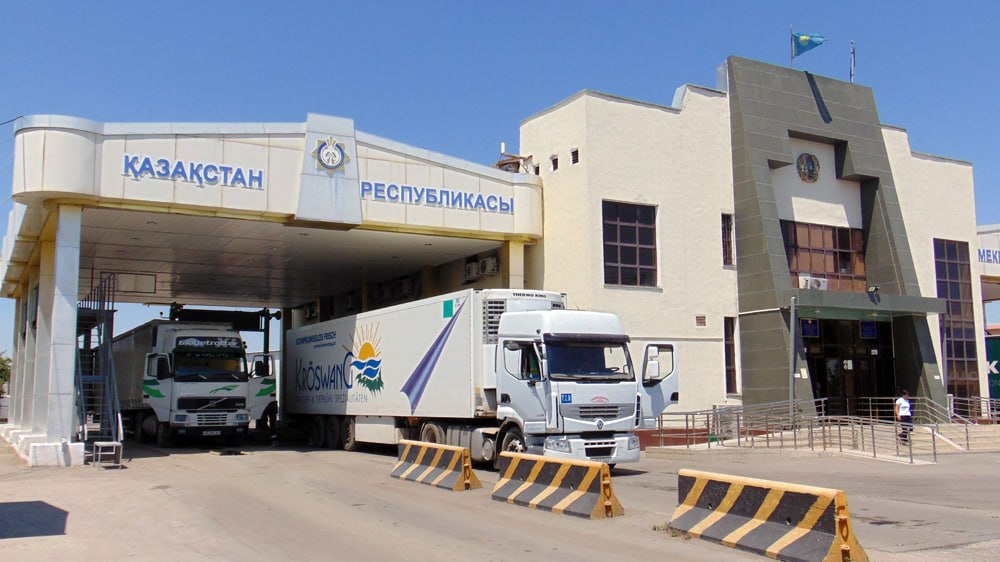
Kazakhstan and Uzbekistan are taking another step toward improving cross-border transport links. The Senate of Kazakhstan has ratified a protocol amending the 2006 intergovernmental agreement on border checkpoints between the two countries.
Under the updated rules, the road checkpoints “Syrdarya — Malik” and “Tselinny — Ok Oltin” will be upgraded from bilateral crossings to international checkpoints. They will also move from daylight-only operation to a 24-hour working schedule.
The change means that the checkpoints will no longer serve only citizens and vehicles of Kazakhstan and Uzbekistan. They will also be open to vehicles and travelers from third countries, making them more relevant for regional trade, tourism and transit.
For the logistics market, this is more than an administrative decision. It reflects a broader trend across Central Asia: countries are modernizing border infrastructure to reduce bottlenecks, support trade growth and connect national transport systems into wider Eurasian routes.
As K2Cargo News previously reported why Kazakhstan and Georgia Are Becoming Key Hubs of Eurasia’s New Logistics Network, border efficiency is becoming just as important as railways, ports and highways in the competition for new freight flows.
Two Checkpoints Gain International Status
The main change concerns the legal and operational status of the two crossings.
Previously, the checkpoints operated as bilateral border crossings, meaning their use was primarily limited to Kazakhstan and Uzbekistan. After ratification, they will receive international status, allowing broader movement of vehicles and passengers from other countries.
This is particularly important for Central Asia, where regional transport routes increasingly depend on smooth border crossings. Even when highways or railways are modernized, delays at checkpoints can reduce the competitiveness of an entire corridor.
The move to round-the-clock operation is also significant. Daylight-only schedules create natural limits on throughput and can lead to queues during peak periods. A 24-hour regime gives border services more flexibility and allows carriers to plan routes with fewer timing restrictions.
For road transport companies, predictable border availability can reduce idle time, improve vehicle utilization and make cross-border delivery schedules more reliable.
Tselinny — Ok Oltin Will Handle Heavy Cargo
The “Tselinny — Ok Oltin” checkpoint will receive the broader transport function.
Under the updated rules, it will be able to process passenger vehicles, empty freight trucks, oversized and heavy vehicles, as well as commercial cargo and goods.
This makes the crossing especially important for freight operators. Heavy and oversized cargo often requires specific routes, infrastructure and customs procedures. Allowing such traffic through Tselinny — Ok Oltin can help redistribute freight flows and reduce pressure on other busy checkpoints along the Kazakhstan-Uzbekistan border.
For industrial companies, agricultural exporters and construction-related cargo operators, this may create more routing options. The ability to move large or heavy shipments through an additional international crossing can support more flexible logistics planning.
The change also matters for regional infrastructure projects. Central Asia is currently investing in roads, railways, industrial zones and logistics hubs. As these projects expand, demand for cross-border movement of machinery, equipment and construction materials is likely to grow.
Syrdarya — Malik Will Serve Cars and Empty Trucks
The “Syrdarya — Malik” checkpoint will have a more limited function.
It will be open for passenger cars and empty freight vehicles. However, commercial cargo will not be processed there.
This division of functions appears designed to separate different types of traffic. By directing loaded cargo and heavy freight to one crossing while allowing passenger vehicles and empty trucks through another, authorities can reduce congestion and improve the organization of border flows.
For logistics companies, this creates clearer planning rules. Loaded trucks, oversized vehicles and commercial goods will need to use the crossing that supports cargo operations, while empty vehicles can use Syrdarya — Malik where appropriate.
Such specialization can help border services manage inspections more efficiently. Passenger traffic, empty truck movements and commercial cargo require different control procedures. Separating them may reduce delays and improve the overall flow of vehicles.
Border Modernization Supports Regional Trade
The Kazakhstan-Uzbekistan border is one of the busiest transport interfaces in Central Asia.
Both countries are important regional markets, and both are investing heavily in transport connectivity. Uzbekistan is seeking better access to international routes, while Kazakhstan is strengthening its role as a transit hub between China, Central Asia, Russia, the Caspian region and Europe.
Improving border crossings is therefore essential. Without efficient checkpoints, even major infrastructure investments can fail to deliver their full economic impact.
The Senate committee noted that the protocol, together with ongoing modernization of border infrastructure, should help distribute passenger and transport flows more evenly across the Kazakhstan-Uzbekistan border.
That objective is important because congestion at a small number of major crossings can create delays for carriers, exporters and passengers. Additional international checkpoints can make the system more resilient and reduce dependence on individual border posts.
Central Asia Is Opening More International Crossings
The Kazakhstan-Uzbekistan decision fits into a broader regional pattern.
In recent years, Central Asian governments have increasingly focused on upgrading checkpoints, expanding customs capacity and giving more crossings international status. The goal is not only to simplify bilateral movement but also to support transit involving third countries.
This trend is visible beyond the Kazakhstan-Uzbekistan border. In April, checkpoints on the Kyrgyz-Kazakh border also received international status, reflecting the same logic: regional transport systems need more flexible and accessible crossing points.
For Central Asia, this is a practical necessity. The region is landlocked, and its competitiveness depends on the ability to move goods across several borders with minimal delays.
What This Means for Logistics Companies
For carriers and freight forwarders, the ratification may not immediately transform the market. However, it creates the legal basis for a more flexible border system.
The most immediate benefit is likely to be improved route planning. Operators will have more options for empty truck repositioning, passenger-related movement and certain categories of heavy or oversized freight.
The 24-hour working regime is also important. Border crossings that operate around the clock can help carriers avoid daytime congestion and plan movements outside peak periods. Over time, this may reduce waiting times and support more predictable delivery schedules.
The broader effect will depend on how quickly infrastructure, staffing, customs systems and digital processes are aligned with the new status of the checkpoints. International status alone does not guarantee higher throughput. It must be supported by modern inspection lanes, electronic documentation, coordination between border agencies and clear procedures for different cargo categories.
A Small Change With Wider Strategic Meaning
The upgrade of the Syrdarya — Malik and Tselinny — Ok Oltin checkpoints may look like a technical border decision, but its strategic importance is broader.
Kazakhstan and Uzbekistan are two of Central Asia’s largest economies, and their transport cooperation affects the wider region. Every improvement at the border can support trade, tourism, industrial cooperation and transit connectivity.
For Kazakhstan, better checkpoint performance strengthens its position as a regional logistics hub. For Uzbekistan, expanded border access improves connectivity with northern routes and neighboring markets. For international carriers, it adds another layer of flexibility in a region where border efficiency often determines route competitiveness.
The next stage will depend on implementation. If 24-hour operations and international status are supported by real infrastructure capacity, the decision could help reduce congestion and make cross-border road transport more predictable.
In a region where trade routes are changing quickly, even targeted border upgrades can have a significant impact on logistics performance.
Read also: Why Kazakhstan and Georgia Are Becoming Key Hubs of Eurasia’s New Logistics Network
