

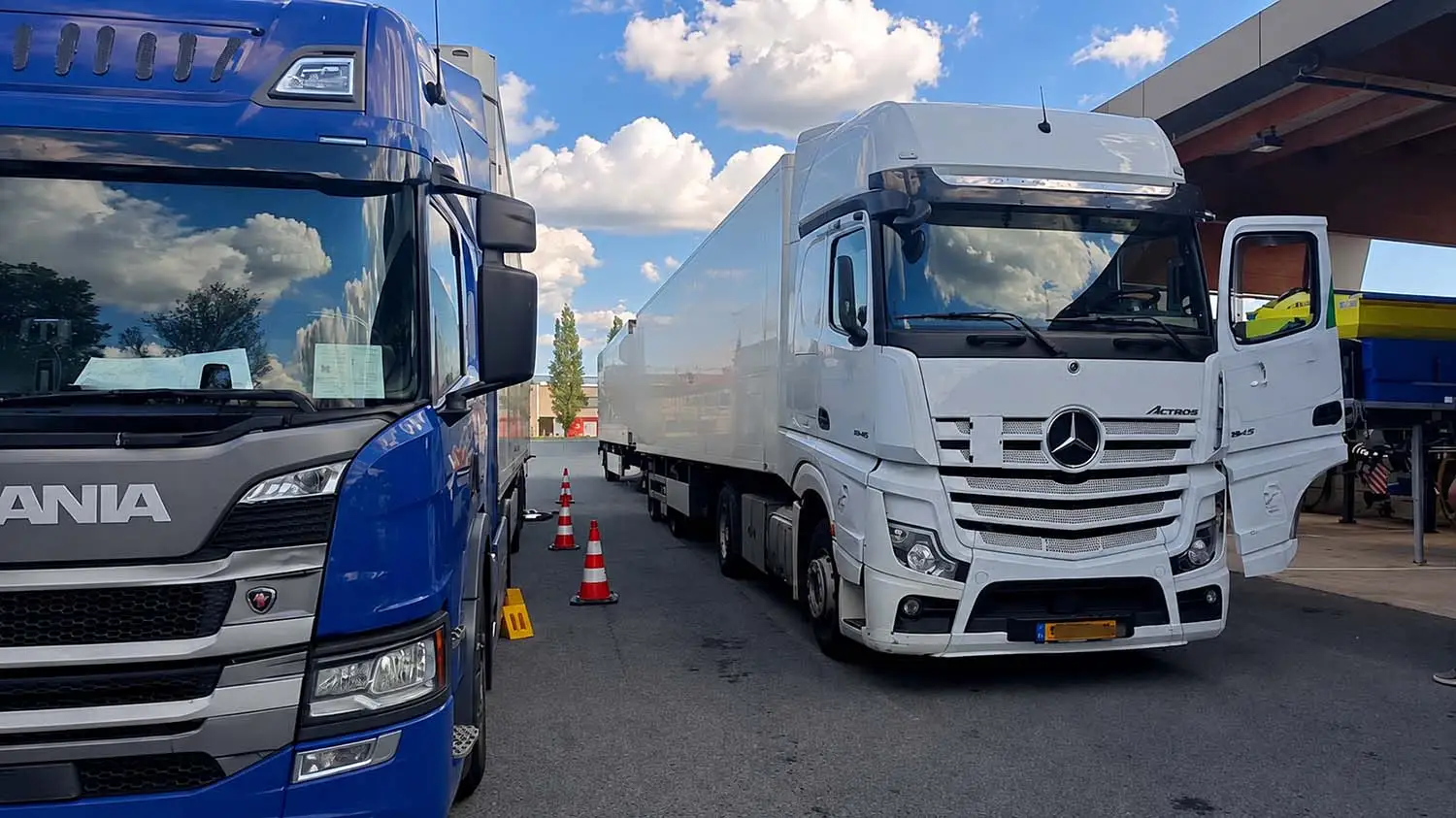
A shortage of LZV-certified personnel led to repeated working-time violations, the interruption of a delivery on the A13 motorway and the forced separation of the vehicle combination
The Hague traffic police stopped a Mercedes-Benz Actros operating as a long and heavy vehicle, or LZV, near Delfgauw on the A13 motorway. The combination used two trailers, with the first featuring a shortened body and an additional fifth-wheel coupling.
Officers examined the driver’s tachograph records and identified multiple infringements of driving and rest-time rules. According to Transport Online, the driver had worked for 18 consecutive days without taking a complete weekly rest period.
He had driven on each of the nine days immediately preceding the inspection. Police also found that he had not taken a standard 11-hour daily rest period at any point during the 18 days under examination.
European rules allow a driver to reduce the standard daily rest period from 11 to nine hours, but such reductions are limited. They cannot be used continuously as a company’s normal scheduling model.
A regular weekly rest period must last at least 45 hours. A new weekly rest must begin no later than the end of six consecutive 24-hour periods following the previous qualifying weekly rest.
The infringements identified near Delfgauw were therefore systematic. The driver had missed his weekly rest and relied exclusively on reduced daily rest periods for almost three weeks.
This pattern increases the risk of fatigue, reduced concentration and slower reactions. Those risks are particularly serious when operating an LZV that may measure up to 25.25 metres and weigh as much as 60 tonnes.
The driver told police that his employer had unexpectedly run short of personnel qualified to operate long and heavy combinations. He claimed that he was the company’s only driver holding the necessary certificate, leaving his schedule filled with consecutive assignments.
A staffing shortage does not exempt either the operator or driver from working-time requirements. The availability of qualified personnel remains the carrier’s operational responsibility and does not permit driving cycles to be extended beyond legal limits.
A standard CE licence is not sufficient to operate an LZV in the Netherlands. According to the Dutch government, drivers must complete additional training and pass a separate test.
Candidates generally need a valid CE licence with Code 95 and sufficient experience with heavy vehicle combinations. These requirements limit the number of employees who can immediately replace an LZV driver during a journey.
Police ordered the driver to begin a 45-hour rest period immediately and prohibited him from continuing the journey.
The company was unable to provide another employee who held both the appropriate truck licence and the required LZV certificate. It therefore had to send an additional tractor unit and two drivers to the inspection site.
The long combination was separated into two conventional units, allowing each trailer to continue behind a different tractor. The original driver was sent home to take the mandatory rest.
Although this solution allowed the cargo to move, it required extra equipment, personnel and time. The carrier may consequently face additional operating costs, delivery delays and disruption to later assignments.
The incident demonstrates that expanding the use of longer vehicle combinations depends on more than vehicle approval and access to authorised roads. Operators also need a sufficient reserve of properly trained drivers.
When only one employee holds the relevant certificate, illness, leave or mandatory rest can suspend the entire operation. Attempting to cover the shortage with additional shifts exposes the company to fines, roadside immobilisation and more serious consequences if fatigue contributes to a collision.
As K2Cargo.News previously reported, Slovakia has also strengthened penalties for serious transport offences and revised its truck rules. Across the EU, roadside enforcement increasingly covers not only vehicle condition but also tachograph records, shift duration and mandatory rest periods.
Police initiated administrative proceedings against the transport company over repeated working-time infringements and shortened rest periods. The published statement did not specify the potential fine.
The final penalty may depend on the number and classification of the recorded violations. Investigators may also examine who prepared the schedule and whether the carrier could have assigned another qualified employee before the journey began.
For LZV operators, the case provides a practical warning: limiting specialist training to one driver can result in an interrupted delivery, forced separation of the combination and costs substantially higher than the expense of qualifying additional personnel.
