

Inspections across the United States and Canada exposed widespread violations involving commercial licences, medical documentation and drivers’ hours
More than 53,000 driver inspections conducted
International Roadcheck 2026 identified 3,969 driver violations requiring out-of-service orders in the United States and Canada. The results included 620 cases in which a commercial vehicle was being operated without a commercial driver’s licence.
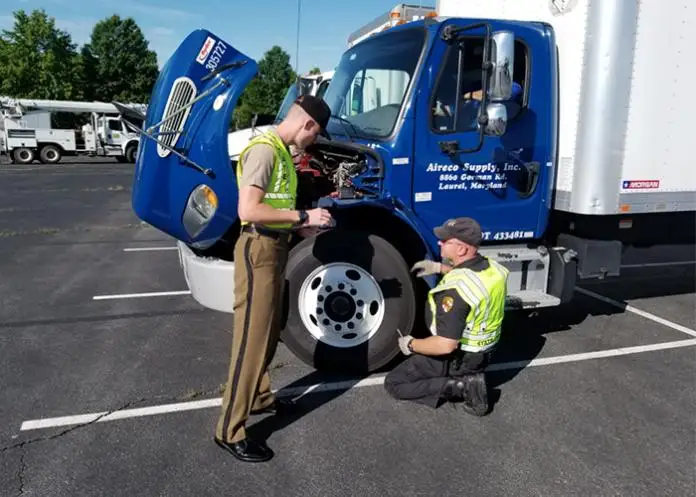
According to the official Commercial Vehicle Safety Alliance results, the three-day campaign took place in May. A total of 53,271 Level I, II and III inspections included examinations of commercial drivers. Inspectors placed 3,184 drivers, or 6% of those checked, out of service.
The number of drivers is lower than the number of violations because one person may receive more than one out-of-service order. The reported 3,969 violations therefore do not represent an equal number of individual truck drivers.
US inspectors recorded 3,806 driver out-of-service violations, while Canada reported 163. Mexico also participated in International Roadcheck, but its out-of-service findings concerned vehicles rather than drivers.
Missing medical cards became the leading violation
The most common driver violation was the absence of a valid medical card. Inspectors recorded 1,072 cases, representing 27% of all driver out-of-service violations.
A medical certificate confirms that a driver meets the physical requirements for operating a heavy commercial vehicle. US drivers covered by federal commercial vehicle regulations must generally be examined by a qualified medical professional before performing regulated transport work.
Hours-of-service violations ranked second, with 929 cases representing 23.4% of the total. Inspectors also issued 266 out-of-service orders for false records of duty status.
Electronic logging device manipulation was the special driver focus of the 2026 campaign. Inspectors issued 146 out-of-service orders for ELD tampering, falsification or manipulation intended to conceal working-time violations.
Inspectors found 620 no-CDL violations
Operating without a commercial driver’s licence was the third-largest violation category. The 620 cases accounted for 15.6% of all driver out-of-service violations reported in the United States and Canada.
Of that total, 614 no-CDL violations were recorded in the United States. Canadian authorities use separate classifications for incorrect licence classes and licence restrictions.
The findings show that driver-qualification problems extend beyond questions involving immigration status or the type of licence issued. However, International Roadcheck data do not identify the citizenship, origin or immigration status of the drivers found without a CDL. The figures also do not establish that every case involved an illegal carrier or cargo-related crime.
For freight operators, an unqualified driver creates operational as well as safety risks. A roadside prohibition can immobilise a truck, delay delivery and require the carrier to dispatch a replacement driver. Insurance coverage may also be disputed if a shipment was transported by someone without the necessary licence.
English proficiency ranks fourth
US inspectors placed 361 drivers out of service for failing to demonstrate the required level of English proficiency. The cases represented 9.1% of the North American violation total and 9.5% of US driver out-of-service violations. The English-language category does not apply to Canadian results.
Federal regulations require commercial drivers in the United States to understand road signs, communicate with officials, answer questions and complete required reports in English.
The rule itself is not new, but stronger enforcement moved English proficiency into the five leading driver violation categories in 2026. Missing medical cards, hours-of-service violations and the absence of a CDL nevertheless accounted for a much larger combined share of the findings.
Federal agencies expand joint enforcement
International Roadcheck is an annual CVSA initiative and is separate from the federal Operation Highway Shield. However, the results of both programmes demonstrate increased scrutiny of driver qualifications and commercial carrier operations.
During the second wave of Operation Highway Shield, conducted between July 28 and 30 in Illinois, Indiana, Iowa and Ohio, authorities placed 766 drivers and vehicles out of service.
Officials detained 51 people identified as being in the country illegally and issued 36 violations for failing English-language proficiency requirements. The agencies also reported the recovery of nearly $1 million in stolen cargo.
These results should not automatically be applied to the broader trucking market or used to explain every violation found during International Roadcheck. They nevertheless indicate that the Department of Transportation and Department of Homeland Security are expanding cooperation on commercial licences, medical documentation, carrier records and freight crime.
Compliance becomes a supply-chain issue
The Roadcheck results increase the risks facing carriers that fail to verify driver documentation. Having an available driver and a mechanically sound truck is no longer sufficient to guarantee that a shipment can continue: an invalid CDL, missing medical card or qualification problem may immediately stop the vehicle.
Shippers and freight brokers may also need to strengthen carrier due diligence, particularly when loads are transferred through several intermediaries. Operating authority, insurance and driver qualifications should be confirmed before cargo is released.
Stronger enforcement could temporarily reduce driver availability on some freight corridors. At the same time, it may improve conditions for compliant carriers that invest in training, medical examinations and working-time compliance but currently compete with operators that avoid those costs.
As K2Cargo.News previously reported, the first fatal Tesla Semi crash raised broader questions about heavy-truck safety and oversight in the United States.
Read also: First Fatal Tesla Semi Crash Raises Safety Questions