

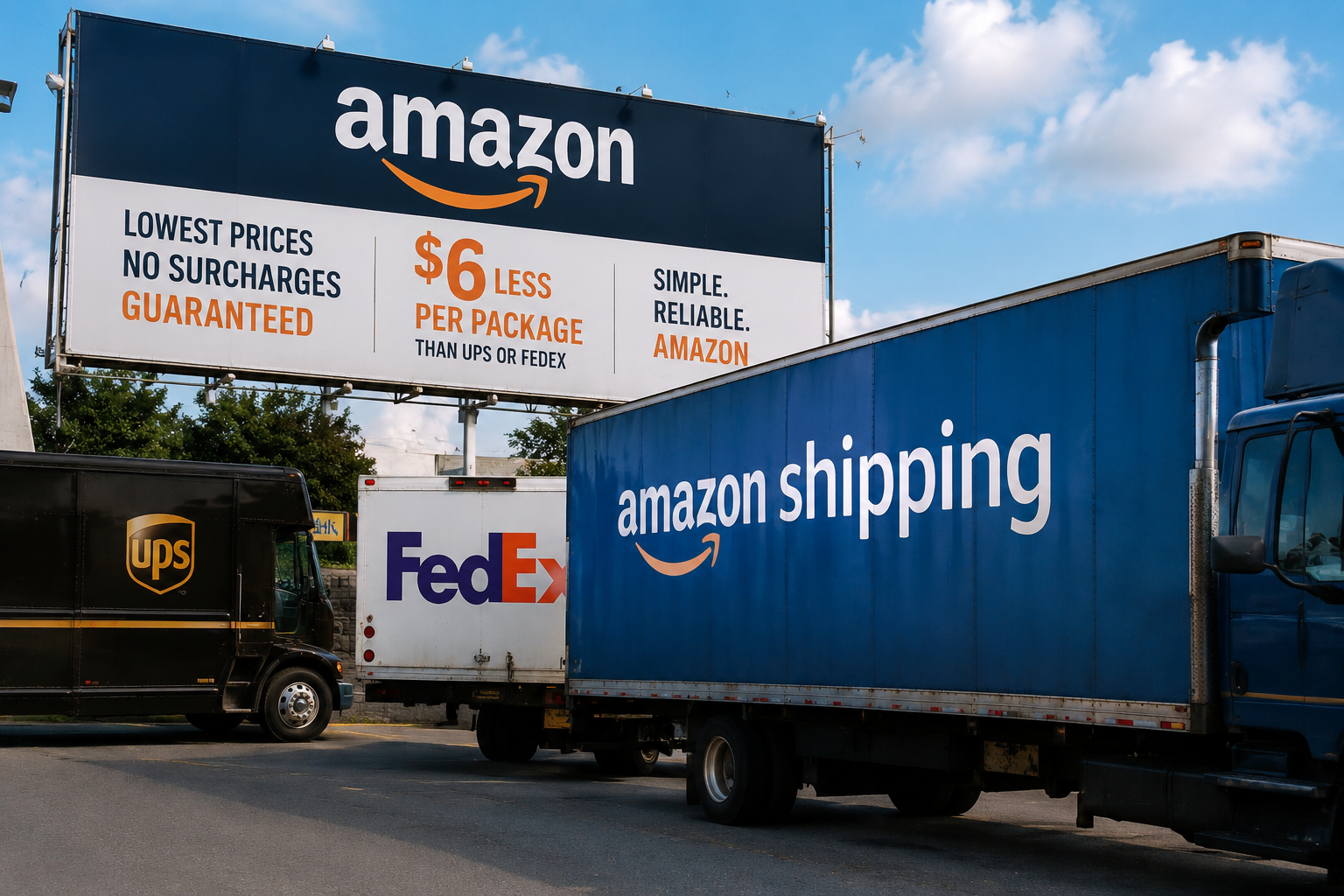
For decades, the American parcel market has revolved around three dominant players: UPS, FedEx, and USPS. But a company that once relied on them to deliver its own orders is now challenging the very foundations of that market.
Amazon is no longer positioning Amazon Shipping as an internal logistics tool. It is emerging as a national parcel carrier, aggressively targeting independent e-commerce businesses with a strategy built on one of the industry’s most powerful competitive weapons: price.
According to logistics consultants familiar with recent customer bids, Amazon Shipping is offering U.S. online retailers significantly lower shipping rates, a simplified pricing structure, and far fewer surcharges than traditional parcel carriers.
For some businesses, the savings are substantial.
Industry analyses indicate that merchants shifting eligible residential shipments from UPS or FedEx to Amazon Shipping can reduce costs by as much as $6 per package. In one reviewed case, Amazon demonstrated that it could cover more than 90% of a retailer’s distribution network, resulting in projected annual shipping savings exceeding 33% compared with FedEx.
Unlike many traditional parcel carriers, Amazon does not apply separate residential delivery or weekend delivery surcharges—fees that have become a standard component of shipping invoices across the industry.
For lightweight parcels weighing less than one pound, Amazon is also reported to be offering rates below those of the U.S. Postal Service on selected shipments.
Amazon’s Service Still Has Limits
Amazon’s ambitions are accompanied by clear operational limitations.
Its core product remains ground delivery within two to five days across the continental United States. The company is not yet competing head-to-head in every segment of parcel logistics.
UPS and FedEx continue to hold a significant advantage in overnight delivery, international express services, healthcare logistics, dangerous goods transportation, and other specialized shipping categories.
That distinction matters.
Amazon is not attempting to replace every logistics provider overnight. Instead, it is targeting one of the fastest-growing and most strategically important segments of the parcel market: lightweight residential e-commerce deliveries.
Why This Is One of the Most Important Logistics Stories of the Period
Amazon is no longer simply delivering its own retail orders. It is building a separate national transportation business capable of taking parcel volume from UPS, FedEx, USPS, and regional carriers.
Every package that migrates to Amazon Shipping represents more than lost revenue for traditional operators. It reduces shipment density, weakens route economics, and increases pressure on carriers already facing rising labor costs, expensive delivery networks, and uneven parcel demand.
For years, Amazon invested billions of dollars in warehouses, aircraft, delivery stations, sortation centers, trailers, and last-mile delivery capacity primarily to support its own marketplace.
That infrastructure now appears ready for a new role: delivering orders for businesses that may not sell through Amazon at all.
A Direct Challenge to the Traditional Parcel Model
The most disruptive element of Amazon’s strategy may not be the headline shipping rate alone. It is the simplicity of the offer.
Traditional parcel contracts often include complex combinations of residential surcharges, delivery-area fees, fuel adjustments, weekend charges, dimensional-weight rules, and other accessorial costs.
Amazon is attempting to present merchants with a more predictable alternative: lower base rates, fewer additional fees, and broad access to a delivery network originally built for the world’s largest online retailer.
For small and mid-sized e-commerce companies, that pricing transparency could be as important as the nominal discount itself.
What Happens Next
If Amazon continues expanding geographic coverage while maintaining its pricing advantage, the competitive landscape of U.S. last-mile logistics could shift dramatically.
UPS and FedEx may be forced to respond with more aggressive discounts, simplified contracts, or new services designed specifically for lightweight residential parcels.
USPS could also face additional pressure in the sub-one-pound segment, where price sensitivity is especially high and e-commerce merchants routinely compare multiple delivery options.
What began as an internal delivery operation is rapidly evolving into a nationwide transportation business.
And this time, Amazon is no longer competing only for shoppers.
It is competing for the packages themselves.
