

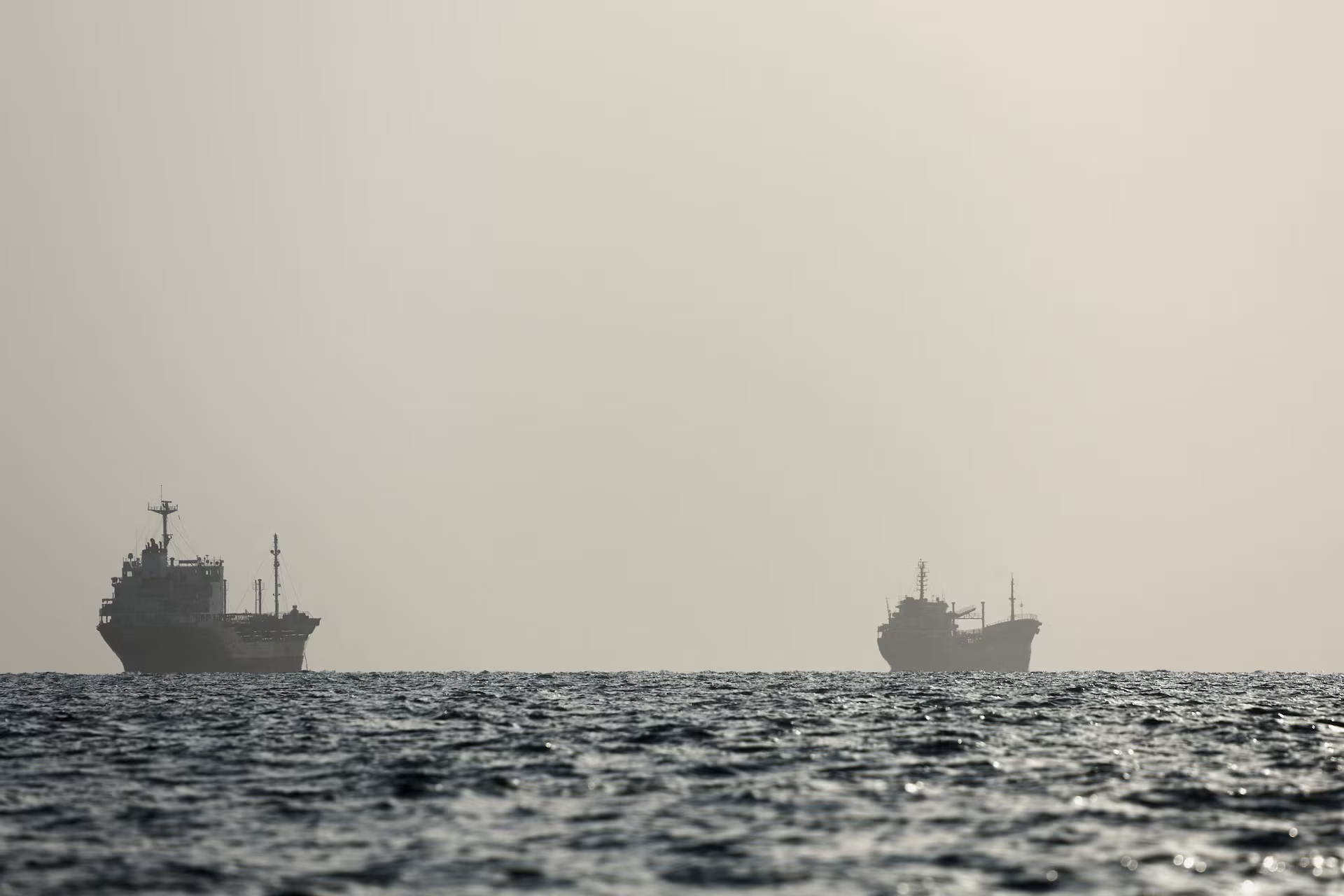
The US attack on Iranian launchers on Larak Island and Tehran’s retaliatory missile strike have raised shipping risks and pushed Brent crude above $90 per barrel
US Strikes Larak Island
The Strait of Hormuz has returned to the centre of the US-Iran military confrontation following several weeks of relatively lower combat intensity. On the evening of August 30, US forces attacked two Islamic Revolutionary Guard Corps launchers on Larak Island near the eastern entrance to the strait.
US Central Command said Iranian personnel had been preparing to launch rockets carrying naval mines into the international shipping route. Washington described the action as limited and precise, intended to neutralise an imminent threat to commercial and military vessels.
“Islamic Revolutionary Guard Corps forces were observed preparing to launch rockets with sea mines into the Strait of Hormuz,” a US representative said
It was the first known US military operation against targets inside Iran since late July. The IRGC rejected Washington’s account, describing the claim that the launchers posed an immediate danger to shipping as false.
Iranian President Masoud Pezeshkian said Tehran did not seek a wider war but would respond decisively to further attacks.
Iran Launches Missiles Toward Jordan
During the night of August 30–31, Iran launched retaliatory missiles toward facilities hosting US forces in Jordan. The Jordanian Armed Forces confirmed that eight missiles entering the country’s airspace had been intercepted. Amman said the projectiles were destroyed before they could threaten civilians or property.
Iranian sources also claimed that US military infrastructure in the United Arab Emirates had been targeted. Reports of an impact at Al Minhad Air Base have not been independently confirmed, while UAE authorities have not announced significant damage at the facility.
The confirmed elements are therefore the US attack on Larak, the Iranian missile launch and Jordan’s interception of eight missiles. Reports concerning additional targets and damage require further verification.
Tanker Struck Near Khasab
The military escalation coincided with continued attacks on commercial shipping. According to United Kingdom Maritime Trade Operations Warning 122-26, an unidentified projectile struck a tanker sailing inbound toward the Persian Gulf at 20:35 UTC on August 29.
The incident occurred approximately 12 nautical miles, or 22 km, north of Khasab, Oman. UKMTO did not identify the vessel or its flag. No crew casualties or environmental damage were reported.
It was the third vessel incident recorded by UKMTO in the area within one week. Ships operating near the strait have been advised to exercise heightened caution, limit the predictability of their movements and report suspicious activity promptly.
IRGC Supertanker Claim Remains Unverified
The IRGC Navy subsequently claimed that an unidentified supertanker attempted to use the southern part of the strait without Iranian authorisation before striking two mines and catching fire.
The semi-official Tasnim news agency carried the statement but provided no vessel name, flag, owner, cargo details or information about the crew.
No independent confirmation has been issued by UKMTO, the alleged vessel’s operator, its flag state or major international news agencies. The account should therefore not be treated as an established incident.
Iran views control of the strait’s traffic arrangements as leverage in wider negotiations. Tehran argues that ships must coordinate their passage with Iranian authorities, while Washington insists on freedom of international navigation and says the main shipping channels have been cleared of mines.
Visible Traffic Remains at Five Ships
Preliminary Kpler data show that only five traceable commodity vessels crossed the Strait of Hormuz on August 31. Four entered the Persian Gulf and one exited. The previous ten-day average was approximately 14 crossings.
Before the conflict, around 130–140 vessels of different categories normally passed through the waterway each day. The figures require cautious comparison because Kpler’s current count primarily covers identified commodity vessels, while the historical total included a broader range of maritime traffic.
The actual number of crossings may be higher. Some vessels deactivate their AIS transponders or restrict position transmissions to reduce the risk of detection and attack. Those voyages may not appear immediately in publicly available data.
Fourteen crossings were recorded on August 29. They included a VLCC carrying approximately 2 million barrels of Qatari crude with its AIS switched off. Some gas carriers also sailed without visible transmissions or used the route administered by Iran.
Disabling AIS may make a vessel less visible to potential attackers, but it also complicates collision avoidance, coordination with other traffic and emergency response.
Up to 400 Ships Remain in the Gulf
Claims that free navigation has been restored differ from the International Maritime Organization’s assessment. According to the IMO, up to 400 ships carrying around 6,000 seafarers have been unable to leave the Persian Gulf safely since the conflict began.
“Thousands of seafarers in the region continue to live and work under conditions of heightened risk and uncertainty,” IMO Secretary-General Arsenio Dominguez said
The organisation has called on governments and the maritime industry to develop a sustainable mechanism for restoring unhindered transit. The obstacles facing shipowners extend beyond the physical presence of mines to include missile and drone threats, uncertain security guarantees and high insurance costs.
Even when naval escort is available, charterers and insurers may reject a voyage if they consider the exposure unacceptable. Declaring a route formally open does not therefore ensure that commercial traffic will return.
Brent Settles Above $90
Oil markets reacted quickly to the renewed exchange of strikes. Brent futures gained approximately 2.7% on August 31 and settled at $90.49 per barrel after trading even higher during the session.
Goldman Sachs estimates that Gulf oil exports are currently running at approximately 15–16 million barrels per day, compared with 22–24 million barrels per day before the crisis. Estimates vary because of dark tanker movements, AIS deactivation and ship-to-ship cargo transfers.
Further pressure on refined-product markets comes from Russia’s extension of its diesel export ban through September 30, 2026. The combination of reduced Gulf supplies and Russian export restrictions creates additional risks for Europe’s diesel, aviation fuel and petrochemical feedstock markets.
For logistics operators, the consequences extend beyond higher bunker costs. Insurance premiums are increasing, voyage planning is becoming more complex, contingency routes are required and the return of tankers and containers to circulation is taking longer.
Read also: Strait of Hormuz had already fallen to seven vessels in one day
