

Changing maritime routes are extending equipment cycles and forcing logistics operators to consider not only freight costs but also container availability at specific ports
Security Is Becoming More Important Than Distance
Middle East tensions, continued uncertainty in the Strait of Hormuz and changing conditions in the Red Sea are forcing shipping lines to reconsider routes, schedules and fleet deployment.
Carriers can no longer base decisions only on distance and fuel costs. The risk of attacks, insurance availability, port infrastructure, crew-change options and access to safe alternatives have become equally important.
“Maritime routes are no longer defined only by distance and efficiency, but also by security, resilience and adaptability,” EContainers Global said
This is particularly visible on the Asia–Europe trade. Depending on security conditions, carriers may restore selected services through the Suez Canal before redirecting them around the Cape of Good Hope again.
Longer Routes Slow Container Turnaround
Sailing around Africa allows vessels to avoid the Red Sea and Bab el-Mandeb Strait, but it increases voyage duration, fuel consumption and fleet requirements. Shipping lines need additional vessels to maintain weekly departures because every round voyage takes longer.
The change also affects container equipment. Boxes spend more time aboard ships, at terminals or within inland supply chains and return later to markets where they can be loaded again.
When a carrier restores a service through Suez, voyage duration decreases and some vessel and container capacity is released. Equipment already distributed along the Africa route, however, cannot immediately return to ports where new demand has emerged. Surpluses can consequently develop in one region while shortages appear elsewhere.
UN Trade and Development previously estimated that large-scale diversions around the Cape of Good Hope increased global demand for container-ship capacity by approximately 12%. This illustrates how longer voyages can reduce effective capacity even when the physical size of the world fleet remains unchanged.
Container Location Becomes a Critical Factor
The physical existence of an empty container somewhere in the global system does not mean it is available for a particular shipment. Equipment may be located at a distant port, aboard a delayed vessel, inside a congested terminal or in a market from which empty repositioning is expensive.
“When routes change, the location of equipment and the time it remains within the logistics system also change. A geopolitical crisis can therefore create regional imbalances in container availability,” EContainers Global CEO Andrés Valencia said
For cargo owners and freight forwarders, the location of equipment inventory is becoming as important as the purchase or leasing price. Even a low-cost container may be unsuitable if moving it to the loading point requires additional inland transport, handling or a prolonged wait.
Export-oriented markets with strongly unbalanced cargo flows are particularly exposed. If imported boxes stop arriving regularly, local exporters may not have enough equipment to ship their products.
Return to Suez Remains Uneven
Some major shipping lines expanded their use of the Suez Canal in late August. The return is nevertheless being implemented service by service and does not represent a complete restoration of the previous network.
As K2Cargo.News previously reported, the seven-day total of container-ship passages through Suez reached 50 vessels by August 25. MSC, Maersk and Hapag-Lloyd restored selected services while retaining contingency arrangements that allow ships to return to the Cape route if security deteriorates.
These changes complicate container-fleet management. Every routing adjustment changes equipment arrival dates, trip duration and empty-repositioning requirements.
Operators must prepare simultaneously for stable Suez transits, another temporary shift around Africa and the continued use of both corridors by different services.
Hormuz Deepens Regional Imbalances
Conditions in the Strait of Hormuz create a separate problem for container flows serving the Persian Gulf. Restricted navigation makes regular port calls in the UAE, Qatar, Bahrain, Kuwait, Iraq and Iran more difficult.
Some cargo can be redirected through ports in Saudi Arabia, Oman or the Red Sea before moving by road and feeder vessel. These arrangements require additional handling and cannot fully replace regular maritime services through Hormuz.
Containers discharged at alternative ports may end up far from their original destinations. Operators must arrange inland delivery, change equipment-release terms and determine where each container will be used after unloading.
Arctic Shipping Attracts Greater Attention
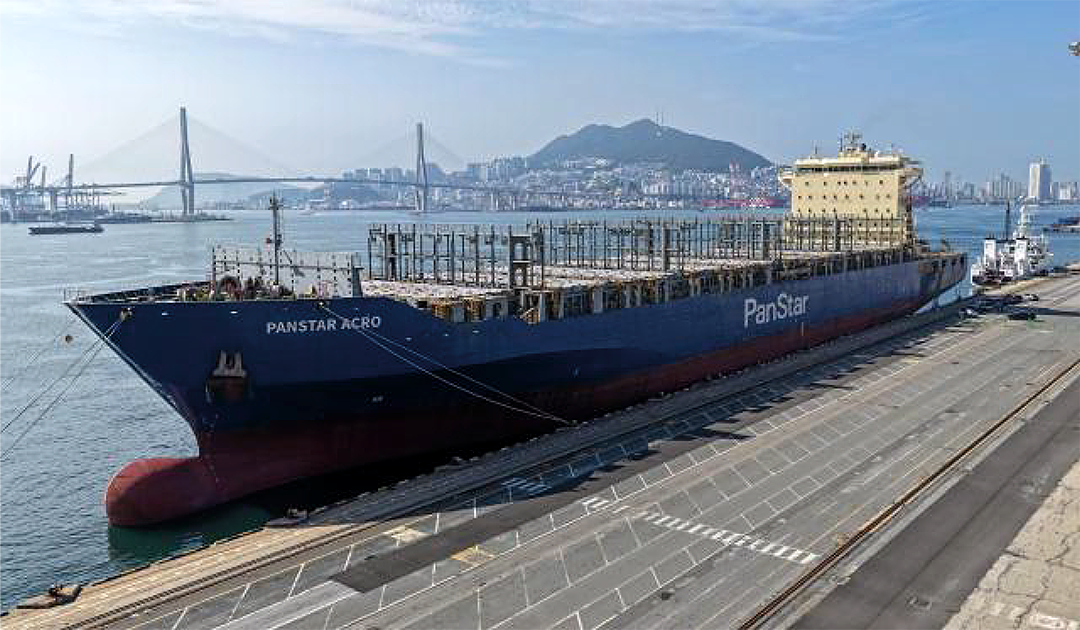
Disruption along traditional maritime corridors is increasing interest in the Northern Sea Route. In August, South Korea dispatched the PanStar Acro on the country’s first government-backed commercial container voyage to Europe through the Arctic.
The 2,758-TEU vessel loaded approximately 837 TEU of cargo, including automotive components, chemical products and around 100 empty containers. Its round voyage, including calls at Felixstowe, Rotterdam and Gdańsk, is expected to take between 40 and 45 days.
Norway’s Centre for High North Logistics recorded 103 transits by 88 vessels in 2025, compared with 43 transits in 2022. South Korea is examining whether regular Arctic services could be developed by 2030.
The Northern Sea Route cannot yet be considered a full alternative to the Suez Canal. Navigation remains seasonal, vessels may require ice-class certification and icebreaker support, while insurers must consider limited rescue infrastructure, severe weather and environmental risks.
Sanctions and the need to coordinate with Russia create additional complications. The Arctic is therefore more likely to develop as a supplementary corridor for selected cargoes than as a mass-market replacement for Asia–Europe container services in the near term.
Flexibility Becomes an Operating Requirement
The new geography of maritime trade is increasing demand for transparent information about container locations. Equipment owners need visibility not only over total inventory but also over container types, depot locations, return dates and release conditions.
Companies also require inventory across several regions, alternative suppliers and the ability to move containers quickly between terminals. Maintaining these options increases costs but reduces the risk of exports being interrupted by equipment shortages.
The market is shifting from optimizing one low-cost supply chain to managing several possible scenarios. The shortest route is no longer necessarily the most reliable, while a low container price provides little benefit if the equipment is too far from the loading point.
For carriers and cargo owners, access to the right container at the right port and at the required time is becoming decisive. In an increasingly unpredictable shipping market, flexibility is no longer an advantage—it is an operating necessity.
Read also: Analytical Report: The Blockade of the Strait of Hormuz During the U.S.-Israeli War Against Iran