

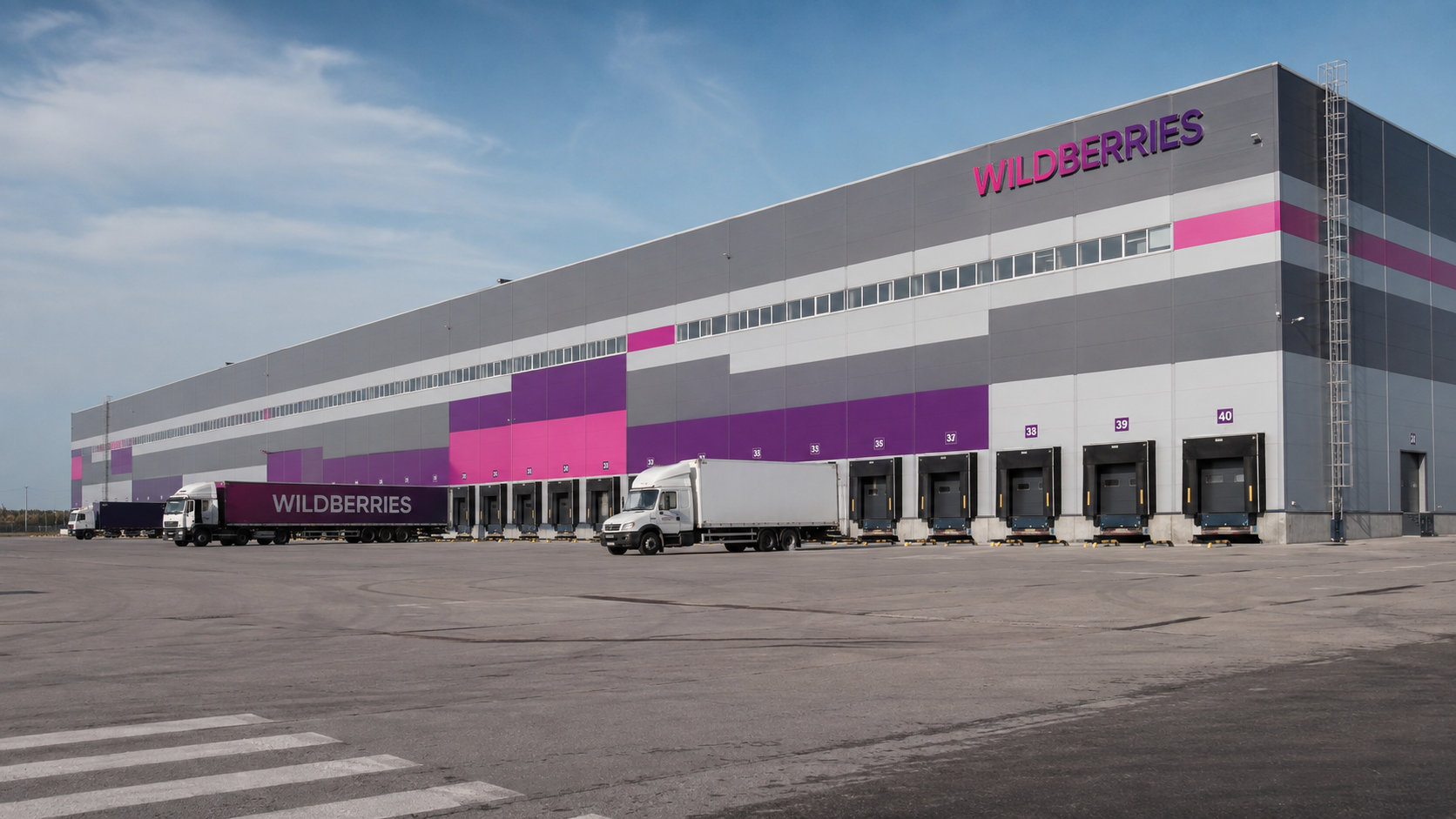
Wildberries Is Expanding Its Kazakhstan Warehouse Network
Wildberries plans to commission major logistics facilities in Almaty and Astana in early 2027.
Kazakhstan’s Minister of Trade and Integration Arman Shakkaliyev announced the timeline during a government briefing.
The Almaty centre is expected to cover 103,000 m², while the Astana development will provide 160,000 m².
The two projects will therefore add a combined 263,000 m² of space, making them one of Kazakhstan’s largest warehouse programmes associated with e-commerce.
Shakkaliyev stressed that the construction plans had been developed long before the attacks on Wildberries facilities in Russia. The Kazakhstan projects should consequently be viewed as part of an established expansion strategy rather than an emergency relocation of warehouse operations.
Astana Hub Is Scheduled for the First Quarter
Construction of the Wildberries logistics centre in Astana is already under way.
The officially announced facility will cover 160,000 m². Investment is estimated at KZT 47.7 billion, and the development is expected to create approximately 6,000 jobs.
Completion is scheduled for the first quarter of 2027. The hub will become one of the largest individual warehouse properties in Astana and Kazakhstan’s wider e-commerce market.
The project will involve more than conventional storage. A modern marketplace fulfilment centre typically combines inbound receiving, sorting, inventory placement, picking, packing, returns processing and handover to last-mile carriers.
The final equipment configuration and stated throughput capacity have not yet been publicly disclosed.
Almaty Will Receive a 103,000 m² Facility
Wildberries’ second large Kazakhstan development will be located in Almaty and cover 103,000 m².
Almaty is the country’s largest consumer market and the principal distribution centre for southeastern Kazakhstan. The city contains a high concentration of importers, retailers, pickup points and businesses selling through online platforms.
A large fulfilment centre in the region could serve Almaty as well as the Almaty, Zhetysu, Zhambyl and neighbouring regions.
The city is also closer to major import routes from China and Kyrgyzstan, making it a practical location for receiving cross-border consignments, customs processing, sorting and national distribution.
Shakkaliyev identified early 2027 as the expected opening period. Detailed figures covering investment, employment and technical equipment at the Almaty facility have not yet been published.
The Two Cities Will Serve Different Logistics Functions
The Almaty and Astana warehouses are unlikely to duplicate each other completely.
Almaty benefits from proximity to Kazakhstan’s largest urban market, the international airport, railway terminals, highways and routes carrying imports from China.
The Astana hub can serve the capital together with the Karaganda, Akmola, Pavlodar, Kostanay and other central and northern regions.
Dividing inventory between two major centres will allow Wildberries to position popular products closer to customers. Orders will no longer have to travel from Almaty to Astana, or in the opposite direction, in every case.
This should reduce interregional mileage, ease pressure on sorting facilities and make delivery times more predictable.
Dependence on Russian Warehouses Could Decline
Some goods purchased by Kazakhstan customers currently move through cross-border supply chains connected to Wildberries’ warehouse network in Russia.
The model supports a wide product range but makes delivery dependent on foreign fulfilment centres, customs procedures, border capacity and international road transport.
The new complexes will allow a larger quantity of merchandise to be physically stored inside Kazakhstan.
The more products positioned in Almaty and Astana before an order is placed, the fewer items will have to cross an international border after purchase.
Customers may receive orders sooner, while sellers could replenish inventory and redistribute goods between regions more efficiently.
The marketplace will not eliminate foreign logistics entirely. A substantial proportion of its assortment will continue to be manufactured or stored outside Kazakhstan.
Attacks in Russia Demonstrated Concentration Risk
Several Wildberries facilities in Russia were struck by drones during the summer of 2026. Some warehouses suffered serious damage, forcing the company to redirect receiving, fulfilment and dispatch operations to alternative sites.
Public estimates indicated that the attacks affected a significant share of the marketplace’s logistics capacity in individual Russian regions. Wildberries has continued its international expansion while developing around 260,000 m² of additional space in Kazakhstan.
Shakkaliyev stressed that the Kazakhstan projects had been prepared before those events.
The attacks nevertheless demonstrated the operational risk created when large quantities of inventory and order-processing capacity are concentrated at a limited number of enormous facilities.
Holding more inventory inside Kazakhstan would improve the resilience of the local Wildberries segment. Some orders could continue to be processed independently if operations at a foreign centre were disrupted.
A Large Local Warehouse Also Creates Concentration Risk
Localisation does not remove every threat.
The greater the amount of merchandise concentrated at one site, the more serious the consequences of a fire, power failure, information-system outage or equipment shutdown.
Facilities exceeding 100,000 m² require backup power, automatic fire suppression, separate fire compartments and redundant communication systems.
Alternative fulfilment routes are also necessary. If one warehouse stops operating, the platform should be capable of redirecting deliveries or temporarily moving sellers to a model in which they dispatch products from their own facilities.
Building two hubs instead of one reduces geographical concentration but requires precise coordination of inventories, transport and digital systems.
Kazakh Sellers Will Gain More Options
The logistics centres are particularly important to local manufacturers and merchants.
Wildberries sellers in Kazakhstan can operate under several models. With FBW, inventory is delivered to a marketplace warehouse in advance and the platform handles storage, picking and delivery. Under FBS, the seller retains the stock until an order is placed and then hands it into the Wildberries logistics network.
Direct-from-seller and express fulfilment models are also available.
Expanding the physical warehouse network will create additional delivery slots and may reduce the distance between a manufacturer and an acceptance point.
Businesses in Astana, Karaganda and northern Kazakhstan could see a particularly important benefit because regularly sending small consignments to the south may currently be uneconomic.
Interregional Delivery Costs Could Fall
A product accepted at one warehouse may be ordered by a customer located more than a thousand kilometres away.
The marketplace must either transfer stock between sorting centres or move each parcel over a long distance after purchase.
Holding inventory in both Almaty and Astana will allow the platform to create shorter order routes. Popular goods can be distributed between the two regions in consolidated loads before customer demand materialises.
A full truck moving stock between warehouses is generally more efficient than a large number of individual parcels travelling along the same corridor at different times.
Sellers will nevertheless require more accurate inventory planning. If an item is held only in Almaty while demand is concentrated in the north, the advantage of the two-hub model will be reduced.
Line-Haul Traffic Between Almaty and Astana Will Increase
The two hubs will generate stable freight demand between southern and northern Kazakhstan.
Movements will include replenishment stock, consumer orders, returns, packaging and goods incorrectly allocated between the two facilities.
Regular road services are likely to perform the main role. Carriers will need vehicles operating on fixed timetables, overnight capacity and precise warehouse appointment compliance.
Rail could support certain large consignments, particularly where the marketplace uses containerised imports from China or other international markets.
Backhaul utilisation will be essential. A truck delivering goods from Almaty to Astana and returning empty would reduce the efficiency gains created by regional inventory placement.
Couriers and Pickup Points Will Handle More Orders
The warehouses will increase the volume of parcels requiring daily delivery to pickup points and customer addresses.
This will generate additional demand for light commercial vehicles, drivers, urban sorting locations and local route planning.
A regional delivery network will develop around each hub. Some vehicles will move parcels to secondary sorting centres, while others will serve urban pickup points or neighbouring regions.
Higher order volumes will require controlled arrival schedules. Dozens of vehicles reaching a major facility at the same time can quickly create queues and loading delays.
Electronic appointments, dock-management systems and dedicated truck waiting areas will therefore be important.
Returns Will Become a Separate Logistics Flow
E-commerce creates substantial reverse logistics.
Customers return clothing, footwear, electronics and other goods because they do not fit, are damaged or fail to meet expectations.
Returned products must be collected from pickup points, inspected and classified before the platform decides whether they can be sold again.
The Almaty and Astana centres could process more returns domestically instead of sending some merchandise back to distant foreign facilities.
This may return suitable items to sale more quickly. It will also require dedicated areas for inspection, repacking, repair, disposal and temporary storage of disputed goods.
For sellers, the quality of returns processing can be just as important as ordinary delivery speed.
Kazakhstan Is Entering a Warehouse Investment Cycle
The Wildberries projects form part of a wider expansion of modern warehouse property around Almaty and Astana.
K2Cargo News previously reported that EDB and Griffin Partners will build a $125 million logistics park in Almaty. The class A+ development will provide more than 125,000 m² and is also expected to open in stages beginning in 2027.
The simultaneous development of Wildberries hubs and independent logistics parks shows that Kazakhstan is moving from smaller warehouses toward large automated facilities.
The projects will serve different models. An independent logistics park can lease space to manufacturers, distributors and third-party logistics operators, while a Wildberries centre will primarily serve the marketplace’s own ecosystem.
Together, they will increase the supply of modern warehouse space while intensifying competition for workers, carriers and strategically located land.
Labour-Market Effects Will Be Mixed
The Astana development is expected to create approximately 6,000 jobs.
Positions may include receiving, sorting, picking, packing, quality control, equipment maintenance, security and transport management.
Additional employment will emerge among carriers, contractors, repair businesses, catering providers and pickup-point operators.
Modern fulfilment centres nevertheless make extensive use of conveyors, automated sorting equipment, scanners and warehouse-management systems.
Employment will not necessarily increase in direct proportion to building size. Automation will reduce some manual roles while increasing demand for technicians, digital-system operators and logistics planners.
The quality of employment, training and contract stability will therefore matter alongside the overall job figure.
Power Supply Will Be Critical
A large e-commerce warehouse is an energy-intensive facility.
Electricity powers conveyors, sorters, lighting, servers, charging equipment, heating and ventilation.
An outage lasting several hours can disrupt the sequence of tens of thousands of orders. Once power is restored, the accumulated backlog cannot be eliminated immediately.
The centres will require backup generators, uninterrupted power for critical IT systems and sufficient emergency fuel.
This is particularly important in Astana, where winter conditions make reliable heating and building systems essential.
Packaging Suppliers Will Gain New Demand
Fulfilment centres consume large quantities of boxes, bags, film, labels, pallets and protective materials.
The two hubs will create a permanent market for Kazakhstan-based packaging manufacturers.
Local supply can be more economical than imports because packaging has relatively low value compared with its physical volume. Transporting empty boxes over long distances is inefficient, encouraging production near major users.
Wildberries will also require a system for collecting and processing waste.
The environmental performance of the facilities will depend on pallet reuse, waste separation and efforts to reduce excessive packaging.
Minister Calls for Support for Domestic Marketplaces
While discussing Wildberries, Shakkaliyev said Kazakhstan should make maximum use of its own online marketplaces.
He argued that the situation had demonstrated the importance of guarantees and trust in commerce.
The statement should not be interpreted as Kazakhstan rejecting foreign digital platforms. Wildberries continues investing in the country and expanding its local infrastructure.
The issue is the need for competition so that sellers and customers do not become dependent on a single platform.
Domestic marketplaces can retain more data, commission income, technological expertise and management decisions inside Kazakhstan.
A Physical Warehouse Does Not Guarantee Trust
A modern building reduces logistics risk but does not automatically resolve questions of responsibility toward sellers.
Businesses need to know who compensates them when inventory is lost or damaged by fire, operational failure or a prolonged warehouse shutdown.
The applicable marketplace agreement, insurance coverage, claim-processing time and calculation of compensation are central issues.
Sellers also require visibility over where their goods are located, when they were accepted, why an order is delayed and how a return was classified.
Trust is therefore built through infrastructure, contracts, insurance, data transparency and an accessible dispute-resolution process.
E-Commerce Remains a Major Source of Complaints
Retail and electronic commerce remain among the sectors generating the largest number of consumer complaints in Kazakhstan.
The country’s consumer-protection authorities processed more than 22,500 complaints during the first quarter of 2026, a significant increase from the same period a year earlier.
Disputes can involve refunds, product quality, cancelled orders, delivery times and uncertainty about whether the seller or platform is responsible.
Additional warehouse capacity may reduce some logistics delays. However, greater overall transaction volumes can increase the absolute number of disputes unless customer support improves at the same pace.
Domestic Platforms Will Also Need Logistics Infrastructure
Calls to support Kazakhstan-based marketplaces raise the question of whether they can compete on logistics quality.
A website and mobile application are only the visible side of e-commerce. Behind them are warehouses, payment systems, delivery fleets, returns processing, inventory analysis and pickup-point networks.
A local platform does not immediately need to build a 160,000 m² facility to compete.
It can work with independent 3PL operators, lease space at logistics parks and combine the capacity of several courier companies.
The decisive factor will be service control. Customers judge a marketplace by whether an order arrives predictably and whether a return can be completed without unnecessary difficulty.
Kazakhstan Must Maintain a Regulatory Balance
Kazakhstan has an interest in attracting foreign investment while also developing domestic e-commerce.
Wildberries’ projects will create jobs, transport demand and modern warehouse infrastructure. Local manufacturers will gain an additional sales channel.
Excessive dependence on one platform could nevertheless weaken sellers’ negotiating positions and reduce market resilience when tariffs, rules or external conditions change.
Regulation should therefore focus on common standards for transparency, liability, consumer protection and market access rather than restricting one investor.
Kazakhstan is also developing a QazTrade-based single window intended to connect domestic producers with retail networks and marketplaces.
New Hubs Will Reshape Kazakhstan’s E-Commerce Market
The two facilities covering a combined 263,000 m² could significantly change the geography of the country’s online retail logistics.
Almaty will reinforce its role as the principal southern distribution centre, while Astana will gain a major hub for central and northern regions.
Carriers will receive regular long-haul and regional work, pickup points will handle more domestically processed parcels, and sellers will gain further options for inventory placement.
The central question is whether infrastructure investment will be accompanied by transparent guarantees for businesses and consumers.
This is why Shakkaliyev’s comments about trust are as significant as the warehouse-area figures.
By early 2027, Wildberries may operate one of Kazakhstan’s largest fulfilment networks. Its long-term success will depend not only on sorting speed but also on the marketplace’s ability to protect inventory, meet its obligations and retain seller confidence.
Read also: Pickup Points 3.0: No Cashier, No Clerk