

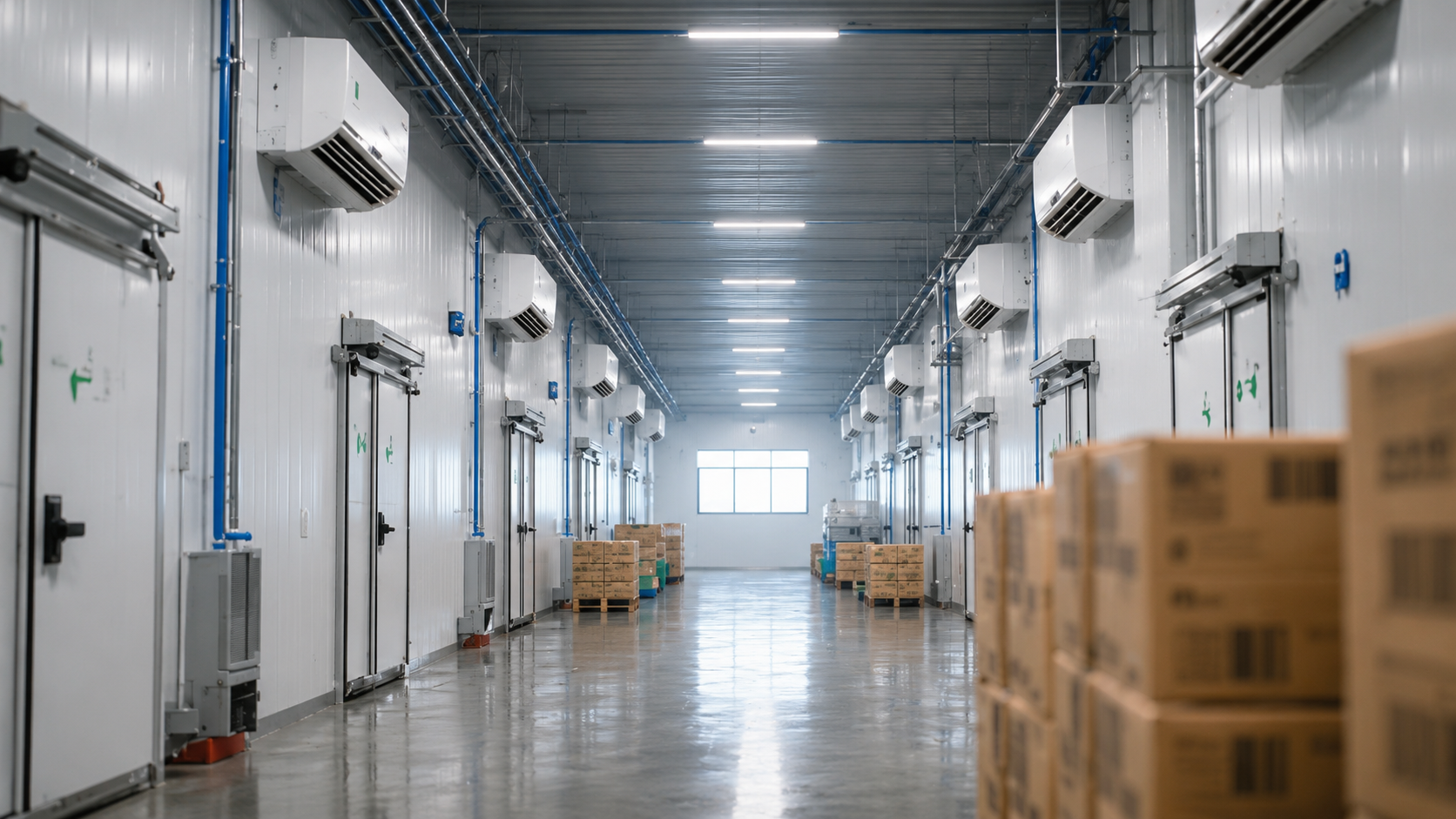
Cold storage facilities are among the most technically complex assets in logistics real estate. Unlike standard dry warehouses, they depend not only on location, floor load and dock capacity, but also on engineering accuracy, refrigeration design, insulation quality, energy efficiency and long-term operating costs.
At the Logistics Picnic 2026 conference in Moscow, Dmitry Batenkin, Deputy Commercial Director of Ingenium, warned that the desire to save money at the design stage or choose the cheapest offer on the market often creates problems that become visible only after the facility is launched. According to him, warehouse owners may discover within one or two years that energy costs are higher than expected, tenants are dissatisfied and temperature-sensitive products are at risk.
For logistics companies, developers and retailers, this message is especially important at a time when demand for cold storage is increasing, while construction costs remain high and access to energy infrastructure is becoming one of the most expensive parts of warehouse development.
As K2Cargo News recently reported in EDB and Griffin Partners to Build $125 Million Logistics Park in Almaty, modern warehouse projects are becoming larger, more capital-intensive and more strategically important for regional supply chains. In refrigerated logistics, however, scale alone does not guarantee efficiency.
A Vague Technical Brief Creates the First Risk
According to Batenkin, one of the most critical mistakes is a poorly prepared technical specification.
If a customer describes the requirement only as “a certain temperature inside the warehouse,” without explaining cargo categories, turnover, storage zones, loading intensity, humidity requirements, door operations, defrosting regimes and future operating scenarios, the market will produce a wide range of incompatible offers.
In such conditions, the cheapest proposal often looks attractive. But the lower price may hide weak engineering assumptions, insufficient refrigeration capacity, poor energy performance or equipment that does not match the real business model.
The consequences appear quickly. The owner faces high electricity consumption, unstable temperature control and complaints from tenants or end users. In some cases, the initial mistake can only be corrected through full reconstruction of refrigeration systems.
This is why a refrigerated warehouse should not begin with a price comparison. It should begin with a detailed operational model.
Universal Warehouses Can Become Too Expensive
Another common trap is the desire to build an excessively universal facility.
Technically, it is possible to design a multi-temperature warehouse with a large reserve of refrigeration capacity. Such a building can serve chilled, frozen and mixed storage zones and adapt to different tenants. But flexibility always has a price.
If the business model does not actually require such a wide temperature range, the owner pays twice: first through higher capital expenditure, then through higher operating costs.
Oversized refrigeration systems, additional engineering complexity and unused technical reserves can reduce the financial efficiency of the project. A warehouse built “for every possible tenant” may become too expensive for the real tenant it eventually receives.
For developers, the key question should not be whether the facility can technically do everything. The key question is which functions will actually generate income.
Energy Efficiency Is Not an Optional Extra
Batenkin also warned against false savings on energy-efficient solutions.
In refrigerated logistics, electricity is one of the largest operating expenses. Decisions made during design can influence costs for the entire life of the warehouse. Frequency control of compressors, heat recovery, efficient fans, optimized defrosting systems and well-designed refrigeration circuits may increase initial investment, but can pay back within one to three years.
The same applies to refrigerant selection. Russia has ratified the Kigali Amendment to the Montreal Protocol, which means the phasedown of synthetic hydrofluorocarbon refrigerants is already part of the regulatory environment. Against this background, natural refrigerants, including carbon dioxide systems, are becoming increasingly relevant for large cold storage projects.
Ignoring future regulatory pressure may create additional risks. A solution that looks cheap today may become expensive tomorrow if maintenance costs rise, refrigerant availability changes or modernization becomes unavoidable.
Redundancy Protects Product and Reputation
The absence of redundancy in refrigeration systems is another serious risk.
For a standard warehouse, a technical failure may cause delays. For a cold storage facility, it can destroy product.
Batenkin considers a “50/50” approach one of the more reliable solutions: one refrigerated room is cooled by two independent units. If one circuit fails, the second can continue operating and protect the cargo.
This is especially important for frozen food, pharmaceuticals, meat, fish, dairy products and other temperature-sensitive goods. Product losses can quickly exceed the cost of better engineering.
Large systems with uncontrolled volumes of Freon create additional risks. Serious leakage may lead not only to technical downtime, but also to high replenishment costs, environmental concerns and complex emergency repairs.
For tenants and customers, system reliability is becoming part of service quality. A warehouse that cannot guarantee temperature stability cannot be considered a professional logistics asset.
Poor Coordination During Design Can Be Expensive
Engineering conflicts often appear when developers try to save on design coordination and 3D modeling.
Batenkin cited an example in which, because different design sections were not properly aligned, a refrigeration pipe was routed directly through an air cooler. Such mistakes may look absurd after construction begins, but they are usually the result of a predictable problem: separate engineering disciplines are designed in isolation.
For refrigerated warehouses, this is particularly dangerous. Refrigeration systems, ventilation, fire safety, racks, docks, floors, drainage, power supply and automation must work as one integrated system.
3D modeling and clash detection may look like additional costs at the beginning of the project, but they often prevent much larger losses during construction and commissioning.
Building Envelope and Floor Protection Matter
The quality of enclosing structures is another critical factor.
Batenkin warned against uncontrolled use of basalt panels in cold storage projects. Because such panels can absorb moisture, they may gradually lose insulation performance. In refrigerated zones, this can lead to condensation, ice formation and higher energy consumption.
Ground protection is equally important. In low-temperature chambers, soil under the floor can freeze if no heating system is installed. In frost-susceptible soils, this may cause floor heave of 10–15 centimeters, deforming floors and putting racking systems at risk.
Such failures are not cosmetic defects. They can create unsafe operating conditions and force the owner to stop warehouse operations for expensive repairs.
The Cost of Mistakes Is Measured in Megawatts
The financial impact of poor engineering can be enormous.
Batenkin described a warehouse project in the Moscow region where the original design required 4.6 MW of connected electrical power. After recalculation and transition to a carbon dioxide circuit with glycol defrosting, required consumption was reduced to 2.9 MW.
This difference matters because grid connection costs can reach tens of millions of rubles per megawatt. At current connection prices, the savings from better engineering can reach 50–100 million rubles even before operating cost reductions are counted.
This example shows why the cheapest design offer is often not the cheapest project. In refrigerated logistics, total cost of ownership is more important than initial construction price.
What This Means for Warehouse Developers
The Russian warehouse market is entering a more cautious phase. After a sharp increase in construction costs in 2024, the cost of building Class A warehouse complexes stabilized in early 2026 at around 69,100 rubles per square meter.
This stabilization may encourage developers to launch new projects, but cold storage remains a special category. Its economics are determined not only by construction cost per square meter, but also by energy consumption, refrigeration reliability, maintenance, regulatory compliance and product safety.
For logistics companies, retailers and investors, the main conclusion is clear: engineering decisions define the future profitability of a refrigerated warehouse.
A cold storage facility cannot be treated as a dry warehouse with refrigeration added later. It must be designed as a single technical and operational system from the beginning.
The market will continue to need more refrigerated capacity. But the most competitive projects will not be the cheapest ones to build. They will be the ones with the lowest long-term operating risks, predictable energy costs and the ability to protect cargo under real operating conditions.
Read also: EDB and Griffin Partners to Build $125 Million Logistics Park in Almaty
