

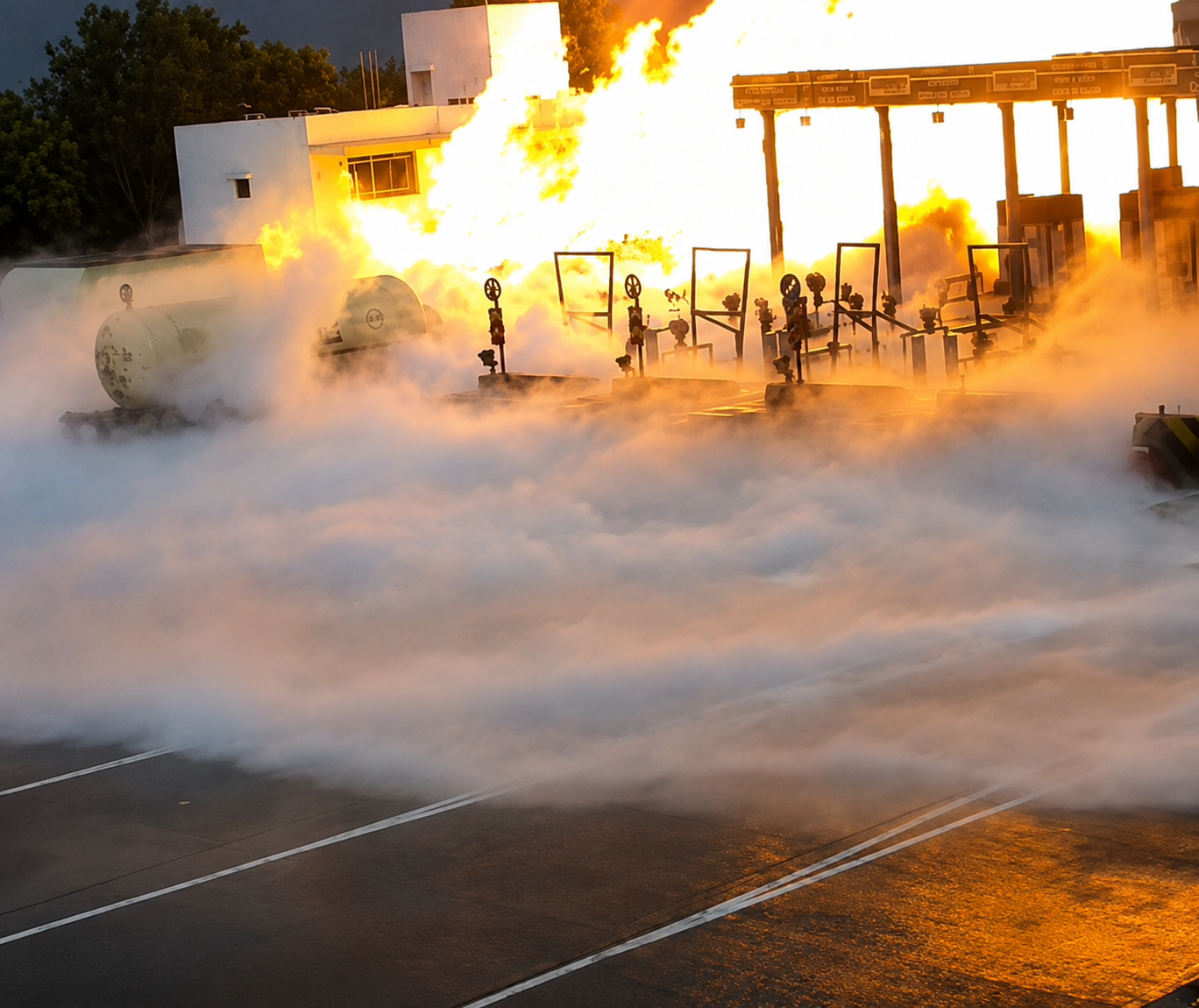
A deadly LPG tanker accident in northern India has again raised questions about the safety of hazardous cargo transport on busy road corridors. The incident occurred on June 26 at the Sihori Toll Plaza in Kaushambi district, Uttar Pradesh, when a tanker carrying liquefied petroleum gas lost control, hit a divider or wall near the toll area and triggered a major fire.
CCTV footage from the scene later appeared online, showing the tanker approaching the toll plaza before the crash and the rapid spread of gas and flames. The video drew wide public attention because it showed how quickly a road accident involving LPG can turn into a large-scale emergency.
Authorities confirmed that the death toll rose to five after several injured toll workers died in hospital. The tanker driver was among the victims. At least one seriously injured person remained hospitalized after the incident.
The accident is now under investigation. Police and technical teams are expected to examine the vehicle, the road conditions, the speed of the tanker, the condition of the toll plaza and the sequence that led from the crash to the gas leak and explosion.
As K2Cargo News previously reported in Euro NCAP Calls for Stronger Trailer Rear Guards, road safety for heavy vehicles is not only about driver discipline. Vehicle design, infrastructure, emergency procedures and interaction with other road users can decide whether an accident remains limited or becomes catastrophic.
What Happened at Sihori Toll Plaza
The accident happened in the morning near the Sihori Toll Plaza under Kokhraj police station limits in Kaushambi district.
According to Indian media reports citing police, the LPG tanker was traveling from Kanpur when it lost control and struck the toll plaza area. The impact caused a gas leak. White fumes quickly spread around the vehicle before ignition produced a large fireball.
The flames damaged the toll plaza area and nearby vehicles. Reports said 16 motorcycles and two cars parked near the site were destroyed. Traffic was disrupted, and emergency services were deployed to bring the fire under control.
The driver, identified in local reports as Dharmendra Dubey or Dwivedi, died in the vehicle. Several toll plaza employees suffered severe burn injuries and were taken to Swaroop Rani Nehru Hospital in Prayagraj. Some of them later succumbed to their injuries, bringing the total number of deaths to five.
Why LPG Accidents Escalate So Quickly
Liquefied petroleum gas is widely used for household, industrial and commercial purposes, but transporting it by road carries serious risks.
LPG is stored under pressure as a liquid. If containment is damaged, it can rapidly vaporize and spread as a gas cloud. Because LPG vapor is heavier than air, it can move close to the ground and accumulate in low-lying areas or around structures before igniting.
That makes the first minutes after a leak critical. If there is an ignition source nearby — a generator, engine, electrical spark, hot surface or open flame — the gas cloud can ignite suddenly. The result may be a flash fire, explosion or intense fireball.
In the Kaushambi case, the most important question for investigators will be how the leak started, how far the vapor spread and what exactly triggered ignition. The CCTV footage may help establish the sequence, but the final technical findings will depend on the official investigation.
A Toll Plaza Is a High-Risk Location
The location of the crash made the incident especially dangerous.
Toll plazas are places where vehicles slow down, stop, queue and pass through narrow lanes. They often include staff booths, barriers, electrical systems, generators, parked motorcycles and small service buildings. If a hazardous cargo vehicle crashes in such an environment, there are many potential ignition points and many people nearby.
This is why hazardous cargo routing requires special attention. LPG tankers and other dangerous goods vehicles need well-maintained vehicles, trained drivers, controlled speeds and emergency response protocols. Infrastructure operators also need procedures for quickly isolating the area, stopping traffic and evacuating workers.
The tragedy at Sihori shows that a toll plaza can become a vulnerable point in the hazardous cargo chain. Even if the tanker itself is designed for pressure transport, a crash in a crowded or infrastructure-heavy location can create severe secondary risks.
What the Investigation Must Establish
Several questions will be central to the investigation.
The first is why the tanker lost control. Reports mention that the vehicle hit a divider or wall near the toll plaza, but investigators will need to determine whether speed, road surface, weather, braking failure, driver error or another technical issue played a role.
The second is whether the tanker’s safety systems functioned properly. Investigators may examine valves, pressure equipment, impact damage and the condition of the tank and fittings.
The third is the emergency response. Authorities will likely review how quickly the area was evacuated, whether traffic was stopped, whether fire units arrived in time and whether toll plaza staff had training for hazardous materials incidents.
The fourth is infrastructure design. Toll lanes, barriers, dividers and service buildings must be assessed from the perspective of dangerous goods traffic. If vehicles carrying hazardous cargo regularly pass through such points, safety planning must reflect that risk.
Lessons for Hazardous Road Freight
The accident is a reminder that hazardous cargo logistics cannot be treated as ordinary trucking.
Transporting LPG requires more than a licensed tanker and a driver. It requires strict maintenance, route planning, driver training, emergency instructions, vehicle tracking and coordination with road infrastructure operators.
For carriers, the key lesson is prevention. A tanker crash involving LPG leaves very little time for correction once a leak begins. The most effective safety measure is to prevent loss of control, prevent impact damage and reduce the chance of ignition.
For infrastructure operators, the lesson is preparedness. Toll plazas, fuel stations, checkpoints and industrial gates should have emergency plans for hazardous cargo incidents. Staff should know when to evacuate, how to block access and whom to call.
For regulators, the accident may support stronger audits of LPG road transport, driver working conditions, tanker maintenance and emergency response readiness.
A Tragedy Beyond One Accident
The Kaushambi explosion was captured on video, but its importance goes beyond the shocking footage.
Five people lost their lives, families were affected, and workers at an ordinary road facility became victims of a hazardous cargo accident. The incident shows how closely transport safety, industrial safety and public infrastructure are connected.
As India’s road freight volumes continue to grow, hazardous cargo movements will also remain essential. LPG, fuel, chemicals and industrial gases must move across highways every day. The goal cannot be to stop such transport. The goal must be to make it safer.
That requires stronger prevention, better emergency planning and a safety culture that treats every LPG tanker as a high-risk vehicle, especially when it approaches toll plazas, populated areas or congested corridors.
The Sihori Toll Plaza tragedy should become a warning for the entire hazardous freight sector: one moment of loss of control can turn a routine trip into a fatal disaster.