

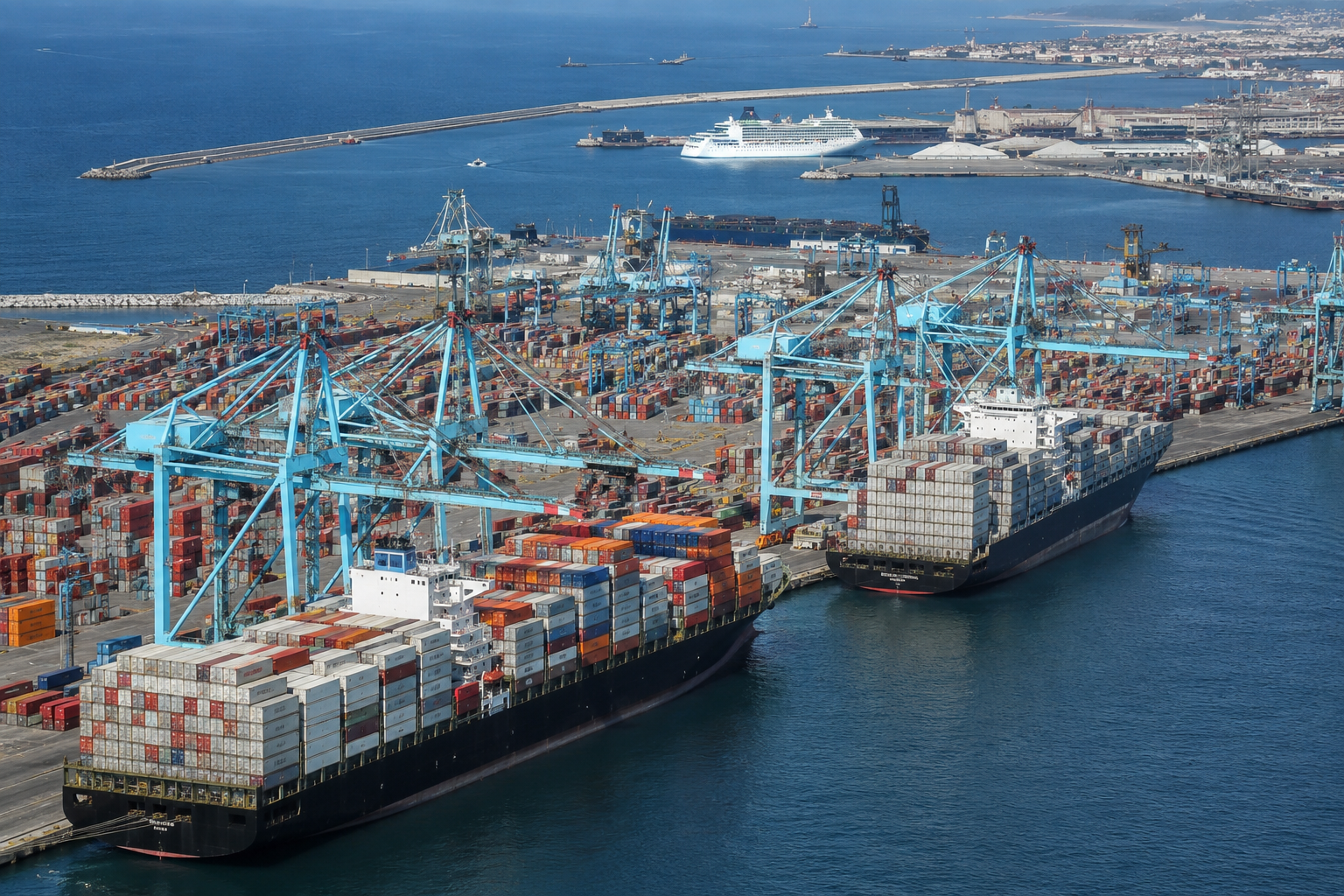
Ports located near these gateways continue to outperform much of Europe, reinforcing their role as critical hubs in global container shipping networks.
Tanger Med Emerges as a Global Leader
According to the 2025 rankings, Tanger Med in Morocco secured 6th place worldwide with a CPPI score of 134.0, making it one of the most efficient container ports on the planet.
The port’s success is driven by its strategic location at the entrance to the Mediterranean Sea, advanced terminal infrastructure, extensive transshipment operations, and strong connectivity between Europe, Africa, Asia, and the Americas.
Over the past decade, Tanger Med has transformed into a major logistics gateway, attracting global shipping alliances and becoming a key hub for container redistribution across multiple continents.
Algeciras Strengthens Gibraltar’s Position
Spain’s Port of Algeciras ranked 12th globally with a CPPI score of 121.9, further confirming the importance of the Gibraltar Strait as one of the world’s most efficient logistics corridors.
Algeciras remains one of Europe’s busiest transshipment centers and serves as a crucial connection point for cargo moving between Northern Europe, the Mediterranean, Africa, and Asia.
Its strong performance demonstrates the growing competitiveness of ports focused on rapid vessel turnaround times, modern automation systems, and efficient container handling operations.
Port Said Benefits from Suez Canal Traffic
Egypt’s Port Said secured 15th place worldwide with a CPPI score of 117.0, maintaining its position among the world’s leading container ports.
Located at the northern entrance to the Suez Canal, Port Said has benefited from its strategic role in global East-West trade routes. Despite disruptions caused by geopolitical tensions and changing shipping patterns, the port successfully managed high volumes of transshipment cargo throughout the year.
The results confirm that logistics excellence in the Mediterranean region is increasingly concentrated around the two major maritime gateways that connect global trade flows.
Red Sea Crisis Produced Mixed Results Across the Mediterranean
The ongoing disruption of shipping routes in the Red Sea had significantly different effects on Mediterranean ports.
While transshipment hubs such as Port Said managed to maintain strong operational performance, several European ports experienced growing pressure from unexpected cargo flows and vessel diversions.
One of the clearest examples was Valencia, which faced a substantial increase in unplanned transshipment volumes. As a result, berth productivity fell from 64% to 49%, causing the Spanish port to drop dramatically to 368th place globally with a CPPI score of -75.8.
The decline illustrates how rapidly changing shipping patterns can overwhelm even well-established logistics hubs when infrastructure capacity becomes constrained.
Italy Shows a Two-Speed Port Performance Landscape
Italy’s results reveal a sharp contrast between its best-performing ports and those facing operational challenges.
Savona-Vado emerged as the country’s strongest performer, ranking 51st worldwide and improving its score by 51 points compared with 2020. It remains the only Italian port within the global top 100, reflecting successful investments in infrastructure modernization and operational efficiency.
In contrast, several major Italian gateways recorded significantly weaker results.
Genoa ranked 392nd globally with a score of -205.3, while Trieste placed 382nd with a score of -130.7.
Industry analysts attribute these low rankings to increasing congestion, longer vessel waiting times, operational bottlenecks, and growing pressure on terminal infrastructure.
Mediterranean Competition Continues to Intensify
The CPPI 2025 results underline a major shift in container shipping dynamics across the Mediterranean region.
Ports located near strategic maritime chokepoints continue to strengthen their competitive positions through investments in automation, terminal expansion, digital logistics platforms, and transshipment capabilities. At the same time, several traditional European gateways are facing mounting challenges related to congestion, infrastructure limitations, and changing global trade patterns.
As shipping lines continue to optimize their networks and adapt to geopolitical disruptions, port efficiency is becoming an increasingly important factor in determining cargo flows and investment decisions.
The latest rankings suggest that the future of Mediterranean container logistics will increasingly be shaped by highly efficient hub ports capable of handling growing vessel sizes, rising transshipment volumes, and rapidly evolving global supply chains.
