

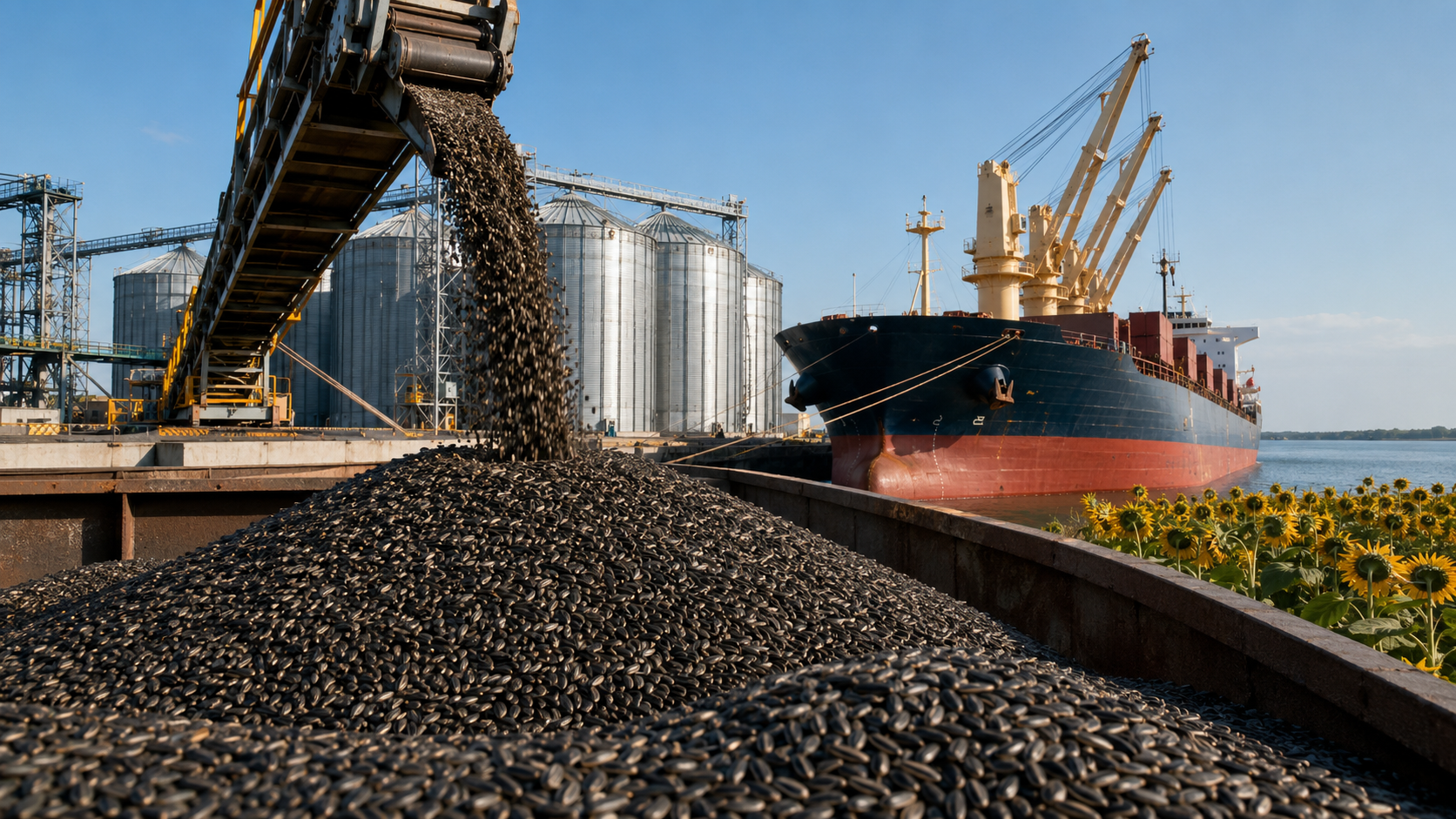
Turkey is preparing to open a new import window for sunflower seed and crude sunflower oil in 2027, a move that could influence Black Sea trade flows and create new opportunities — but also new risks — for Ukrainian exporters.
Under the approved mechanism, Turkey will allow imports of up to 1.25 million tons of oilseed sunflower at a 0% customs duty. Alternatively, the quota may be used for an equivalent volume of crude sunflower oil — up to 500,000 tons — with an import duty of 20%. The preferential regime will apply from January 11 to May 31, 2027.
The policy is designed to balance two goals. First, Ankara wants to support domestic farmers by giving priority quota access to companies that buy locally produced sunflower seed between July 1 and November 30, 2026. Second, it wants to ensure that Turkish crushers and oil processors have enough raw material after the local harvest is absorbed.
For exporters in the Black Sea region, the quota is significant. Turkey is a large processing and consumption market, and any change in its import rules affects the pricing of sunflower seed, crude sunflower oil and related products. For Ukraine, the measure could open additional sales opportunities, but competition will be intense, especially from Russia.
As K2Cargo News previously reported in Ukrainian Ports Handle Over 40 Million Tons of Cargo Despite Ongoing Attacks, Ukraine’s export capacity depends heavily on stable logistics through ports and regional corridors. In the oilseed sector, market access is only one part of the equation; delivery cost, reliability and buyer confidence are just as important.
What the Turkish Quota Allows
The 2027 quota will apply to oilseed sunflower and crude sunflower oil.
If the entire quota is used for seed, Turkey may import up to 1.25 million tons with zero duty. If it is used for crude oil, the equivalent volume is 500,000 tons, with a 20% duty. The conversion is based on a 40% oil yield, which reflects the relationship between seed volume and crude oil output.
Companies will need import licenses from Turkey’s Ministry of Trade, and those licenses will not be transferable. The quota allocation rules are expected to be defined through separate ministerial procedures.
The timing is also important. Imports under the preferential regime will begin only in January 2027, after the main domestic purchasing period. This means Turkey is trying to avoid direct pressure on local farmers during harvest, while still giving processors access to cheaper imported raw material later in the season.
Why Turkey Needs Imports
Turkey has a large vegetable oil market and strong processing capacity, but domestic sunflower production does not always cover industrial demand.
That creates a structural need for imports. Depending on harvest conditions and prices, Turkey may import sunflower seed for crushing, crude sunflower oil for refining, or both. The quota gives the government a tool to manage supply and prices while keeping some protection for local producers.
For processors, the quota improves predictability. They can plan purchases knowing that part of the raw material will be available under lower duties. For consumers, the policy is aimed at supporting stable vegetable oil supply and limiting price pressure.
However, farmers may see the measure differently. Even if imports start after the domestic purchasing window, the expectation of cheaper imports can influence buyer behavior during harvest. Crushers may use future import access as a bargaining factor when negotiating with local suppliers.
What It Means for Ukraine
For Ukraine, the quota creates both opportunity and uncertainty.
Ukraine remains one of the world’s major producers and exporters of sunflower oil and sunflower meal. In theory, Turkey’s import window could support additional demand for Ukrainian seed or crude oil in early 2027. But the final result will depend on price, logistics and competition.
Russia remains a major competitor in the Black Sea sunflower complex. If Russian seed, oil or meal is cheaper and more predictable for Turkish buyers, Ukrainian exporters may find it difficult to regain market share without a clear price or quality advantage.
This is especially visible in sunflower meal. According to ASAP Agri analysis, Turkey has shifted strongly toward Russian sunflower meal and away from Ukrainian product. A decade ago, Ukraine and Russia each held around 45% of Turkey’s sunflower meal import market. In the current season, Russia accounts for about 90%, while Ukraine’s share has fallen to around 4%.
The reasons are not only political. ASAP Agri points to disrupted Ukrainian logistics, lower crushing activity, weaker supply predictability and a price gap in favor of Russian product. In feed markets, where sunflower meal is often interchangeable and cost is critical, buyers usually choose the cheaper and more reliable offer.
Sunflower Meal Shows the Risk
The sunflower meal trend is a warning for Ukraine’s wider oilseed exports.
Meal is a byproduct of sunflower crushing and is used in animal feed. If Turkey imports more sunflower seed and processes it domestically, its own meal supply may increase. This can reduce the need for imported meal or change the structure of demand.
At the same time, when Turkey does import meal, Russian suppliers currently have a strong advantage. ASAP Agri notes that Russian sunflower meal offers in early 2026 were around $15–20 per ton cheaper than Ukrainian product on a Black Sea basis. This price gap helped Russia strengthen its position in Turkey.
For Ukrainian exporters, the challenge is clear: Turkey can be an attractive market, but it is no longer guaranteed. Ukraine has redirected more sunflower meal exports toward China and the EU, while Turkey has become less central in its export structure.
This makes the 2027 quota important not only as a volume issue, but also as a competitiveness test. Ukraine will need reliable logistics, competitive pricing and predictable supply if it wants to capture part of Turkey’s additional demand.
Black Sea Competition Will Intensify
The new quota will likely increase competition among Black Sea suppliers.
Turkey’s processors will compare offers from Ukraine, Russia, Moldova, Romania, Bulgaria and other origins. They will consider price, delivery time, payment terms, quality, phytosanitary conditions, insurance and port reliability.
For Ukraine, logistics will remain decisive. If maritime exports through Ukrainian ports continue to operate steadily and freight costs stay competitive, Ukrainian crude oil and seed may be attractive to Turkish buyers. If delays, insurance costs or supply uncertainty increase, Turkish companies may prefer alternative suppliers.
For Russia, the quota may provide another outlet, especially if EU restrictions continue to redirect Russian sunflower products toward non-EU markets. For Turkey, this creates more supplier options, but also strengthens dependence on Black Sea politics and logistics.
A Market Signal for 2027
Turkey’s decision shows that the country expects to continue relying on imported sunflower raw materials in 2027.
The quota is larger than the previous preferential framework and gives processors a clear import channel after the domestic purchasing period. For the Black Sea region, this means that Turkish demand will remain one of the important price signals for sunflower seed and crude oil.
For Ukraine, the opportunity is real, but not automatic. The country must compete not only with price, but also with reliability. The shift in Turkey’s sunflower meal imports toward Russian product shows what happens when buyers begin to see one supplier as cheaper and more predictable.
The 2027 quota may therefore become a chance for Ukrainian exporters to regain part of their position in Turkey — or another example of how Black Sea agricultural trade is being reshaped by logistics, duties and risk perception.
Read also: Ukrainian Ports Handle Over 40 Million Tons of Cargo Despite Ongoing Attacks