

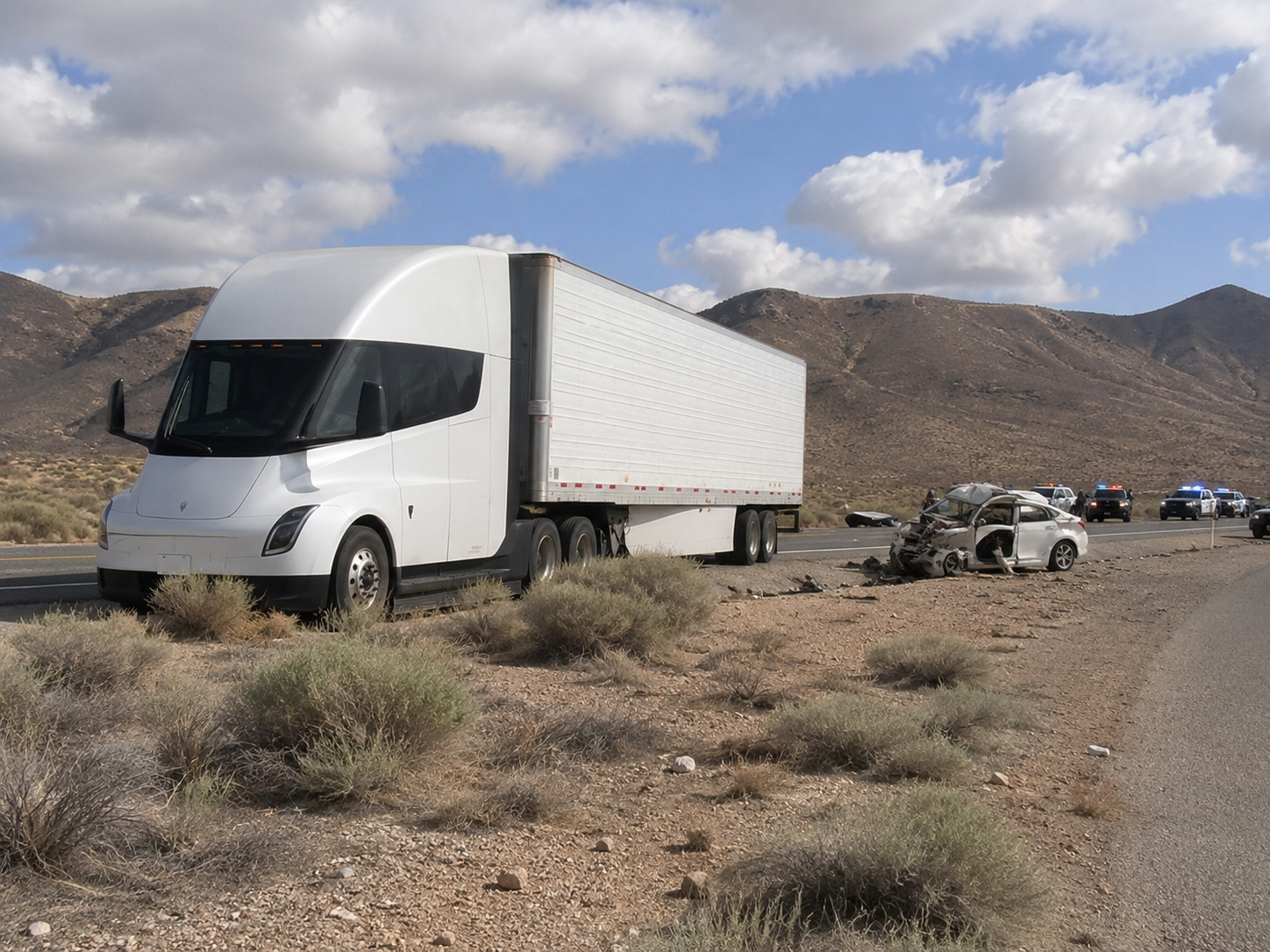
The first known deadly crash involving a Tesla Semi has become a difficult test for the electric truck’s public image. The crash happened on June 28 in Dayton, Nevada, when a Tesla Semi struck two passenger vehicles stopped at a traffic light on U.S. Highway 50 near Traditions Parkway.
Two people in a Volkswagen Beetle were killed. Another person suffered life-threatening injuries and was taken to a hospital. According to preliminary statements cited by local authorities and U.S. media, the truck driver may have fallen asleep before the collision. The investigation is still ongoing, and no final official conclusion has been released.
The case is especially sensitive because Tesla is preparing to expand Semi production near its Nevada Gigafactory. The truck is positioned as a next-generation electric vehicle for heavy freight, but the crash has raised an old question: how far can vehicle technology go in preventing accidents caused by human fatigue?
As K2Cargo News previously reported in Euro NCAP Calls for Stronger Trailer Rear Guards, truck safety is increasingly judged not only by vehicle strength, but also by the ability to prevent crashes or reduce their consequences.
Human Error or a Technology Question?
At this stage, driver fatigue remains the main theory. If confirmed, the crash would fall into one of the oldest and most dangerous categories in freight transportation: a professional driver losing alertness behind the wheel.
But the Tesla Semi is not a conventional diesel tractor. It is a highly publicized Class 8 electric truck from a company closely associated with driver-assistance technology. That is why the public reaction quickly moved beyond one individual crash.
The central question is not whether a truck driver can make a fatal mistake. They can, and fatigue remains a serious risk in road freight. The real question is whether a modern heavy truck should be able to recognize such a situation and intervene before impact.
In passenger cars, automatic emergency braking and advanced driver-assistance systems have become common. In heavy trucks, the challenge is greater because the vehicle is heavier, stopping distances are longer, and the consequences of a rear-end collision can be severe.
Tesla Semi Is Not an Autonomous Truck
One important point must be clear: the Tesla Semi is not an autonomous truck.
Tesla’s passenger cars have been at the center of years of debate over Autopilot and Full Self-Driving, but the Semi should not automatically be placed in the same category. Tesla describes the Semi as having active safety features, advanced motor and brake controls, a central seating position, and a structure designed to improve visibility while reducing rollover and cab-intrusion risks.
However, Tesla has not publicly disclosed detailed technical specifications for the Semi’s collision-avoidance systems at the level regulators, insurers, and fleet operators may now want after a fatal crash.
That creates uncertainty. If the truck has active safety systems, what are their limits? At what speeds and under what conditions can they detect stopped vehicles? How do they respond if the driver does not react? These are the questions that now matter for carriers considering the Semi.
The Final Safety Barrier
Fatigue-related crashes are especially dangerous because there may be almost no time to correct the situation.
If a driver falls asleep, there may be no braking, no steering input, and no attempt to avoid the obstacle. In that scenario, the vehicle’s own ability to detect danger and apply the brakes becomes the last line of defense.
This does not mean technology can prevent every crash. A loaded heavy truck cannot stop like a passenger car. Road surface, speed, weight, reaction time, sensor performance, and trailer configuration all affect the outcome.
But the Nevada crash is likely to strengthen arguments for tougher automatic emergency braking standards for heavy vehicles. U.S. regulators have already proposed rules that would require AEB systems on vehicles weighing more than 10,000 pounds. The Tesla Semi case shows why the issue is not theoretical.
Why the Timing Is Difficult for Tesla
The crash comes at a difficult moment for Tesla.
The company is trying to prove that the Semi can become a serious alternative to diesel tractors for large fleets. Electric trucks promise lower energy costs, reduced emissions, and simpler drivetrains, but fleet buyers still focus first on reliability, uptime, safety, charging infrastructure, and total cost of ownership.
One crash does not define the safety of an entire vehicle platform. Heavy trucks of all brands are involved in serious crashes every year. But the first fatal Tesla Semi crash carries symbolic weight because the vehicle is still new, highly visible, and closely tied to Tesla’s broader technology image.
For fleet customers, the case may not immediately change purchasing decisions. But it will increase the need for transparent safety data, clear driver-assistance documentation, and evidence of how the truck behaves in emergency scenarios.
Not Every Tesla Debate Applies to the Semi
There is a risk of mixing two different debates.
Tesla passenger vehicles have faced years of scrutiny over Autopilot and Full Self-Driving. Those systems require active driver supervision and do not make the vehicle autonomous, but their branding and real-world use have generated legal and regulatory controversy.
The Semi is different. It is a professional freight vehicle designed to be operated by a human driver. The proper comparison is not with robotaxis or consumer FSD, but with other Class 8 trucks equipped with active safety systems.
That distinction matters. If investigators do not find a vehicle defect or system failure, the crash should not be treated as proof that electric trucks are unsafe. But it can still be used to ask whether all heavy trucks — electric or diesel — need stronger last-resort safety systems.
A Warning for the Entire Freight Industry
The Nevada crash is a tragedy first. Two people died, and another person was seriously injured. The technical and legal questions should not overshadow the human loss.
For the freight industry, the broader lesson is clear. Electrification changes the powertrain, but it does not eliminate the core risks of road transportation: fatigue, distraction, speed, stopping distance, and the vulnerability of passenger vehicles in collisions with heavy trucks.
If next-generation trucks promise better safety, manufacturers will need to show how those systems work in real conditions. Regulators will need clearer standards. Fleet operators will need strong fatigue-management policies, not only new vehicles.
The Tesla Semi crash may eventually be explained mainly by driver fatigue. But the question it raises is bigger than one driver and one brand: when human attention fails, how much protection should a modern heavy truck provide?