

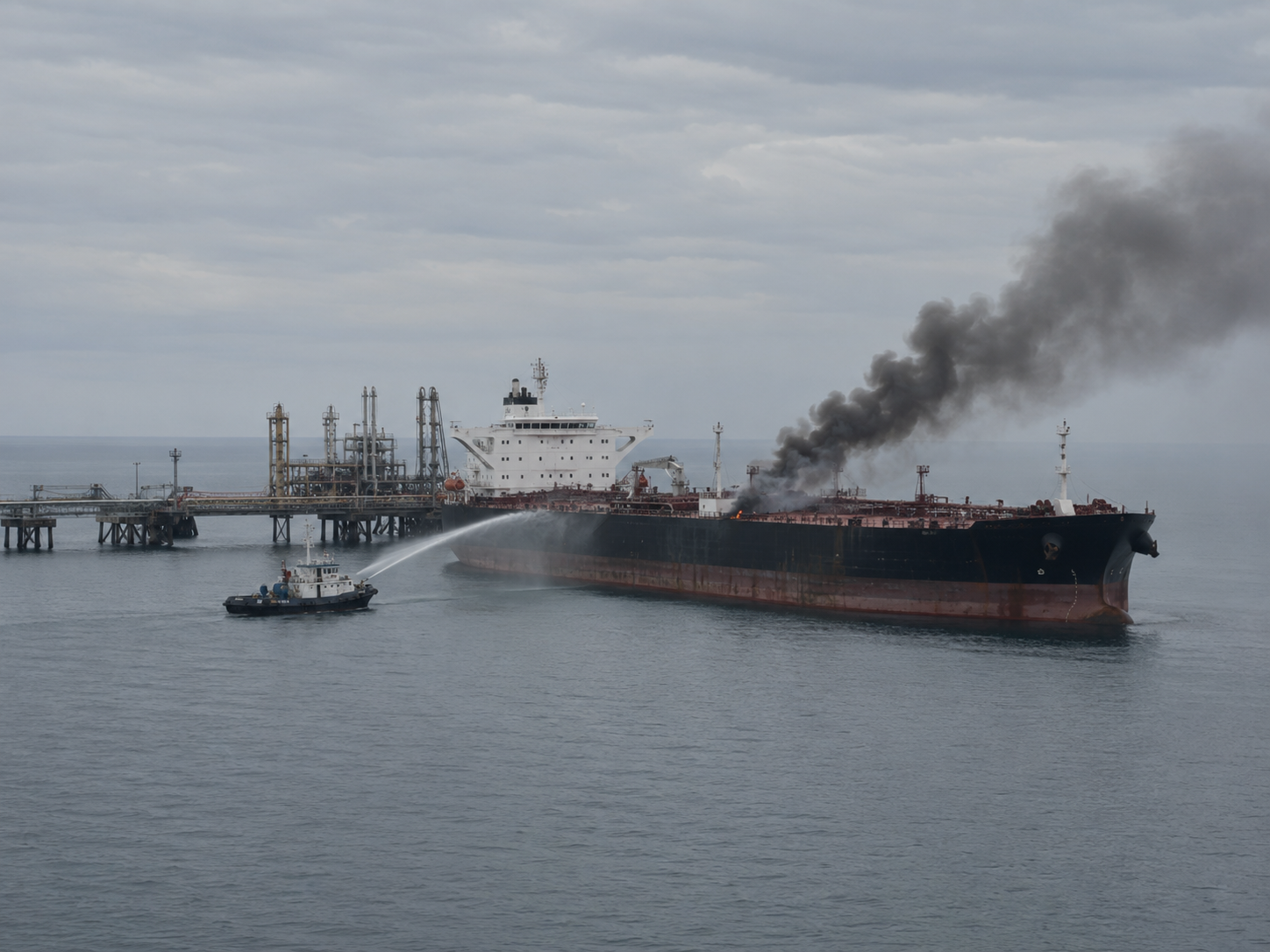
NISSOS SIFNOS Was Hit During Loading
Oil tanker operations at the Caspian Pipeline Consortium’s Black Sea Marine Terminal have again been disrupted following another reported drone attack.
According to preliminary information, Marshall Islands-flagged tanker NISSOS SIFNOS was attacked overnight on July 30 while conducting loading operations.
The vessel was taking on crude belonging to Tengizchevroil, operator of Kazakhstan’s giant Tengiz field.
A fire broke out on the cargo deck following the strike.
The crew began firefighting, supported by CPC auxiliary vessels and emergency-response resources.
The fire was brought under control.
According to the information available at publication time, no crew members were injured and no oil spill occurred.
Loading operations were temporarily suspended following the incident.
MARATHI Was Attacked While Approaching the Terminal
A second incident was reported during the same period.
The tanker MARATHI, which was heading toward the CPC terminal for loading, was also reportedly attacked in the Black Sea.
MARATHI is a Maltese-flagged crude oil tanker approximately 274 metres long with deadweight capacity of nearly 150,000 tonnes.
At publication time, detailed information about damage to MARATHI, the condition of its crew or its ability to continue the voyage had not been disclosed.
The latest episode therefore affected two commercial tankers connected with CPC loading operations: one already at the terminal and another approaching it.
Responsibility for the latest attacks had not been independently and officially confirmed at publication time, making definitive attribution premature.
NISSOS SIFNOS Is a Large Suezmax Tanker
NISSOS SIFNOS is a modern crude oil tanker delivered in 2020.
It is 274 metres long and 48 metres wide, with deadweight capacity of approximately 157,400 tonnes.
The vessel is registered in the Marshall Islands and belongs to the Suezmax class, widely used for transporting large crude cargoes internationally.
Its cargo tanks have nominal capacity exceeding 164,000 cubic metres.
Ships of this size are central to CPC’s export system.
Crude travels through the Tengiz–Novorossiysk pipeline before being transferred to tankers through offshore single point moorings.
Damage to a tanker during loading can therefore interrupt not only that individual voyage but also operations at the affected offshore loading point.
CPC Had Resumed Loading Only on July 27
The latest incident came just days after CPC restarted oil lifting.
On July 27, the consortium announced that loading had resumed at its Marine Terminal, with two tankers berthed at offshore moorings.
Operations had previously remained constrained for roughly a week following a series of attacks and safety assessments involving vessels and terminal infrastructure.
Restarting exports was critical for Kazakhstan.
Export restrictions forced Kazakh producers to sharply reduce oil output. On one day, crude and gas-condensate production fell to roughly 1 million barrels per day compared with an average of about 2.16 million bpd in June.
A renewed suspension now creates another risk across the entire chain connecting western Kazakhstan’s oilfields with international buyers.
Two Tankers Were Attacked on July 19
The July 30 incident follows a sequence of earlier attacks around the terminal.
On July 19, tankers ASIA and NISSOS IOS were attacked during loading operations.
ASIA was carrying Tengizchevroil crude, while NISSOS IOS was loading volumes associated with Kashagan and KazMunayGas.
A fire broke out aboard ASIA and was extinguished with CPC emergency-response assistance.
No oil spill was reported, both tankers remained afloat and their crews did not require medical treatment.
CPC suspended loading after the incident.
Operations partially resumed later on July 19, but the period of normal activity proved extremely short.
NELSA Was Hit the Following Day
On July 20, another civilian tanker, NELSA, was attacked while loading at a CPC single point mooring.
The strike hit the starboard aft section between the accommodation block and the engine and boiler spaces.
Fire broke out on deck and inside parts of the vessel and took several hours to extinguish.
Twenty-two members of the international crew were evacuated onto CPC tugboats, while the master and chief officer remained aboard.
NELSA stayed afloat and no oil escaped from its cargo tanks, but loading was again suspended.
Including the preliminary reports from July 30, the pattern now involves repeated incidents affecting tankers either directly during loading or while approaching the CPC terminal.
CPC Is Critical to Kazakhstan
For Kazakhstan, the issue is far larger than damage to individual vessels.
The 1,511-kilometre CPC pipeline connects the country’s largest oilfields with the Russian Black Sea coast near Novorossiysk.
Current industry estimates put the route at more than 80% of Kazakhstan’s oil exports.
CPC transports crude from Tengiz, Kashagan and Karachaganak, all major international energy projects.
The system handled approximately 70.5 million tonnes of crude in 2025.
More than 75% of that volume belonged to international shippers including Tengizchevroil, ExxonMobil, KazMunayGas, Eni and Shell.
Attacks around the terminal therefore affect far more than Russian infrastructure.
They directly disrupt Kazakhstan’s exports and the interests of major international oil companies.
Terminal Shutdowns Quickly Reduce Oil Production
Oil logistics differ from many other freight chains because the flow cannot simply be parked indefinitely.
Production continues feeding crude into the pipeline, while storage tanks and terminal facilities have finite capacity.
If tankers stop taking crude, available storage begins to fill.
Pipeline throughput must then be reduced and upstream producers eventually have to cut output at the fields themselves.
That effect was already visible during the previous CPC shutdown.
Even a relatively short loading suspension can therefore affect production at Tengiz and other major Kazakh projects within days.
CPC Cannot Be Quickly Replaced
Kazakhstan has been expanding alternative export options through the Caspian Sea and Azerbaijan, China and rail-based routes.
None currently offers anything close to CPC’s capacity.
Redirecting large volumes from Tengiz is particularly difficult.
Replacing the Novorossiysk route would require additional pipelines, Caspian tanker capacity, terminals, rail infrastructure and long-term commercial agreements.
During a short-term CPC disruption, the practical response is therefore usually not to reroute all crude but to reduce production and wait for Black Sea loadings to resume.
That dependence makes Kazakhstan particularly vulnerable to repeated interruptions at the terminal.
Shipowners and Insurers Now Face Higher Risks
The implications extend beyond oil producers.
After several attacks within a short period, tanker owners need to reassess whether calls at the CPC terminal remain commercially acceptable.
A terminal can technically be ready to operate, but exports still require shipowners willing to send vessels there.
Each new incident can increase war-risk insurance premiums, security requirements and freight rates.
Owners must also consider the possibility of damage to an expensive Suezmax tanker, risks to international crews and months of repair downtime.
A similar commercial response has already emerged elsewhere in the Black Sea. K2Cargo.News previously reported that shipowners temporarily suspended new calls at Ukrainian ports as security risks increased sharply.
Military risk is therefore increasingly affecting commercial shipping on both sides of the Black Sea.
Attacks During Loading Carry Greater Consequences
An attack while a tanker is loading crude presents a more serious hazard than damage to an empty ship at sea.
The tanker is connected to terminal infrastructure through cargo hoses, oil is moving through deck manifolds and the volume inside its cargo tanks is continuously increasing.
A major fire around the manifold or cargo deck could potentially compromise the transfer system.
In a worst-case scenario, the result could include an oil spill, major fire and damage to the offshore loading facility itself.
That scenario was avoided in the earlier July incidents.
On July 19 and 20, and according to preliminary information again on July 30, emergency response prevented a crude spill.
But repeated attacks increase the probability that a future incident could have more serious consequences.
Black Sea Shipping Is Entering a New Risk Phase
July’s incidents indicate that commercial vessels in the Black Sea are becoming increasingly exposed to the direct effects of the Russia–Ukraine war.
Ships have been attacked around Russian terminals, in the Sea of Azov and near Ukrainian ports.
Many of the vessels involved are registered under third-country flags and carry multinational crews.
For insurers, that distinction matters less than physical exposure.
War-risk assessments focus on the probability that a vessel could be damaged in a particular area, regardless of its flag.
When several tankers are hit near one terminal within days, the location itself begins to be treated as a higher-risk maritime zone.
Kazakhstan Again Faces Export Constraints
For Astana, the immediate question is how long the latest suspension will last.
Following earlier attacks, Kazakhstan had already been forced to reduce production, while the July 27 restart allowed producers to begin restoring normal export operations.
Another attack only three days later shows that the route has not yet returned to stable operation.
If the terminal remains offline for an extended period, producers may again need to adjust output.
Tengiz would be particularly exposed because it is the largest source of CPC crude and one of Kazakhstan’s most important international energy projects.
The disruption may also affect shipping schedules, freight rates and the timing of CPC Blend deliveries to international buyers.
The Key Question Is How Quickly Loading Can Restart
Three factors now matter most: the condition of NISSOS SIFNOS and MARATHI, the integrity of CPC’s offshore loading infrastructure and whether other tanker operators remain willing to approach the terminal.
If vessel damage is limited and CPC’s equipment remains operational, a technical restart could be possible relatively quickly.
But after a sequence of attacks, the decision no longer depends on CPC alone.
Shipowners, tanker operators, insurers and cargo owners all have to reassess the risk.
That transforms the July 30 incidents from isolated maritime events into a systemic problem for Kazakhstan’s export logistics.
CPC may be able to restore equipment rapidly, but stable oil exports are impossible if tankers cannot safely approach the single point moorings.
The latest attacks again show that the most vulnerable part of the Tengiz-to-Black Sea supply chain is increasingly its final stage — the offshore transfer of crude into tankers.
Read also: Shipowners Suspend Calls at Ukrainian Ports
