

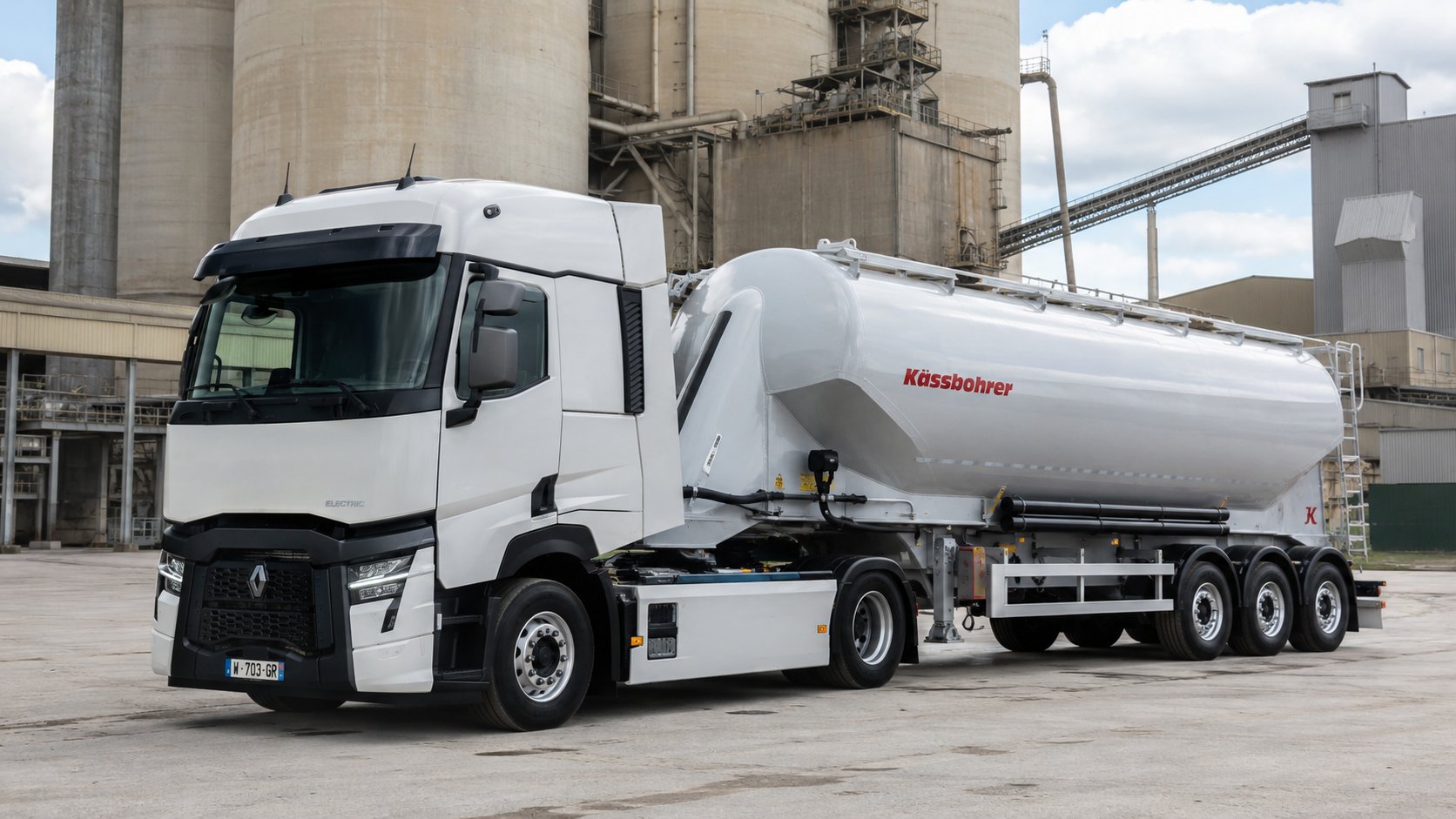
Premiere Scheduled for IAA Transportation 2026
Kässbohrer is preparing to officially unveil the SSL 33 Zero Emission Cement Silo, a new semi-trailer designed to transport cement and other dry bulk materials.
The manufacturer describes the vehicle as Europe’s first and only zero-emission cement silo. It will make its public debut at IAA Transportation 2026, taking place in Hanover from September 15 to 20.
The semi-trailer has also been entered for the International Trailer Award 2027 in the Body category, which covers innovative commercial vehicle body and superstructure solutions.
What “Zero Emission” Means
The semi-trailer does not propel itself, so the zero-emission description primarily concerns the operation of the complete vehicle combination and the unloading process.
When the SSL 33 is coupled to a battery-electric tractor, transport can take place without local exhaust emissions. Unloading also does not require a diesel engine because the trailer is equipped with an onboard electric compressor.
The compressor connects to the tractor’s electrical system. It produces the compressed air required to pressurise the tank and pneumatically discharge the cement.
Conventional configurations commonly use a compressor driven by the tractor’s engine or by a separate diesel-powered unit. The engine must continue running during unloading, consuming fuel and producing emissions and noise.
Electric Compressor Is Mounted on the Trailer
The onboard compressor allows carriers to use a tractor that does not have its own pneumatic unloading equipment.
This expands the range of compatible vehicles and makes it easier to assemble a fully electric combination. The transport company does not need to order a specialised blower system mounted directly on the tractor chassis.
The solution is particularly relevant for electric trucks. Additional equipment installed on the tractor can increase weight, complicate the configuration and occupy space required for batteries and other drivetrain components.
Electrifying the unloading process could also reduce noise at cement plants, construction sites and terminals, particularly during operations in urban areas or at night.
Lightweight Design Offsets Battery Weight
One of the main challenges facing heavy battery-electric trucks is their higher unladen weight. Battery systems are heavier than fuel tanks and some components of a conventional diesel vehicle, potentially reducing the available payload.
Kässbohrer redesigned the SSL 33 to reduce the trailer’s own weight and partially compensate for the battery mass of an electric tractor.
According to the manufacturer, the lightweight silo can recover approximately 44% of the payload capacity that might otherwise be lost because of heavy battery systems.
This is particularly important in cement transport. The cargo has a high density, and the profitability of each trip depends directly on the number of tonnes the combination can carry without exceeding gross vehicle or axle-weight limits.
The 44% figure does not mean that an electric combination will fully match a diesel truck’s payload. The actual difference will depend on the tractor model, battery capacity, equipment, permitted combination weight and national regulations.
Silo Capacity Reaches 33 Cubic Metres
The Kässbohrer SSL 33 Zero Emission is 7.65 metres long and has a capacity of 33 m³.
Its basic dimensions and purpose are similar to those of the standard SSL 33 designed for conventional diesel tractors. However, the new version has been developed from the outset around the requirements of electric transport.
Its compact dimensions should support manoeuvrability at industrial facilities, construction sites and locations where available space is limited.
A volume of 33 m³ is suitable for typical cement and mineral-powder transport operations, where the vehicle often reaches its legal weight limit before its full geometric capacity is used.
Diesel Tractors Can Also Use the Trailer
Despite its Zero Emission name, the SSL 33 is not restricted to battery-electric trucks. Kässbohrer says the semi-trailer is also compatible with diesel tractor units.
In that configuration, the complete vehicle combination cannot be described as zero-emission because the tractor continues to burn fuel while driving. However, the electric compressor can reduce diesel consumption and emissions during unloading.
Kässbohrer estimates that the lower unladen weight and electric compressor could together eliminate 12.8 tonnes of CO₂ and produce annual savings of approximately €9,050 per vehicle.
The announcement does not provide a detailed calculation methodology, including the assumed mileage, electricity cost, diesel price or operating pattern. The result achieved by an individual carrier will therefore depend on trip frequency, unloading time, energy prices and vehicle configuration.
Payload Remains Central to Electrification
Kässbohrer’s development shows that the transition to electric road freight involves more than tractors and charging stations.
Trailer manufacturers must also adapt their products to the higher weight of electric vehicles, new power interfaces and changing operational requirements.
Replacing a diesel tractor with an electric model is not enough on its own. Carriers must examine trailer compatibility, available payload, auxiliary energy consumption and whether loading or unloading can be performed without a separate combustion engine.
These issues are particularly important in cement transport because unloading requires substantial compressor power and every kilogram of lost payload affects the cost of moving each tonne of material.
Zero Emissions Does Not Mean a Zero Carbon Footprint
The SSL 33 Zero Emission name refers to the absence of local exhaust emissions when the trailer operates with an electric tractor and uses its electric compressor.
It does not mean that manufacturing the semi-trailer, batteries, electricity or cement produces no greenhouse-gas emissions. The full carbon footprint depends on the electricity mix, materials, operating life and intensity of use.
Even so, electric unloading removes the need to run a diesel engine at the delivery site. This can provide practical benefits for companies seeking to reduce local air pollution, noise and fuel consumption.
The Hanover premiere should provide a clearer indication of whether the design is ready for widespread commercial use and whether its operational benefits can offset the higher cost of electric equipment.
Read also: Volvo to Show Future Trucks at IAA 2026