

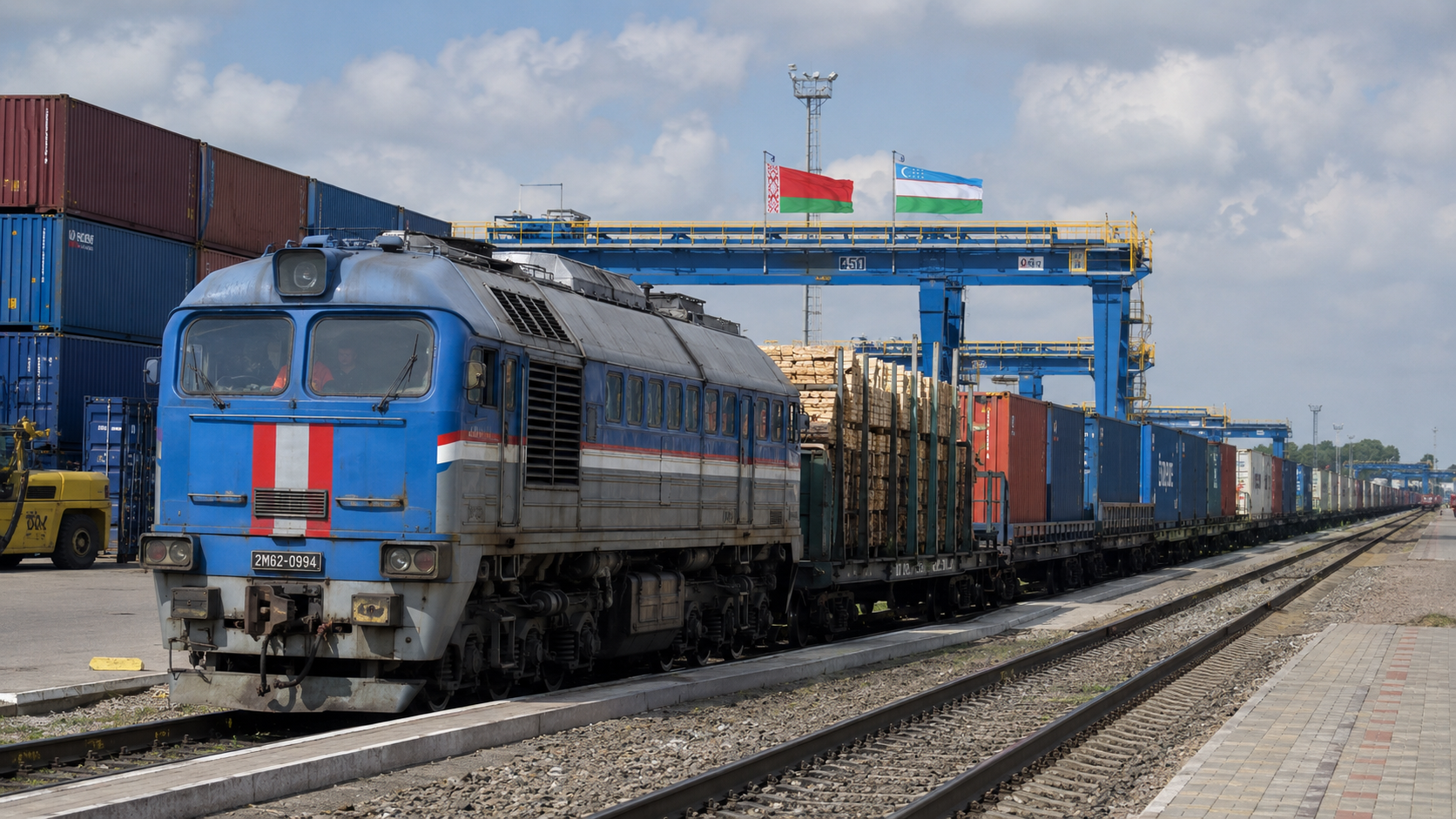
First Train Departs From Orsha
Belarus has launched a new regular rail service for exports to Uzbekistan. The first Slavic Caravan train departed from Orsha-Vostochnaya station on July 30, 2026 and will travel through Russia and Kazakhstan.
The train includes wagons carrying wood-processing products, sugar, potato starch and animal feed. The project is intended to increase exports of Belarusian machinery, agricultural goods, wood products and other commodities to the Uzbek market.
During the initial stage, the train is expected to operate twice a month. A second train has already been assembled, indicating that the partners intend to develop the route as a regular logistics service rather than a single demonstration shipment.
Delivery to Uzbekistan Will Take Up to Seven Days
One of the main advantages of the new route is expected to be shorter and more predictable transit times.
The train will travel through Belarus, Russia, Kazakhstan and Uzbekistan without being broken up or making additional operational stops. It will run according to a fixed schedule, allowing shippers to know when the cargo is due to depart and arrive.
The expected journey from Orsha to Uzbekistan will take between five and seven days. Under the previous arrangement, the delivery of an individual freight wagon could take as long as two months.
Rail Service Is Expected to Reduce Costs
The new service is not intended only for major companies capable of filling an entire freight wagon.
According to the Belarusian side, transporting a 20-tonne container by rail will cost at least one and a half times less than moving the same shipment by road. Companies will be able to ship individual containers without waiting until they have enough cargo to fill a standard 60-tonne wagon.
A consolidated container service will also be available for smaller consignments from several shippers, making the route more accessible to small and medium-sized businesses.
Orsha Becomes a Consolidation Hub for Belarusian Cargo
Orsha-Vostochnaya was selected as the formation point for the Slavic Caravan because of its location and connections with Belarus’s national rail network.
Cargo from every region of the country can be delivered to the station, where wagons and containers are consolidated into a single train for direct movement to Uzbekistan.
The range of cargo is expected to expand in the future. Containers delivered to Orsha by truck may also be included in the train, allowing road and rail services to be combined within a single multimodal supply chain.
Uzbekistan Will Provide Return Cargo
The project is designed to carry cargo in both directions. Similar trains are expected to travel from Uzbekistan to Belarus with textiles, food products and fruit.
Return loading will be important to the commercial viability of the service. Regular two-way cargo flows would reduce empty wagon movements and could help operators maintain more competitive freight rates.
Vitebsk Regional Executive Committee Chairman Alexander Rogozhnik is expected to visit Uzbekistan in mid-August. A cooperation road map between the Vitebsk and Andijan regions is due to be signed during the visit.
Belarus and Uzbekistan Develop an Orsha Logistics Centre
The Slavic Caravan is part of a broader programme to strengthen transport links between Belarus and Uzbekistan.
Uzbekistan previously instructed officials to work with Belarusian Railway to commission an intermodal logistics centre at Orsha station by the end of 2026. The facility is expected to handle export and import cargo under preferential tariff arrangements.
The two countries also agreed to establish direct block-train services between Belarus and Uzbekistan. The newly launched train represents one of the first practical results of that work.
What the Route Means for Shippers
For Belarusian exporters, the Slavic Caravan creates an additional route to Central Asia without relying entirely on road transport or slow individual-wagon shipments.
A fixed schedule, fewer handling operations during transit and the option to send smaller container loads could make the service attractive to producers of food, wood products, machinery and agricultural commodities.
The route’s long-term performance will depend on whether it maintains the announced transit times, offers stable pricing, moves efficiently through transit countries and attracts sufficient return cargo from Uzbekistan.
Read also: China-Kazakhstan Lianyungang Base Reaches 8,000 Trains