

The winner will be announced at IAA Transportation 2026 on September 14, with the shortlist showing that the future of road freight extends far beyond battery-electric trucks alone
The International Truck of the Year jury has announced five finalists for the Truck Innovation Award 2027. The prize recognises developments with the potential to improve the efficiency, safety and environmental performance of commercial road transport.
The shortlist comprises BYD Flash Charging with the Blade Battery 2.0, the Cellcentric BZA375 hydrogen fuel-cell system, the Iveco and PlusAI autonomous-driving programme, Scania ProDriver and the ZF TraXon 2 Hybrid transmission.
The field differs substantially from the main International Truck of the Year 2027 contest, in which four of the five finalists are battery-electric trucks. The innovation award covers a much broader range of solutions, including charging infrastructure, fuel cells, software, automation and transitional hybridisation of diesel platforms.
The winner will be revealed in Hanover on September 14 during the Night of the Stars gala held ahead of IAA Transportation 2026.
China’s BYD has entered a combination of its Flash Charging technology and second-generation lithium iron phosphate Blade Battery.
In its Chinese-market specification, the charging system can deliver up to 1,500 kW through a single connector. BYD says a compatible battery can charge from 10% to 70% in five minutes and from 10% to 97% in nine minutes.
At minus 30 degrees Celsius, charging from 20% to 97% is expected to take approximately 12 minutes. The Blade Battery 2.0 also offers an energy-density improvement of around 5% compared with the previous generation.
BYD proposes battery-buffered charging stations. These can draw electricity gradually from the grid before releasing it to a vehicle at a much higher rate for a short period. The approach reduces the need for every charging point to have a continuous 1.5-MW grid connection.
The frequently quoted estimate of restoring 100 km of truck range in four minutes remains a theoretical calculation. A 1.5-MW charger can deliver approximately 100 kWh in four minutes before losses, broadly corresponding to the energy a heavy electric truck may consume over 100 km.
The official finalist material does not report a test involving a fully laden 40-tonne combination, however. Real performance will depend on battery capacity, the charging curve, temperature, cooling efficiency and the energy consumption of the individual truck.
For freight transport, the principal constraint may be infrastructure rather than battery technology. Charging several tractors simultaneously at 1.5 MW would require major energy-storage systems, new substations and substantial grid investment.
The second finalist is the Cellcentric BZA375 hydrogen fuel-cell system developed for long-haul trucks and other heavy-duty applications.
Cellcentric was established as an equally owned joint venture between Daimler Truck and Volvo Group. In July 2026, the companies signed a binding agreement for Toyota to join as a third equal shareholder. Completion remains subject to regulatory approval and is expected around the end of 2026 or the beginning of 2027.
The BZA375 is a single fuel-cell system delivering up to 375 kW of continuous net power, equivalent to more than 500 hp. It weighs less than 500 kg and is designed to fit within a conventional engine compartment originally intended for a 13-litre diesel.
For a fully laden 40-tonne truck, the developer is targeting hydrogen consumption below 6 kg per 100 km. This is approximately 20% lower than the previous BZA150 system.
Power density has increased by 40%, while waste heat under high load has been reduced by approximately 40%. The number of components and interfaces has fallen by a similar proportion. The expected service life is 25,000 hours, broadly equivalent to ten years in a heavy-duty truck.
Cellcentric is already producing prototype and pre-series systems for vehicle-manufacturer testing. Large-scale series production is planned closer to the end of the decade.
Hydrogen infrastructure remains the main obstacle. Improved fuel-cell efficiency does not resolve the cost of hydrogen, the source of the energy used to produce it, construction of filling stations or fuel availability along international corridors.
Iveco and autonomous-driving software developer PlusAI have entered a programme for Level 4 automated heavy trucks.
The partners are preparing two Iveco S-Way tractors equipped with the SuperDrive virtual driver. Spanish logistics company Sesé and the Government of Aragon are also participating.
The trucks are intended to operate between Madrid and Zaragoza along a freight corridor measuring approximately 300 km. Multi-year trials are scheduled to begin in 2026.
Level 4 automation means the system can perform the driving task independently within defined conditions and a specified operational area. A safety operator will nevertheless remain aboard throughout the testing phase.
The project should therefore not yet be described as a fully driverless commercial operation. Its purpose is to evaluate the virtual driver, sensors, maps, communications, responses to road conditions and integration with an active logistics process.
Autonomous operation could increase vehicle utilisation, stabilise driving speeds and partially reduce the effect of driver shortages. Large-scale deployment will still require proven safety, clear liability rules, insurance solutions and authorisation to operate without a person in the cab.
Scania has submitted the only finalist that does not require a new powertrain or dedicated infrastructure.
ProDriver is a digital coaching system that uses connected-truck data to analyse driving behaviour. Users receive personalised recommendations, audio and video lessons, practical exercises and digital rewards.
Fleet managers can monitor driver performance, progress and potential fuel savings through the fleet-management platform.
Scania says ProDriver has already been used by 120,000 drivers in 56 countries and can reduce fuel consumption by up to 5%.
An analysis covering 897 drivers found that average fuel consumption declined by 3.1% after they began using the programme. The greatest improvements were recorded among drivers who had received the lowest initial driving scores.
The percentage may appear modest compared with the headline specifications of new batteries or fuel cells. Digital coaching can, however, be deployed rapidly across thousands of diesel, gas and electric trucks already in service.
For a large carrier, a fleet-wide reduction of 3.1% can produce meaningful financial savings without the capital cost of replacing vehicles.
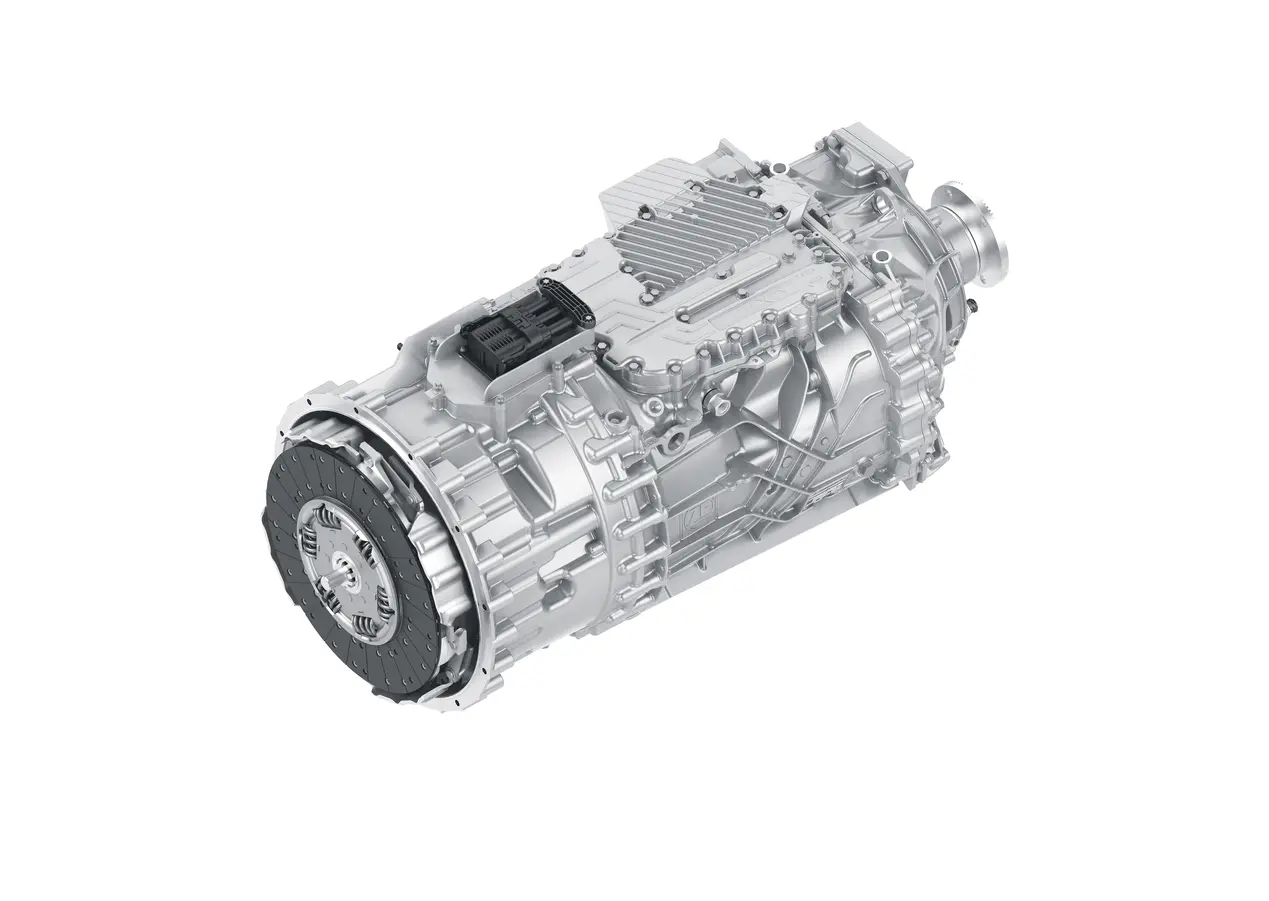
ZF TraXon 2 Hybrid combines an automated manual transmission for heavy commercial vehicles with an electric module.
The motor is installed between the clutch and transmission and delivers power to the input shaft through a planetary gear. It provides 190 kW, or approximately 258 hp, of continuous output and uses a 600–800 V electrical architecture.
The vehicle can travel for limited periods using electric power alone. The motor can also support the combustion engine during acceleration and hill climbing, while recovering energy during braking.
This allows manufacturers to electrify existing truck platforms without developing an entirely new battery-electric vehicle. The system can be used in conventional and plug-in hybrids, including vehicles that need to operate electrically in restricted urban areas.
ZF claims that the plug-in version could reduce CO₂ emissions by up to 47% in long-haul operation. That figure is based on the company’s internal simulation, however. Actual savings will depend on the route, battery size, charging frequency, cargo weight and share of electric driving.
The hybrid system does not eliminate diesel consumption but could provide a transitional solution for markets and carriers without sufficient charging or hydrogen infrastructure.
Each finalist addresses a different logistics problem.
BYD aims to reduce charging duration to the length of a normal rest stop. Cellcentric seeks to retain diesel-like range and refuelling speed without tailpipe emissions. Iveco and PlusAI are automating driving along a defined freight corridor.
Scania is improving the efficiency of vehicles already in service through driver coaching and connected data. ZF offers a transitional route for gradually electrifying conventional truck platforms.
ProDriver appears to be the easiest solution to scale immediately because it is already available and does not require vehicle replacement. ZF’s hybrid transmission could also be introduced on existing platforms, although it requires investment by manufacturers and fleet operators.
BYD Flash Charging could fundamentally change electric-truck operations if its performance is demonstrated in heavy commercial vehicles and the required infrastructure becomes available.
The BZA375 is aimed at a longer-term market because large-scale production and a hydrogen filling network still need to be developed. The Iveco–PlusAI programme will similarly require an extended period of testing and regulatory approval.
The five finalists demonstrate that the industry has not selected one universal technology. Road freight is likely to combine battery-electric trucks, hydrogen, hybrid powertrains, automation and digital efficiency management.
The Truck Innovation Award 2027 winner will indicate which of these approaches the international jury considers the most significant step toward practical commercial deployment.
Read also: Volvo to Show Future Trucks at IAA Transportation 2026