

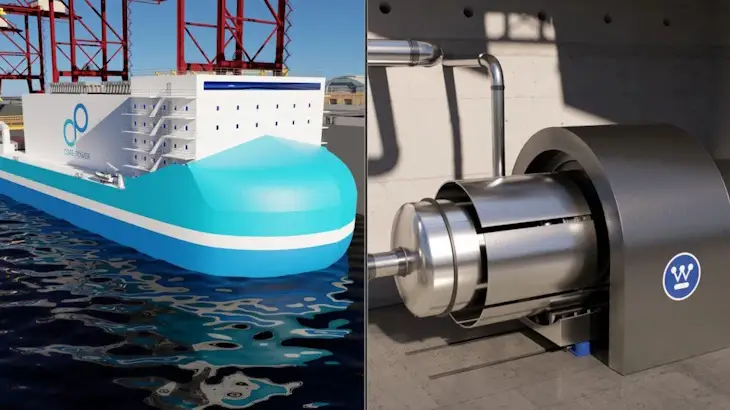
The planned containerships and LNG carriers could reduce dependence on marine fuels, although no confirmed order for 50 vessels has been placed
Core Power Signs Cooperation Framework With MARAD
British company Core Power and the US Maritime Administration have signed a non-exclusive memorandum of cooperation covering civilian maritime nuclear energy. The parties intend to develop the regulatory, industrial and technical conditions required for US-flagged commercial ships powered by nuclear reactors.
According to World Nuclear News, the framework covers licensing, port operations, insurance, workforce training, nuclear fuel services and specialised infrastructure.
Core Power is targeting the start of construction work from 2028. The memorandum, however, is not a shipbuilding contract and does not guarantee federal funding for the entire programme.
“We are not asking for another study. Core Power is targeting first construction starts from 2028. Government can set the direction and coordinate; private industry must move the money and the steel,” Core Power founder and CEO Mikal Bøe said
Long-Term Target Envisions 50 Ships
Core Power’s wider concept calls for a fleet of 50 nuclear-powered merchant ships. According to The Maritime Executive, the fleet could include containerships and LNG carriers.
The preliminary cost is estimated at approximately $700 million per vessel, compared with around $250 million for a conventionally powered ship of similar size. The higher construction cost would be offset by lower conventional fuel expenses, higher operating speeds and longer periods at sea.
Core Power is targeting delivery of the first vessel in 2033. The final ship design, reactor output, operating route, owner and financing structure have not yet been confirmed.
The 50-ship figure should therefore be understood as a programme objective rather than a firm order. Further vessels will depend on the performance of the initial demonstration project and acceptance by cargo owners, carriers, insurers and ports.
Hulls Could Be Built in Japan and South Korea
The preliminary industrial model would divide construction between the United States and allied shipbuilding countries. Conventional hulls and marine systems could be produced in Japan and South Korea, which have the capacity and experience required for series construction of large commercial vessels.
Reactor installation, initial fuelling, testing and lifecycle support would take place at a specialised US facility. Core Power is considering Corpus Christi, Texas, where the company has signed a preliminary agreement.
The yard would be responsible for nuclear installation, maintenance, refuelling, defuelling, repairs, decommissioning and management of reactor-related components.
This model could accelerate hull production, although it raises questions about how much of the programme would directly rebuild US commercial shipbuilding. The most highly regulated nuclear work would remain in the United States, while much of the conventional construction could take place overseas.
Military Ports Could Accelerate Initial Deployment
Core Power previously proposed beginning commercialisation with a floating nuclear power plant stationed at a port controlled by the US Department of Defense. The facility could supply electricity to military infrastructure or nearby data centres.
The US military has decades of experience operating reactors aboard aircraft carriers and submarines. It already maintains procedures for security, access control, specialist training and emergency response.
Locating an early project at a military port could potentially shorten deployment compared with a civilian site subject to the complete commercial nuclear licensing process.
This would not automatically allow nuclear-powered merchant ships to enter ordinary commercial ports. Regular international services would still require civilian regulation, bilateral agreements and acceptance by port authorities.
The Programme Must Cover the Entire Nuclear System
Core Power argues that deploying a reactor alone would not create a viable commercial service. The ship, operator, crew, ports, security arrangements, insurance, financing and nuclear fuel lifecycle must be developed as a single system.
In its response to a MARAD request for information, the company proposed a seven-year initiative called Project Pathfinder. It would select a first bounded service, operator and participating ports while establishing a specialised yard, liability framework and workforce programme.
Core Power recommended that the first contract cover not only one demonstration vessel but also firm or priced options for at least two additional ships. This structure would support a transition from a one-off project to repeatable production.
“The programme should be judged by safe ship availability, cargo moved, schedule reliability, maintenance performance, port acceptance and the cost and time required to order the next ship,” Core Power said
Nuclear Propulsion Could Change Voyage Economics
A reactor can provide high power for several years without regular bunkering. Nuclear-powered ships could maintain higher average speeds and operate without depending on the availability of LNG, methanol, ammonia or petroleum fuels at ports.
Core Power estimates that a conventional fleet would require approximately 66% more tonnage to transport the same cargo volume as a nuclear-powered fleet. The calculation reflects higher speed, longer operating periods and improved vessel utilisation.
The commercial case remains unproven. Operators must also account for nuclear fuel, specialist crews, security, insurance, dedicated maintenance and eventual reactor decommissioning.
Insurance and Port Access Remain Major Barriers
Liability following a nuclear incident is one of the largest unresolved issues. Existing international conventions and insurance structures were developed mainly for land-based power stations and government-operated nuclear fleets.
Commercial projects will require a clear division of responsibility among the shipowner, reactor operator, equipment manufacturer, fuel supplier and port. Without such a framework, insurers and lenders are unlikely to support series construction.
Ports must also establish rules for entry, berthing, towage, repairs and emergency response. If some countries refuse to accept nuclear-powered vessels, available routes could be restricted and the project’s commercial value reduced.
The 50-Ship Fleet Remains an Objective
The Core Power–MARAD framework creates an official process for examining commercial nuclear shipping in the United States. It could accelerate the development of standards and the selection of an initial demonstration service.
Claims about a 50-vessel fleet should nevertheless be treated as a long-term industrial target. No firm orders, fully committed financing or final contracts with shipyards and shipping companies have been announced.
If the first project is built and licensed, the maritime industry will be able to evaluate its actual cost, safety and operating performance. Only then can the initiative move from a concept toward a series-built merchant fleet.
Read also: Tokyo allocates $95 million for hydrogen-, ammonia- and battery-powered vessels