

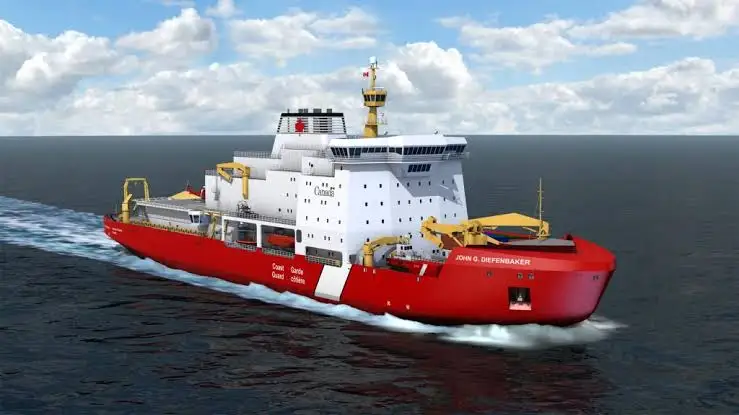
Chantier Davie will build six new Canadian Coast Guard icebreakers in Québec, with the first vessel expected in 2032 and the entire fleet scheduled to enter service by 2038
Davie Wins the Largest Shipbuilding Contract in Québec’s History
The Government of Canada has awarded Chantier Davie Canada Inc. a fixed-price contract to design and build six Polar Class 3 icebreakers for the Canadian Coast Guard.
The agreement is valued at C$11.3 billion before tax, equivalent to approximately US$8.15 billion at the exchange rate used when the contract was announced. The government described it as the largest shipbuilding contract in Québec’s history.
All six vessels will be constructed at Davie’s shipyard in Lévis. Work on the first icebreaker is scheduled to begin in 2027, with delivery expected approximately five years later in 2032. The complete fleet is due to enter service by 2038.
The project forms part of Canada’s National Shipbuilding Strategy. The government originally announced the procurement of six program icebreakers in 2019, while Davie received the initial design contract in 2024.
New Ships Will Replace an Aging Icebreaker Fleet
The six vessels will replace Canadian Coast Guard heavy and medium icebreakers approaching the end of their operational lives.
During winter, they will support navigation in Atlantic Canada, the St. Lawrence waterways and the Great Lakes. In summer, the ships will deploy to the Arctic for extended northern operations.
The icebreakers will escort commercial and government vessels, release ships trapped in ice and help keep critical Eastern Canadian transport routes open.
Their other missions will include:
- search and rescue;
- environmental emergency response;
- resupply of northern and coastal communities;
- carriage of general and containerized cargo;
- support for Arctic scientific research;
- strengthening Canada’s operational presence in northern waters.
The Canadian Coast Guard is a civilian service. The vessels are therefore being developed primarily as versatile working platforms rather than warships.
Each Icebreaker Will Be 114.9 Metres Long
Davie has published the principal dimensions and performance figures for the vessels. Each icebreaker will be 114.9 metres long, with a maximum beam of 21.2 metres and a draft of 7.6 metres.
The ships will maintain three knots through 1.4 metres of ice. Their range will reach 20,000 nautical miles at 11 knots without refuelling, equivalent to approximately 37,000 kilometres.
Accommodation will be provided for as many as 68 crew members and program personnel. The vessels will also have significant capacity for general and containerized cargo.
Each ship will be able to operate and maintain one medium Canadian Coast Guard helicopter. Aviation facilities will extend the reach of search-and-rescue missions, support ice reconnaissance and allow personnel and supplies to be transported to remote locations.
Polar Class 3 Provides Advanced Ice Capability
Polar Class 3 vessels are designed for year-round operation in second-year ice that may contain inclusions of older multi-year ice.
Their capabilities will exceed those of conventional icebreakers designed mainly for seasonal service. They will, however, be smaller and less powerful than the separate Polar Class 2 heavy icebreakers Canada is acquiring under its Polar Icebreaker Project.
The ability to maintain three knots through 1.4 metres of ice will allow the ships to open channels for following commercial vessels and assist ships unable to proceed independently.
Their long range will reduce reliance on intermediate refuelling and allow extended deployments in remote Arctic regions where port and fuel infrastructure remains limited.
Icebreakers Will Protect Canadian Trade Routes
Canada treats icebreaking capacity as part of its transport infrastructure. Ice on the St. Lawrence River, in port approaches and across inland waterways can restrict cargo flows between industrial regions and international markets.
Icebreakers preserve access to ports, escort commercial vessels and reduce the risk of prolonged winter delays. Their support also allows operators to use routes that would otherwise be closed or accessible only to ships with high ice-class ratings.
The government expects the new fleet to support year-round marine trade in Eastern Canada and improve the reliability of northern supply chains.
In the Arctic, the vessels will resupply communities, transport equipment and materials, support scientific expeditions and respond to maritime emergencies. Their long endurance will be particularly valuable during operations far from permanent Coast Guard bases.
Program Will Support Nearly 5,000 Jobs
The federal government expects construction of the six icebreakers to support nearly 5,000 jobs. The program is forecast to contribute approximately C$650 million, or about US$469 million, to Canada’s gross domestic product annually.
Under the Buy Canadian Policy, the vessels will use Canadian steel and other domestically produced materials. Canadian manufacturers, suppliers and small and medium-sized businesses will receive priority when procurement opportunities are allocated.
The order covers more than a decade of work, providing long-term activity for the Lévis shipyard and companies producing marine equipment, steel structures, electrical systems and other components.
A fixed-price arrangement transfers a significant share of the cost-overrun risk to the contractor. Delivery will nevertheless depend on material prices, access to skilled workers and Davie’s ability to manage several major shipbuilding programs simultaneously.
The Order Is Separate From Polar Max
The new six-ship Polar Class 3 fleet is separate from the Polar Max heavy icebreaker project. In 2025, Davie received a C$3.25 billion contract before tax, approximately US$2.35 billion, to design and build one Polar Max vessel for the Canadian Coast Guard.
Polar Max is a higher-rated Polar Class 2 ship designed for year-round operations at high latitudes. It will be considerably larger than the six program icebreakers.
Polar Max is being constructed jointly in Canada and Finland. Hull production began at Davie-owned Helsinki Shipyard, while additional structures are being produced in Lévis. Delivery to the Canadian Coast Guard is expected in 2030.
In contrast, all six Polar Class 3 program icebreakers are scheduled to be built in Canada at Davie’s Québec shipyard.
Initial Design Contract Was Worth C$19.6 Million
In 2024, the Canadian government awarded Davie C$19.6 million, approximately US$14.1 million, to begin the initial design of the six program icebreakers.
This phase allowed the shipbuilder and Coast Guard to refine operational requirements, vessel specifications, production planning and estimated costs. The latest contract moves the program from design into full-scale construction.
Davie became the third strategic shipyard partner under Canada’s National Shipbuilding Strategy in April 2023. Large federal shipbuilding contracts had previously been concentrated at Seaspan Vancouver Shipyards and Irving Shipbuilding.
Davie’s inclusion provided access to long-term government orders covering icebreakers, ferries and other specialized vessels.
Québec Invested C$519.2 Million in Shipyard Modernization
In 2023, the Québec government provided C$519.2 million to support the modernization of Davie’s Lévis facilities. Combined with the company’s own expenditure, the investment program was valued at almost C$840 million.
The project covers upgrades to production buildings, equipment and shipbuilding processes required for large specialized vessels.
Québec also provided C$110 million to support Davie’s acquisition of Helsinki Shipyard in Finland. The package consisted of a C$43 million equity investment and a C$67 million loan.
The Finnish yard specializes in designing and constructing ice-capable ships. Its acquisition gave Davie access to engineering knowledge and production experience that can now support Canadian programs.
Canada Is Accelerating Arctic Fleet Renewal
The C$11.3 billion contract combines transport, industrial and strategic objectives. It will replace aging Coast Guard vessels, support year-round navigation and establish a more durable domestic capacity for icebreaker construction.
Implementation will nevertheless take more than a decade. Until the first new ship arrives, the Coast Guard will have to continue operating and maintaining its existing fleet.
The start of construction in 2027 will be the first major test of the schedule, followed by delivery of the lead vessel in 2032. If those targets are met, Canada will have six modern multi-purpose icebreakers by 2038 to support trade, northern resupply and Arctic operations in increasingly demanding ice conditions.
Read also: Canada Studies Year-Round Churchill Shipping to Double Non-U.S. Exports