

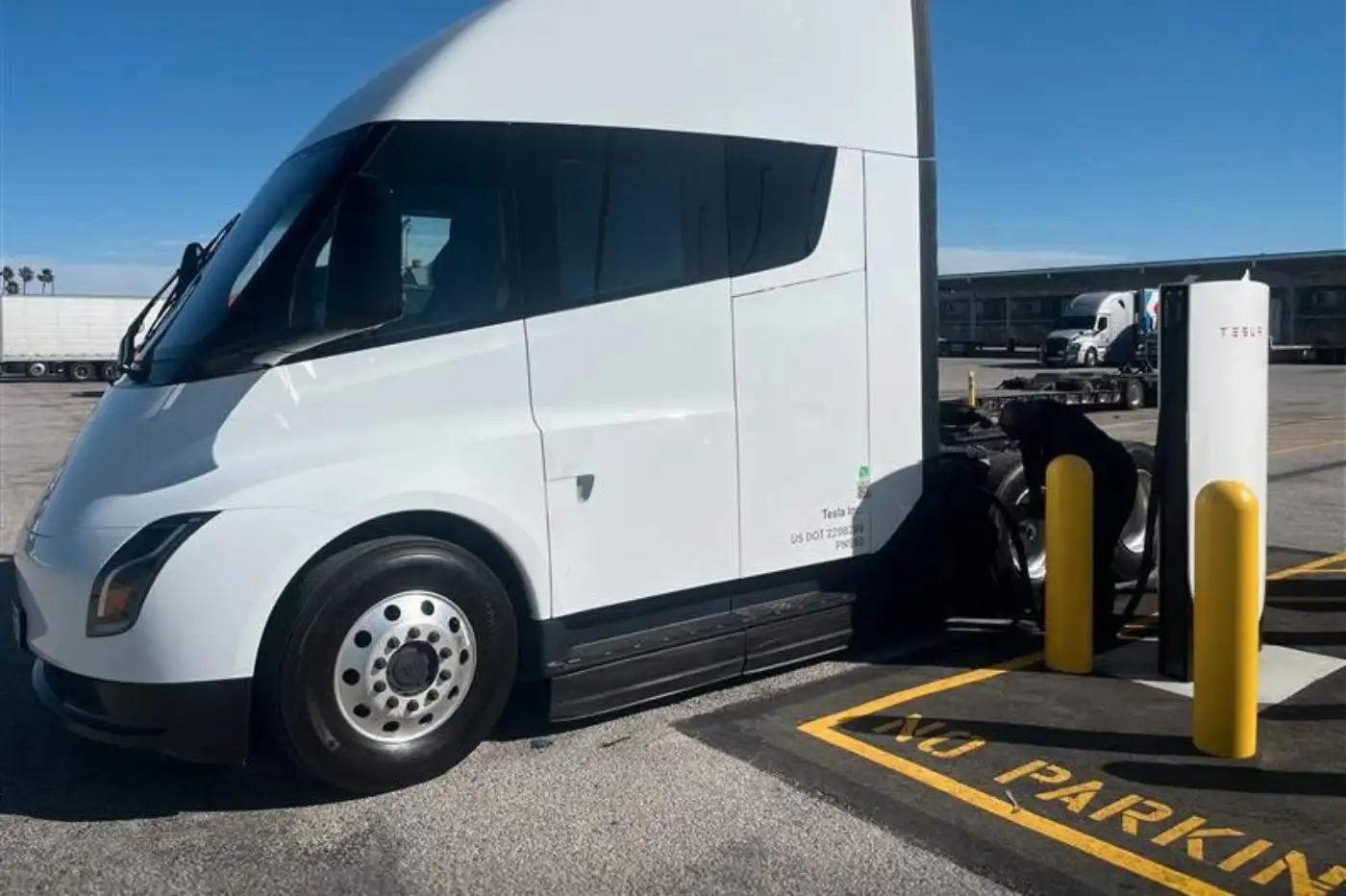
The company is expected to announce the electric tractor’s range, configurations and European sales timetable at the September 15–20 exhibition in Hannover
Tesla Is Preparing a Commercial European Entry
Tesla has confirmed that it will present the specifications of the European Semi and disclose details of its regional commercial launch at IAA Transportation 2026 in Hannover.
The exhibition will run from September 15 to 20, preceded by a dedicated press day on September 14. Tesla plans to display the updated Semi developed for the transition from limited fleet trials to broader production and customer deliveries.
This represents a significant change from IAA Transportation 2024. Tesla brought U.S.-market trucks to Hannover and offered demonstration rides but did not provide pricing, an order timetable or a target date for European deliveries.
The August 20, 2026 announcement is the clearest indication so far that Tesla is preparing an actual European market programme rather than simply presenting the American truck to potential customers.
Tesla Is Building a European Commercial Team
Tesla has started creating the sales and operational structure required to support the Semi in Europe. The company is recruiting a Fleet Coordinator for the Semi programme in France, while a Business Development Manager position near Munich focuses on developing fleet accounts and expanding customer deployments.
The German role includes matching vehicle configurations to customer requirements and coordinating with infrastructure teams responsible for site and utility readiness.
Heavy electric trucks require this work to begin well before vehicle delivery. Operators must secure sufficient grid capacity, install chargers, identify suitable routes and adjust driver schedules around charging requirements.
U.S. Versions Offer Up to 805 Kilometres of Range
U.S. certification information covers two configurations of the updated Tesla Semi. According to specifications summarized by IAA Transportation, the Standard Range version has a 548 kWh battery and an estimated range of approximately 523 kilometres. The Long Range model uses an 822 kWh battery and has a claimed range of around 805 kilometres.
Both versions use three integrated electric motors on the rear axles. Maximum output is listed at up to 800 kW, equivalent to approximately 1,072 horsepower.
The truck is designed to support megawatt charging at up to 1.2 MW. With suitable infrastructure, Tesla says the Semi can recover as much as 60% of its range in 30 minutes.
These U.S. figures cannot automatically be applied to the European vehicle. Configuration, payload, range and even the number of available variants could change during adaptation to regional regulations.
Tesla’s UK Website Currently Shows One Configuration
Tesla’s UK Semi product page currently lists an estimated range of approximately 550 kilometres, energy consumption of 1 kWh per kilometre and a curb weight of around 9,100 kilograms. Maximum drive power is listed at 800 kW, while the charging connection is identified as MCS 3.2.
These figures appear closer to the U.S. Standard Range configuration, although the published range is slightly higher. The 805-kilometre Long Range version is not currently shown on the UK page.
This may indicate that Tesla will initially prioritize the lighter model for regional and medium-distance freight. A definitive conclusion will not be possible until the Hannover presentation.
European Type Approval Will Require Adaptation
The American Tesla Semi was developed for a different regulatory and operating environment. Under current European rules on maximum vehicle dimensions, a standard tractor and semi-trailer combination is generally limited to 16.5 metres in length and 2.55 metres in width, subject to defined exceptions.
European operators will be concerned not only with the tractor’s dimensions but also with compatibility with standard trailers. A longer cab can reduce the space available within the legal combination length, making vehicle packaging and coupling geometry particularly important.
Weight is another major issue. Most European international operations work within gross combination weight limits of 40 to 44 tonnes, depending on the vehicle configuration and type of transport. A large battery can reduce commercial payload unless its mass is offset through vehicle design or regulatory allowances for zero-emission trucks.
The Semi must also obtain European type approval and comply with the EU General Safety Regulation. Relevant requirements include intelligent speed assistance, blind-spot and moving-off information systems, driver drowsiness and distraction warnings, advanced emergency braking and protection for vulnerable road users.
MCS Is Emerging as the Likely Charging Standard
It was previously unclear whether Tesla would build a closed European Megacharger network or use the Megawatt Charging System being adopted for heavy commercial vehicles.
The UK product page now specifies MCS 3.2, increasing the likelihood that the Semi will be compatible with wider European megawatt-charging infrastructure rather than relying exclusively on proprietary Tesla sites.
The technology is being developed as an interoperable high-power solution for heavy-duty transport. Industry association CharIN describes the Megawatt Charging System as a charging architecture capable of supporting currents of up to 2,000 amperes.
The connector alone will not solve the infrastructure challenge. Charging at approximately 1.2 MW requires substantial grid connections, transformers, load-management systems and sites designed to accommodate articulated vehicles.
The availability of such facilities, rather than vehicle range alone, will determine whether the Semi can operate efficiently on international freight corridors.
Einride’s 500-Truck Deployment Is for North America
Shortly before Tesla’s European announcement, Swedish freight technology company Einride disclosed plans to deploy 500 Tesla Semi trucks. According to the company’s official announcement, it will be the largest deployment involving the model announced to date.
Despite Einride being headquartered in Sweden, the trucks are not part of a European order. They will operate in North America across freight corridors in California, Texas, New Jersey, Illinois and Georgia.
The phased deployment is scheduled to begin in September 2026 and continue over 24 months. The vehicles will be integrated with Einride’s Saga AI fleet-intelligence platform and serve Amazon and other customers.
The programme will provide Tesla with an opportunity to demonstrate the Semi’s performance in a large commercial fleet, but it does not establish a European delivery timetable.
Nevada Production Is Still Ramping Up
Tesla announced in April 2026 that the first Semi had rolled off its new high-volume production line next to Gigafactory Nevada. The facility is intended to move the programme beyond small pilot deployments and into larger-scale manufacturing.
The company has not disclosed its current production rate. In its second-quarter 2026 update, Tesla said the Semi remained on track for production during the year. It also described battery-pack capacity as the main limiting factor for near-term growth in overall vehicle production.
European exports will therefore depend not only on regulatory approval but also on the Nevada plant’s ability to fulfil North American orders without further delays.
The production ramp also increases attention on reliability and safety. As K2Cargo.News previously reported, the first fatal crash involving a Tesla Semi has intensified questions about driver-assistance systems, emergency braking and fatigue management in heavy electric trucks.
Tesla Will Face an Established Market
Tesla will enter a European electric truck market that is considerably more developed than it was several years ago. Mercedes-Benz already offers the eActros 600, MAN is expanding the eTGX range, and Volvo, Scania, DAF and Renault Trucks have production electric models supported by established service networks.
Competition from Chinese manufacturers is also increasing. Sinotruk has begun contract manufacturing trucks at Steyr Automotive in Austria, while SuperPanther is preparing European electric truck production at the same site.
Fleet purchasing decisions will depend on more than maximum range and power. Payload, acquisition price, financing, battery warranty, service coverage, residual value and repair downtime will all influence the Semi’s competitiveness.
The availability of public and depot charging will be equally important. A technically capable truck may still be unsuitable for a route if the operator cannot obtain sufficient grid capacity or reliably access megawatt chargers.
2027 Remains the Main Working Target
Semi programme head Dan Priestley previously linked a large-scale international launch to the completion of the U.S. production ramp.
In February 2026, Elon Musk said Tesla hoped to bring the truck to Europe the following year. The statement, made during an interview concerning Gigafactory Berlin and reported at the time, indicated 2027 as the company’s working target.
That date remains provisional. The Hannover exhibition should reveal how far Tesla has progressed with type approval, sales preparation and charging infrastructure.
The main questions at IAA Transportation will concern the European truck’s final range, available configurations, payload, price, order opening and first deliveries. Only after those details are released will operators be able to judge whether the Tesla Semi can compete with electric trucks already working on European roads.
Read also: 93% of German Electric Truck Operators Are Satisfied With Their Vehicles