

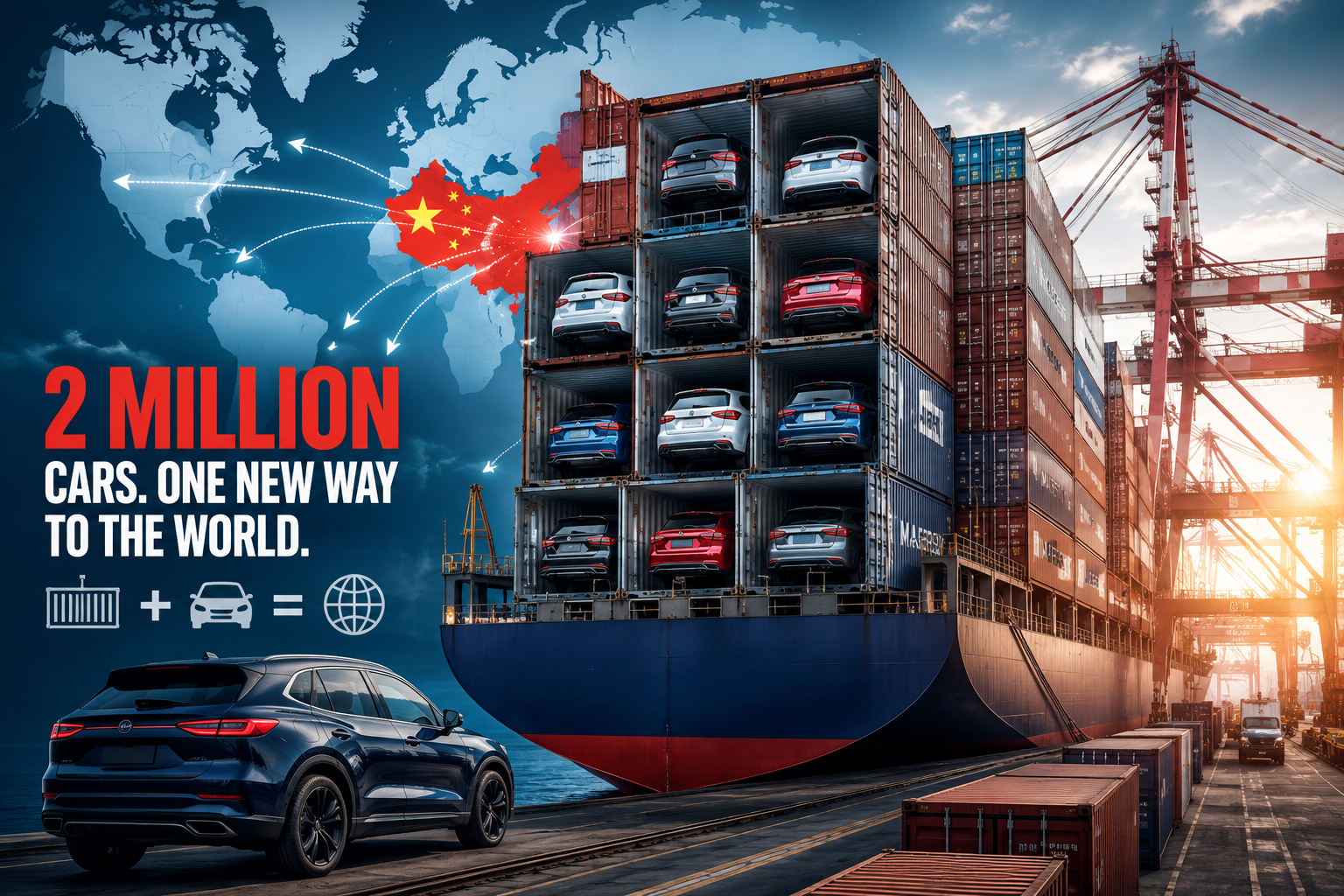
The rapid expansion of China’s automotive exports is forcing the maritime industry to adopt unconventional solutions. This year, approximately 2 million vehicles are expected to be transported in standard shipping containers instead of dedicated pure car and truck carriers (PCTCs). The figure will set a new record and clearly demonstrate that the existing global fleet is no longer able to keep up with the explosive growth of China’s automotive industry.
According to maritime analytics firm Veson Nautical, the use of container ships to transport passenger vehicles has evolved from a temporary workaround into a structural feature of the global shipping market. While just over 1 million vehicles were transported using alternative methods last year, that figure is expected to double in 2026.
The main driver behind this trend is the continued surge in Chinese vehicle exports. China is projected to export around 10 million passenger vehicles across all transport modes this year, while the global fleet of Pure Car and Truck Carriers (PCTCs) is expected to expand by only 7.6%. Moreover, most of the new vessels will enter service gradually throughout the year, limiting their immediate impact on easing capacity constraints.
Against the backdrop of a shortage of specialized car carriers, exporters are increasingly relying on container shipping services to deliver vehicles to overseas markets. This approach helps avoid shipping delays and allows manufacturers to maintain strong export volumes despite the limited availability of dedicated ro-ro vessels.
Analysts say the shift reflects a broader transformation of the global automotive supply chain driven by China’s emergence as the world’s leading vehicle exporter. In just five years, the country’s annual passenger vehicle exports have surged from 1.6 million units in 2021 to a projected 10 million units in 2026. According to the China Association of Automobile Manufacturers (CAAM), exports reached 4.06 million vehicles during the first five months of this year, representing a 63% increase compared with the same period last year.
Industry experts believe that as long as China’s automotive production continues to outpace the expansion of the global car carrier fleet, container shipping will remain an essential part of the international automotive supply chain.
Read also: Environmental Disaster in Nepal: Dangerous Bacteria Found in Drinking Water