

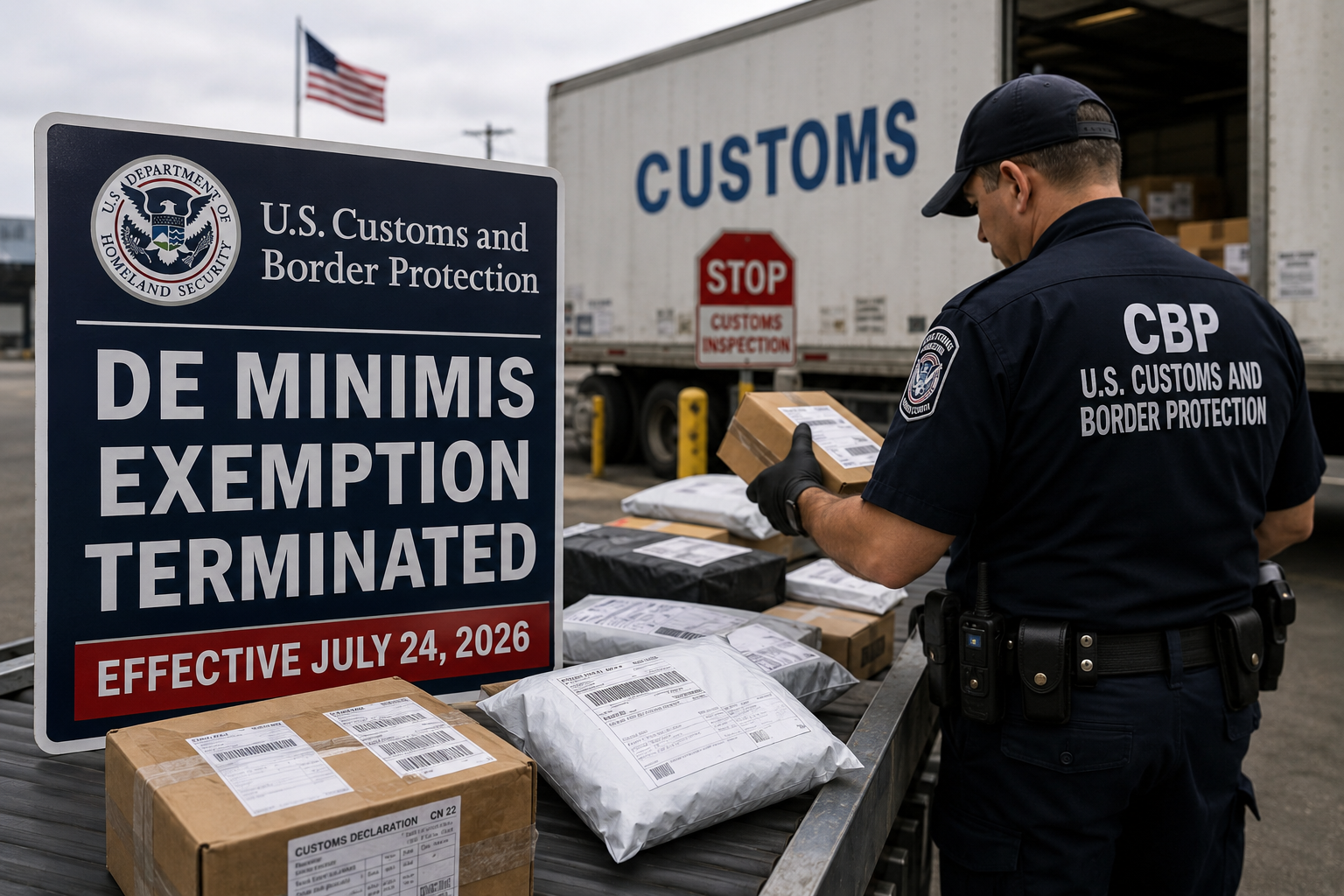
For decades, millions of low-value parcels crossed America’s borders with minimal customs intervention. That policy became one of the cornerstones of global e-commerce, allowing Chinese marketplaces, online retailers, and exporters around the world to ship inexpensive products directly to U.S. consumers with little regulatory friction.
That era is now coming to an end.
The U.S. Customs and Border Protection (CBP) has issued an Interim Final Rule that permanently eliminates the de minimis exemption for international postal shipments valued at up to $800. At the same time, the agency is introducing a new customs clearance framework for international mail.
The core provisions of the rule will take effect on July 24, 2026.
A Fundamental Shift in Cross-Border Trade
The decision represents one of the most significant U.S. customs policy changes of the year.
For years, the de minimis threshold enabled millions of low-value parcels to enter the United States under simplified customs procedures. Beginning this week, a substantially larger share of international postal shipments will require formal customs processing, fundamentally changing how small parcels move across the world’s largest consumer market.
Why It Matters
The implications extend far beyond customs authorities.
Every additional customs declaration means more paperwork, more processing time, and higher operational costs throughout the supply chain. Postal operators, customs agencies, fulfillment centers, and last-mile delivery providers will all face increased workloads as shipment volumes requiring clearance rise sharply.
The impact will be especially significant for businesses built around high-volume, low-value international e-commerce.
Who Will Be Affected
- USPS
- International postal administrations
- Global e-commerce marketplaces
- International logistics providers
- Cross-border retailers
- Customs brokers
Expected Industry Impact
The economics of cross-border e-commerce are set to change.
As more international parcels become subject to customs processing, businesses should expect higher administrative costs, longer processing times, and increased compliance requirements. Those additional costs are likely to be reflected in shipping prices, making international online purchases more expensive for U.S. consumers.
Logistics providers will also need to expand customs operations, invest in new digital processing systems, and increase staffing to handle the higher volume of regulated postal shipments.
What Changes on July 24
- The de minimis exemption for international postal shipments will be permanently eliminated.
- A new customs clearance process for international mail will become mandatory.
- The volume of shipments requiring customs processing will increase significantly.
- Postal operators and logistics companies will face substantially higher compliance and administrative workloads.
