

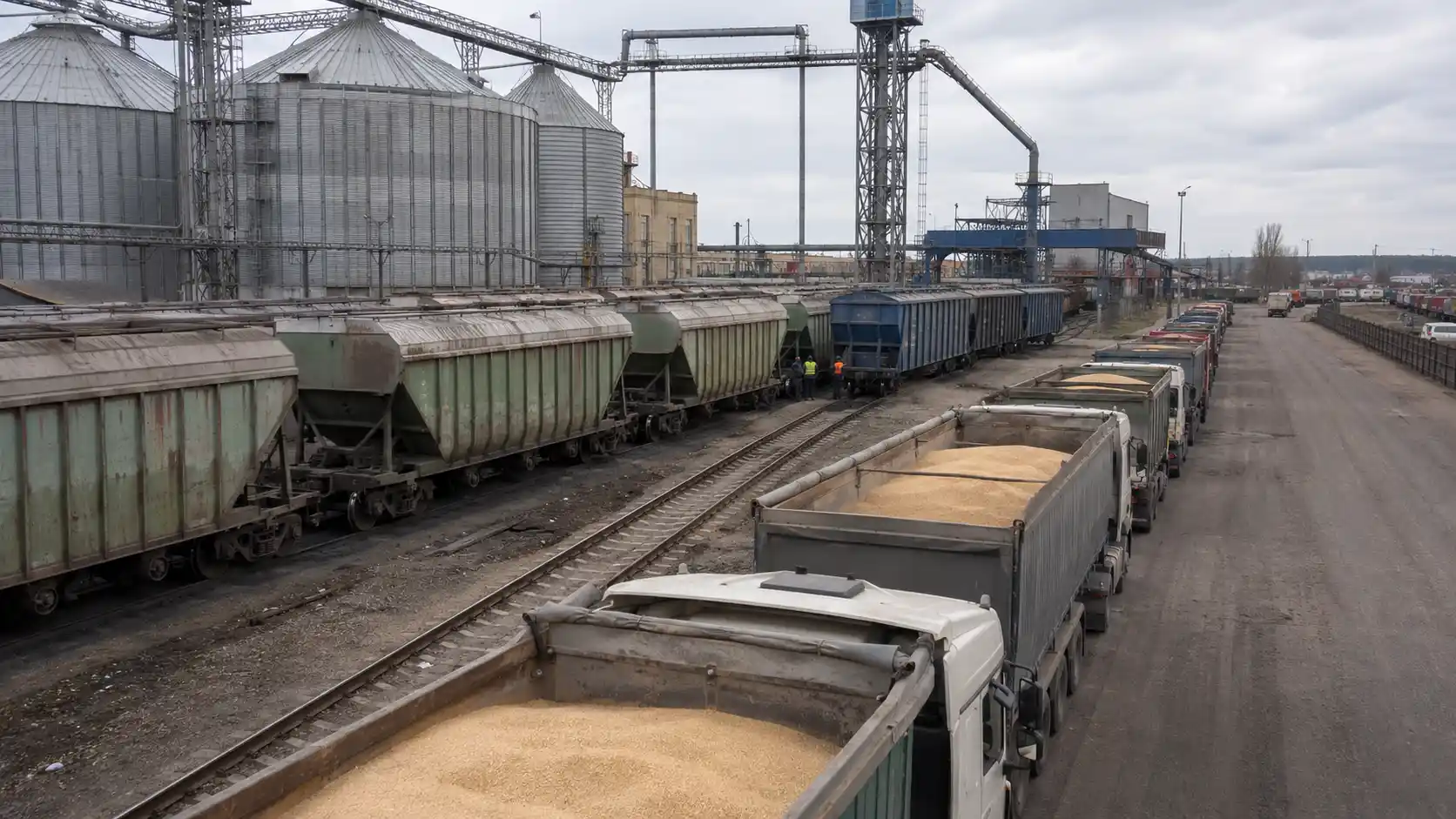
Restricted access to Black Sea ports has intensified Ukraine’s agricultural logistics crisis, while alternative corridors currently cover only about one-third of required export volumes
The Monthly Export Gap Has Reached 3.5 Million Tonnes
The loss of stable access to Black Sea ports has become one of the most serious challenges facing Ukraine’s agricultural sector since the beginning of the full-scale war. In August, the country expects to export approximately 1.5 million tonnes of agricultural products through alternative routes, compared with an average monthly requirement of around 5 million tonnes.
Road, rail and other available corridors will therefore handle approximately 30% of the required volume. Even under the most favourable scenario, their capacity is unlikely to exceed half of Ukraine’s agricultural export needs, according to the Ministry of Agrarian Policy and Food.
The figures were presented by Agrarian Policy and Food Minister Taras Vysotskyi during an online discussion organised by the Ukrainian Agribusiness Club.
“Alternative routes are expected to handle about 1.5 million tonnes in August against a monthly requirement of 5 million tonnes,” Vysotskyi said
The Crisis Is More Difficult Than in 2022
At the beginning of the full-scale war, Ukrainian agricultural businesses still had financial reserves and could temporarily store products while waiting for export channels to recover. Much of that resilience has now been exhausted.
Additional rail and road transport costs are not being offset by a sharp increase in global grain prices. Higher logistics expenses are therefore reducing producer revenues and placing downward pressure on domestic purchasing prices.
The European harvest season creates another constraint. Terminals, wagons, warehouses and port facilities in neighbouring countries are already handling domestic grain, making it difficult to accommodate substantial additional volumes from Ukraine.
Prolonged storage also places pressure on grain elevators and agricultural companies’ working capital. For smaller producers, delayed exports may create funding shortages ahead of the next production cycle.
Poland Transit Could Rise to 600,000 Tonnes
Poland remains one of the most promising alternative corridors. Approximately 300,000 tonnes of Ukrainian agricultural products currently move through Polish territory every month. Ukraine wants to double that volume to 600,000 tonnes.
Rail transport is expected to provide most of the additional capacity. Ukraine has formally proposed doubling the number of freight trains crossing the Polish border.
The plan also calls for customs, veterinary and other border services to operate around the clock. Continuous processing could reduce train waiting times and increase the capacity of existing infrastructure without waiting for major construction projects to be completed.
Increasing the number of trains will not be sufficient on its own. Operators will also need enough wagons, locomotives and transshipment equipment, together with coordinated schedules between Ukrainian Railways and Polish rail companies.
Different Track Gauges Remain a Bottleneck
Ukraine uses the 1,520 mm railway gauge, while most of Poland’s network operates on the European 1,435 mm standard. Cargo must therefore be transferred between wagons, bogies must be changed, or terminals equipped with both gauges must be used.
Participants discussed expanding container transport, deploying specialised grain wagons and attracting investment into border terminals. They also considered measures to reduce delays at the Rava-Ruska–Werchrata, Mostyska–Medyka and Yahodyn–Dorohusk crossings.
Priorities include coordinating train schedules, accelerating sanitary inspections and clearly separating Ukrainian transit cargo from products intended for the Polish market.
Higher-Value Products Can Absorb Logistics Costs More Easily
The ministry is encouraging agricultural businesses to increase the share of processed products in their exports. Transporting vegetable oil, flour, finished food products and other higher-value cargo is generally more economical than moving unprocessed grain.
“The share of products with added value must be increased as quickly as possible,” the ministry said
The higher the value of each tonne, the smaller the transport cost becomes as a share of its final price. This approach cannot replace the required volume of grain exports, but it can reduce the impact of expensive inland logistics on producers’ revenues.
Cargo Diversions Are Increasing Pressure on Constanța
Intensified attacks on Ukrainian Black Sea ports have resulted in the cancellation or suspension of some vessel calls at Odesa and Chornomorsk. Some cargo is being redirected to Romania’s Port of Constanța.
However, Constanța also handles Romania’s domestic trade and transit flows from other regional markets. Additional Ukrainian volumes increase demand for terminal capacity, trains, trucks and ferry services.
The pressure is consequently spreading across the wider regional transport system, from Ukrainian-Polish rail crossings to Danube ports and Romanian terminals. Without infrastructure expansion and round-the-clock border processing, alternative routes cannot fully replace the deep-water ports of Greater Odesa.
Read also: Ukrainian Ports Under Massive UAV Attacks