

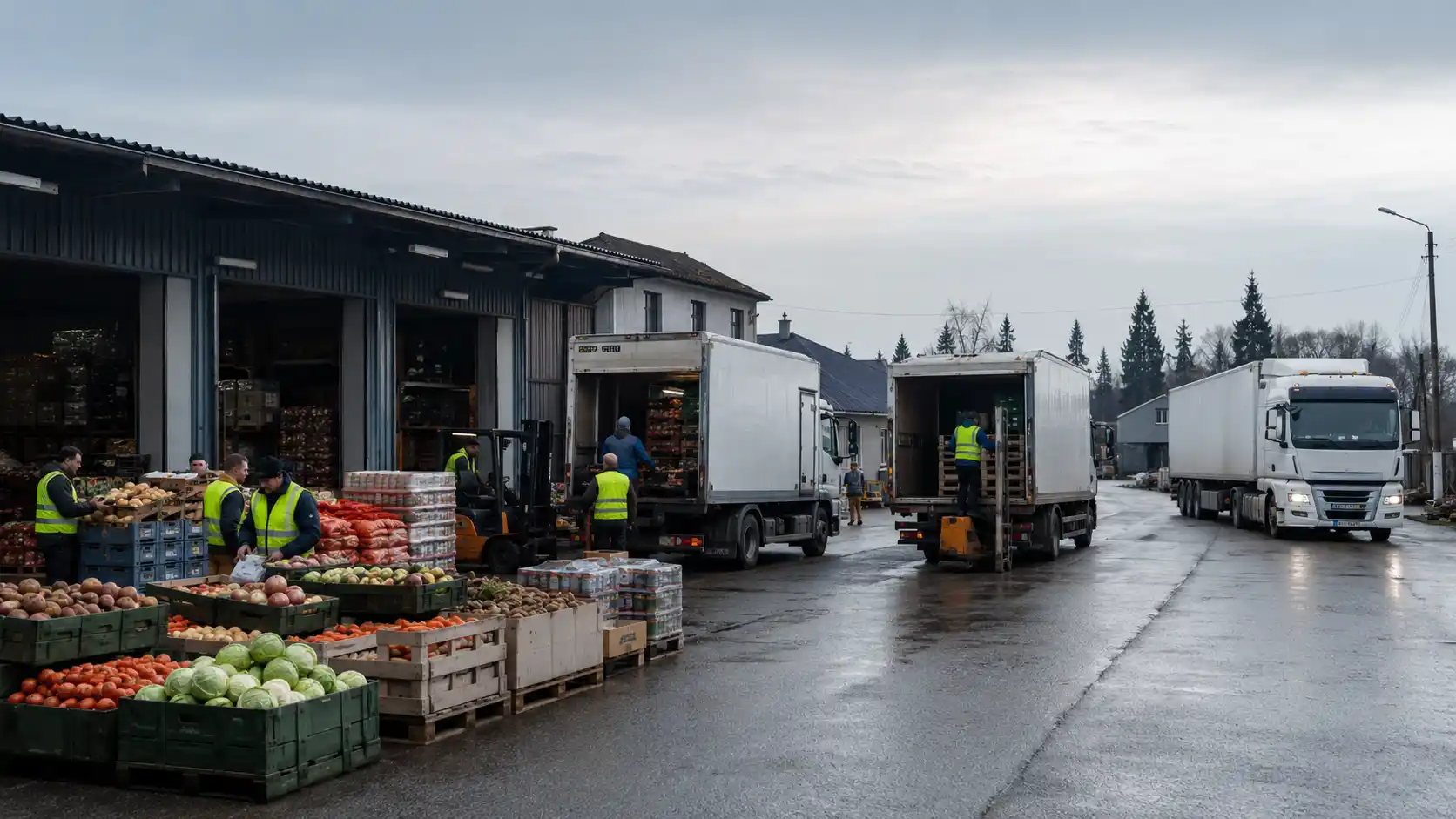
Ukraine is shifting toward distributed storage and direct food deliveries in response to Russian attacks on warehouses, while additional transport costs could raise consumer prices by no more than 2.5%
Ukraine has sufficient food reserves to supply its domestic market, but Russian attacks on warehouses and other food infrastructure are forcing the government and businesses to restructure logistics chains.
The assessment was presented by Ukrainian Minister of Agrarian Policy and Food Taras Vysotskyi. According to the minister, the new system should reduce the concentration of products at large warehouses and prevent significant volumes of inventory from being destroyed in a single attack.
Instead of keeping large consignments at individual distribution facilities, companies are moving toward a more decentralized model. It involves storing smaller quantities at multiple locations and expanding direct deliveries from producers to retail outlets.
“One of the key elements of the new food-supply model is the distribution of products in smaller batches. The second is direct delivery from producers to points of sale. It is important for us to decentralize this approach and make the simultaneous large-scale destruction of significant volumes of products impossible. At the same time, this allows us to provide Ukrainians with the necessary products on time and at the required quality, preventing interruptions in supply.”
Taras Vysotskyi, Minister of Agrarian Policy and Food of Ukraine
Although the primary purpose of the new model is to protect Ukraine’s domestic food market, its logistics consequences will primarily affect Eastern Europe. Ukraine is closely integrated with the transport, warehousing and retail systems of Poland, Romania, Moldova, Slovakia and Hungary.
Changes in the location of Ukrainian inventories, a higher number of smaller shipments and the expansion of direct deliveries could affect traffic on regional trucking routes, border terminals and distribution centers in neighboring countries.
Additional demand may emerge for warehouse capacity and transport services in western Ukraine and EU border regions. Some companies are likely to place safety stocks closer to the western border and use several smaller facilities instead of relying on one large distribution center.
This model improves resilience but makes inventory management more complicated. Logistics operators will need to coordinate more journeys, suppliers and delivery points while maintaining the ability to redirect cargo rapidly between regions.
K2Cargo.News expects the initial effect on Eastern Europe to appear not as a regional food shortage but as a change in freight flows, stronger demand for distributed warehousing and a higher number of smaller road shipments.
Decentralization requires additional transport spending. Direct delivery from a producer to a retail outlet reduces dependence on large distribution centers, but it increases the number of journeys and may reduce the average load factor of individual trucks.
Warehousing costs may also change. Operating several smaller facilities usually requires more complex management, additional personnel, security, cargo handling and inventory-control systems.
According to the Ukrainian Ministry of Agrarian Policy and Food, the restructuring should not lead to a substantial increase in food prices. The maximum rise associated with additional transport and storage costs is estimated at up to 2.5%.
This figure is an estimate rather than a confirmed price increase applying to every product. The actual impact will depend on the type of goods, delivery distances, transport availability and the extent of infrastructure damage in each region.
Vysotskyi warned that individual stores may temporarily offer fewer varieties of certain products. This would result from the transition from large centralized deliveries to smaller and more frequent consignments.
A temporary reduction in product selection should not automatically be interpreted as a physical food shortage. According to the minister, Ukraine has sufficient reserves to cover domestic consumption.
The country also has the storage capacity required for vegetables. Key crops, particularly vegetables commonly included in Ukraine’s traditional “borscht set,” are expected to be produced in sufficient quantities and remain available to consumers.
The primary risk is therefore not a nationwide absence of food but localized interruptions if transport routes, warehouses or distribution centers are damaged in further attacks.
Moving inventory from a small number of major logistics hubs into a network of smaller facilities can reduce the consequences of a single strike. Damage to one location in such a system should not simultaneously stop supplies across an entire region or retail chain.
However, decentralization cannot eliminate every risk. Smaller warehouses still require physical protection, backup electricity, reliable communications and alternative delivery routes.
As K2Cargo.News previously reported, Russian attacks have already damaged Ukrainian distribution centers and warehouses, forcing companies to redirect orders between stores, backup facilities and third-party logistics providers.
Further decentralization could become a long-term operating model for Ukraine’s food logistics sector. Transport companies and warehouse operators in Eastern Europe are likely to feel its effects first because the region contains the main contingency routes linking the Ukrainian market with EU suppliers, terminals and distribution networks.
Read also: Kyiv Attack Damages Yves Rocher and Fayni Lyodu Warehouses