

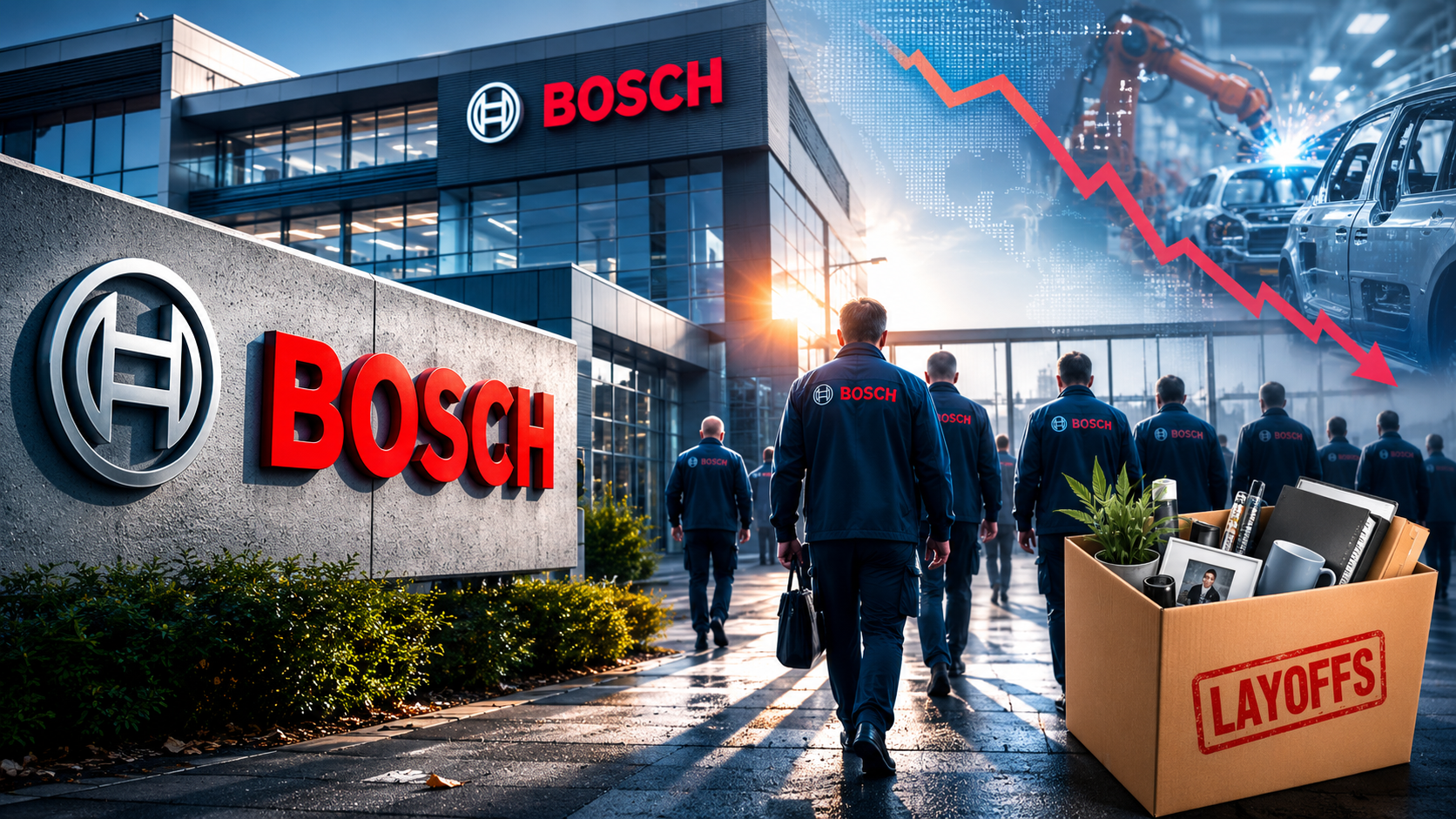
German technology giant Bosch has confirmed that workforce reductions in its automotive business will continue over the coming years. As early as 2025, German media reported plans to cut a “five-digit number” of jobs within the Bosch Mobility division. The company later clarified the scale of the restructuring program, which could ultimately affect approximately 22,000 positions worldwide, primarily in Germany.
According to Reuters and several German publications, the latest cuts are part of a broader efficiency and cost-reduction strategy. Bosch aims to reduce annual expenses by around €2.5 billion by 2030.
Why Bosch Is Cutting Jobs
The primary driver behind the restructuring remains the difficult situation facing Europe’s automotive industry. Bosch is confronting several major challenges simultaneously:
- Slowing vehicle production in Germany and across Europe;
- Declining demand for traditional internal combustion engine (ICE) components;
- Slower growth of the electric vehicle market than previously forecast;
- High investment costs associated with new technologies;
- Increasing competition from Chinese automakers and component suppliers.
Bosch CEO Stefan Hartung has previously stated that the company cannot completely avoid layoffs because the automotive industry is undergoing a fundamental structural transformation. At the same time, Bosch continues to invest heavily in automotive software, automated driving systems, hydrogen technologies, and electric powertrain solutions.
Timeline for the Job Cuts
Most of the restructuring program is expected to run through 2030. Back in 2024, Bosch announced plans to cut around 5,500 jobs across various Mobility divisions, including automotive software development and electric vehicle component production.
In September 2025, reports emerged that the company would eliminate an additional 13,000 positions, primarily at German facilities. As a result, the total number of planned job reductions rose to nearly 22,000.
According to German media reports, manufacturing sites in Baden-Württemberg and other traditional automotive production hubs are expected to be among the most affected. Some measures have already been implemented, while the remaining reductions will be carried out gradually throughout the rest of the decade.
What It Means for the Automotive Components Market
Industry experts view Bosch’s actions as part of a broader transformation taking place across Europe’s automotive sector. Major suppliers are being forced to adapt their business models to a market increasingly shaped by electric vehicles, digital technologies, and software-driven solutions.
Despite the workforce reductions, Bosch remains committed to developing future-oriented technologies, including autonomous mobility systems, steer-by-wire and brake-by-wire technologies, artificial intelligence applications for vehicles, and hydrogen solutions for commercial transport.
The company believes these growth segments will become the foundation of its future business as the automotive industry completes its transition toward new mobility technologies.