

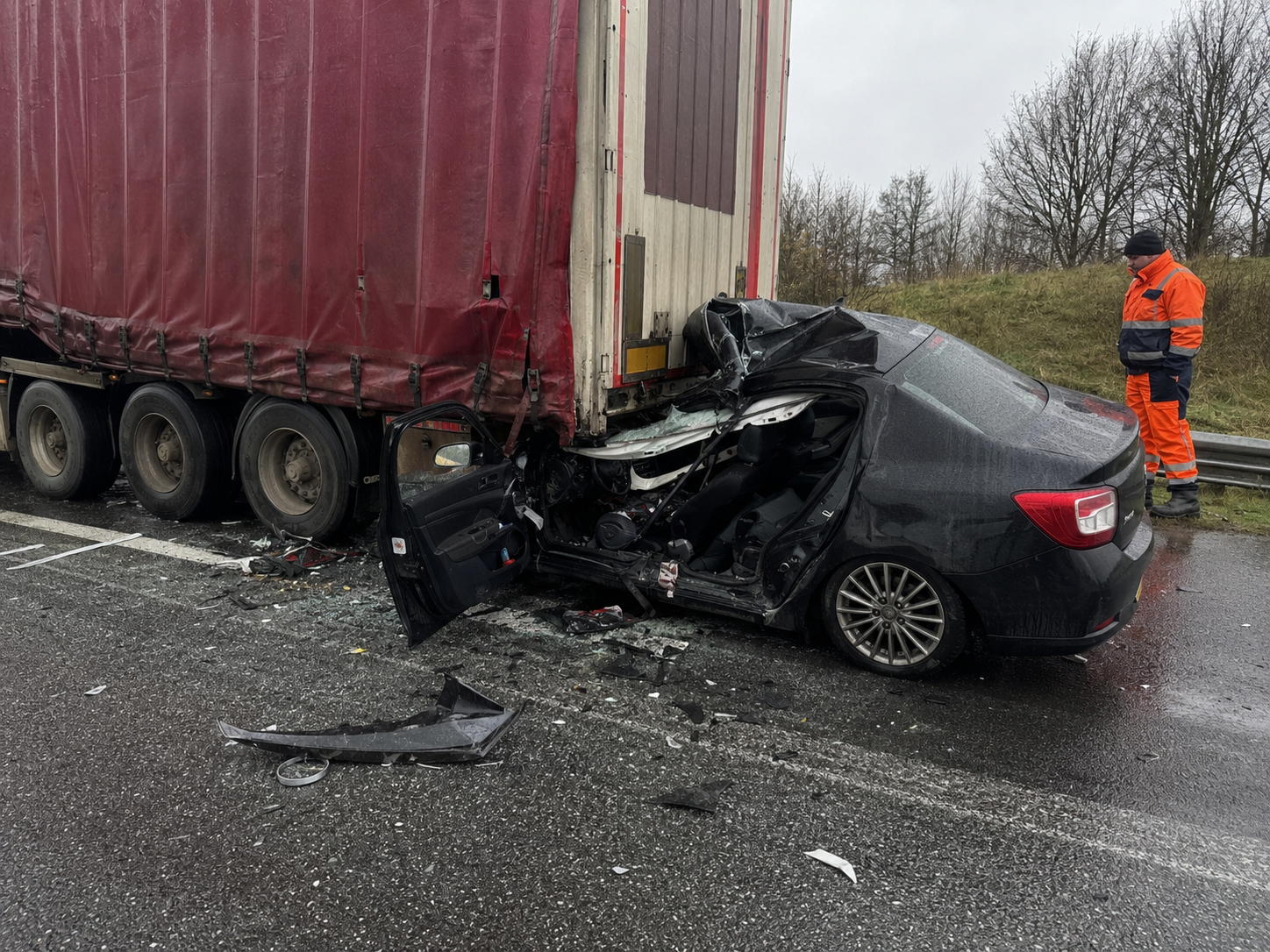
Every year, hundreds of people are killed in crashes where passenger cars slide underneath the rear of trucks or trailers. Although passenger vehicle safety has improved significantly over the past two decades, a new investigation by Euro NCAP shows that one critical part of road safety in Europe has failed to keep pace with modern crash protection standards.
Euro NCAP, working together with Germany’s ADAC, Sweden’s Transport Administration Trafikverket, the U.S. Insurance Institute for Highway Safety (IIHS) and National Highways in the United Kingdom, carried out an extensive testing program focused on rear underrun crashes. The results revealed two major safety problems: some driver assistance systems do not always detect the rear of trailers correctly, while many physical rear guards fitted to trucks and trailers fail to prevent severe underrun in real-world crash conditions.
For the transport industry, the findings could mark the beginning of a new regulatory debate. If lawmakers act on the results, European trailer manufacturers and fleet operators may face tougher requirements for rear underrun protection systems in the coming years.
K2Cargo News previously reported that a new report revealed widespread problems in Europe’s international road transport sector. The latest Euro NCAP findings show that vehicle safety remains one of the most sensitive issues for the European freight industry.
Why Rear Underrun Crashes Are So Dangerous
A rear underrun crash occurs when a passenger car hits the back of a truck or trailer and partially slides underneath it.
In a conventional frontal collision, the front structure of a car is designed to absorb crash energy through controlled deformation. This is one of the reasons modern passenger cars undergo extensive crash testing and receive safety ratings. But in an underrun collision, the impact often occurs above the strongest part of the car’s front crash structure.
As a result, the bonnet and front crumple zone may not work as intended. The impact can move directly into the passenger compartment, sharply increasing the risk of fatal injuries for drivers and passengers.
According to Euro NCAP, rear underrun crashes involving trucks and trailers could be linked to around 400 deaths every year across the European Union and the United Kingdom. This makes the issue not simply a technical weakness, but a systemic road safety problem.
Crash Tests Expose Weaknesses in European Rules
To assess the real level of protection provided by existing equipment, Euro NCAP and its partner organizations conducted crash tests using a modern five-star-rated passenger car.
The vehicle was crashed into the rear of trailers equipped with rear underrun protection systems that comply with the current European regulation UN ECE R58.03. The tests included trailers from major European manufacturers, including Schmitz Cargobull and Krone Trailer.
The results were alarming.
Although the rear guards formally complied with current regulations, they did not provide sufficient resistance in real crash conditions. The passenger car slid underneath the rear of the trailer, and the occupant compartment suffered critical damage.
According to the testing organizations, occupants in such a crash would have had little chance of avoiding fatal injuries.
The key conclusion is clear: compliance with the current European standard does not always mean adequate real-world protection.
The U.S. Standard Shows a Different Outcome
The testing program also included an identical crash scenario involving a trailer equipped with rear underrun protection built to the American IIHS TOUGH GUARD standard.
At 56 km/h, the result was fundamentally different.
The stronger underrun guard prevented the passenger car from sliding beneath the trailer. Instead, the car’s crash structure was able to deform as intended, while the passenger compartment remained far better protected.
This shows that the technical solution already exists. In the United States, the TOUGH GUARD program has been in place since 2017, and a large share of newer trailers on the road are already fitted with reinforced rear underrun protection systems.
For Europe, this is an important signal. The issue is not the lack of an engineering solution, but the need to update the strength, geometry and mounting requirements for rear guards already used in commercial transport.
ADAS Does Not Always Recognize Trailers
The second problem identified by the investigation concerns Advanced Driver Assistance Systems.
Modern automatic emergency braking systems rely on cameras, radar and other sensors to identify obstacles ahead. However, testing showed that some older ADAS systems perform worse when detecting real truck and trailer rear profiles than they do when facing standard laboratory targets.
Curtain-sided trailers, skeletal trailers and impact protection vehicles used at roadworks proved particularly difficult for some systems to recognize.
This matters because the average age of vehicles on European roads continues to rise. Even if new passenger cars are increasingly equipped with more advanced emergency braking systems, the renewal of the entire vehicle fleet will take many years.
According to Euro NCAP, it could take more than 15 years before most cars on European roads are capable of reliably avoiding crashes with stationary trailers.
Until then, physical protection at the rear of trucks and trailers remains critically important.
Euro NCAP Urges Regulators to Update the Rules
Based on the test results, Euro NCAP is calling on lawmakers in the European Union and the United Kingdom to update the current UN ECE R58.03 regulation.
The organization wants European requirements to move closer to the level demonstrated by the American IIHS TOUGH GUARD standard, which has already proven its effectiveness in crash testing.
Euro NCAP is also urging trailer manufacturers not to wait for mandatory legal changes and to voluntarily improve the design of their rear underrun protection systems.
Fleet operators are being encouraged to contact manufacturers and consider replacing outdated rear guards as part of fleet renewal programs.
This approach fits into a broader trend in European transport regulation. As K2Cargo News previously reported, Romania is preparing to ban truck drivers from loading and unloading cargo themselves, another measure connected with higher safety standards in the sector.
What This Means for Carriers
At first glance, Euro NCAP’s initiative mainly concerns trailer manufacturers. In practice, however, it may also affect transport companies.
If the rules are revised, new trailers could face stricter design requirements for rear underrun protection. This may increase equipment costs, but it could also reduce the severity of accidents, lower insurance risks and improve the safety profile of freight operations.
For large fleets, safety is increasingly becoming not only a technical issue, but also a reputational one. Companies operating on international routes already face growing scrutiny over vehicle condition, driver working hours and compliance with safety rules.
K2Cargo News previously reported that nearly half of trucks inspected in France violated driver rest rules. This shows that European enforcement authorities are paying closer attention not only to paperwork, but also to the real safety performance of road transport operations.
Rear underrun protection could become one of the next areas of increased regulatory focus.
Truck Safety Goes Beyond the Cab
The Euro NCAP investigation shows that truck safety cannot be assessed only by looking at the tractor unit, the driver’s qualifications or the performance of electronic assistance systems.
The trailer itself is a critical part of road safety.
If its structure cannot protect a passenger car during a rear-end crash, the consequences may be catastrophic even when the car involved has a high safety rating.
For the road transport industry, this means a shift from minimum legal compliance toward real-world crash performance.
In the coming years, pressure on trailer manufacturers, fleet operators and regulators is likely to increase. Euro NCAP has effectively raised the question of whether current European standards are sufficient for modern roads.
If Europe decides to bring its rules closer to the American TOUGH GUARD standard, rear underrun protection could become one of the most important truck safety upgrades introduced in the coming years.
Read also: New Report Reveals Widespread Problems in Europe’s International Road Transport Sector