

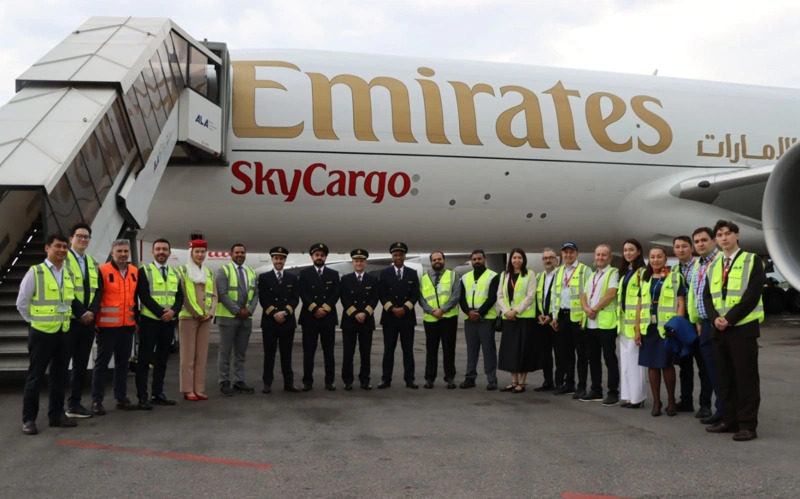
Emirates SkyCargo has opened a new cargo connection between Dubai and Almaty, creating a regular air freight link between Central Asia and the Gulf region. The first Boeing 777F freighter arrived at Almaty International Airport on 16 June 2026, where it was welcomed with a traditional water salute and a ribbon-cutting ceremony.
The new service will operate weekly on Tuesdays and provide more than 100 tonnes of cargo capacity per week. According to Emirates SkyCargo, the route is designed to support the movement of electronics, perishables, industrial equipment and consumer goods between Kazakhstan, the wider Central Asian region and international markets connected through Dubai.
For Kazakhstan, the launch is more than an aviation milestone. It is another step in the country’s effort to strengthen its role as a regional logistics hub linking Asia, the Middle East and Europe.
As K2Cargo News previously wrote in Kazakhstan and Georgia are becoming key hubs of Eurasia’s new logistics network, Central Asian countries are increasingly investing in transport infrastructure to capture new trade flows and reduce dependence on traditional routes.
A Regular Weekly Service, Not a One-Off Flight
The arrival of the first Emirates SkyCargo aircraft in Almaty was presented as the beginning of a scheduled service rather than a single ceremonial flight.
The company announced that dedicated Boeing 777F freighter flights to Almaty would begin on 16 June and operate every Tuesday. This means the route is expected to function as a regular weekly cargo rotation, giving shippers predictable access to capacity between Kazakhstan and Dubai.
For air cargo customers, frequency matters as much as aircraft size. A weekly freighter service allows logistics companies to plan shipments in advance, build stable export schedules and integrate Almaty into wider distribution chains through Emirates’ global network.
The use of Boeing 777F aircraft also gives the route significant operational flexibility. The aircraft is widely used for long-haul cargo operations and can handle a broad range of shipments, from consumer goods and electronics to industrial components and temperature-sensitive products.
Almaty Strengthens Its Role as a Central Asian Gateway
Almaty remains Kazakhstan’s largest city and one of the most important commercial centers in Central Asia. Although the country’s political capital moved to Astana, Almaty continues to serve as a major financial, trade and logistics hub.
Its airport is increasingly important for high-value and time-sensitive cargo. Air freight is especially relevant for goods that cannot wait for rail, road or sea transport, including pharmaceuticals, electronics, spare parts, perishables and urgent industrial equipment.
The Dubai–Almaty route gives businesses in Kazakhstan direct access to one of the world’s most connected logistics hubs. Through Dubai, cargo can be distributed onward to Europe, Africa, the Middle East, South Asia and other parts of the Emirates SkyCargo network.
This is particularly important for landlocked countries. Kazakhstan has strong railway and road links, but access to global air cargo networks can significantly improve the speed and resilience of supply chains.
Dubai Becomes a Bridge for Central Asian Cargo
Dubai has spent decades building its position as a global logistics hub. Its combination of airport infrastructure, free zones, sea-air connections and international airline networks allows it to serve as a redistribution point for cargo moving between continents.
For Central Asian exporters and importers, this creates new opportunities. Goods produced or distributed through Kazakhstan can now move faster to Gulf markets, while cargo arriving from Asia, Europe or Africa can reach Almaty through Emirates SkyCargo’s hub.
The new route also fits into the broader development of logistics infrastructure across the Gulf. K2Cargo News recently reported on the New Al Dhaid Logistics Hub to Strengthen Trade Flows Across the Gulf Region, showing how Gulf states are continuing to expand multimodal logistics capacity.
Together, these projects point to a wider trend: the Gulf is becoming not only a consumer market, but also an increasingly important logistics platform for Eurasian trade.
Kazakhstan Is Building a Broader Cargo Strategy
The launch of the Emirates SkyCargo route comes as Kazakhstan is also working to develop its own air cargo capabilities.
Kazakhstan Temir Zholy has been tasked with creating a new cargo airline to attract additional freight flows and support the country’s logistics ambitions. In October 2025, KTZ Air Cargo was officially registered, indicating that Kazakhstan wants to become more active not only in rail transit but also in air freight.
This matters because Kazakhstan’s logistics strategy can no longer rely on one mode of transport. Rail corridors remain essential for bulk cargo and container flows, while road transport connects regional markets. Air freight adds another layer by serving high-value and urgent shipments.
In this sense, the Dubai–Almaty route complements the broader development of Eurasian transport corridors. Kazakhstan is simultaneously investing in rail, aviation, logistics centers and cross-border connectivity.
K2Cargo News also recently analyzed the Trans-Afghan Railway Project Estimated at $7 Billion, another example of how Central Asia is seeking better access to international markets through new infrastructure.
What This Means for the Logistics Market
The new Emirates SkyCargo service could improve Kazakhstan’s position in several segments of international logistics.
First, it gives exporters access to faster delivery options for goods that require speed or controlled conditions. Second, it provides importers with a more direct route for receiving products from global suppliers. Third, it increases Almaty’s attractiveness as a regional distribution point for Central Asia.
For logistics companies, the main advantage is predictability. A weekly freighter rotation creates a fixed schedule around which forwarders, warehouses and cargo owners can organize operations.
The route may also support Kazakhstan’s ambitions to become a stronger connector between Asia, Europe and the Middle East. While rail and road corridors remain central to the country’s long-term transit strategy, air cargo can serve a different market segment: faster, more expensive and more time-sensitive freight.
The success of the route will depend on demand from exporters, importers and freight forwarders. If volumes grow, Emirates SkyCargo could eventually consider additional frequencies. For now, the key point is that Central Asia has gained a new direct link to one of the world’s most important logistics networks.
Read also: Uzbekistan and Russia’s Kaliningrad Region Expand Trade and Investment Cooperation
